


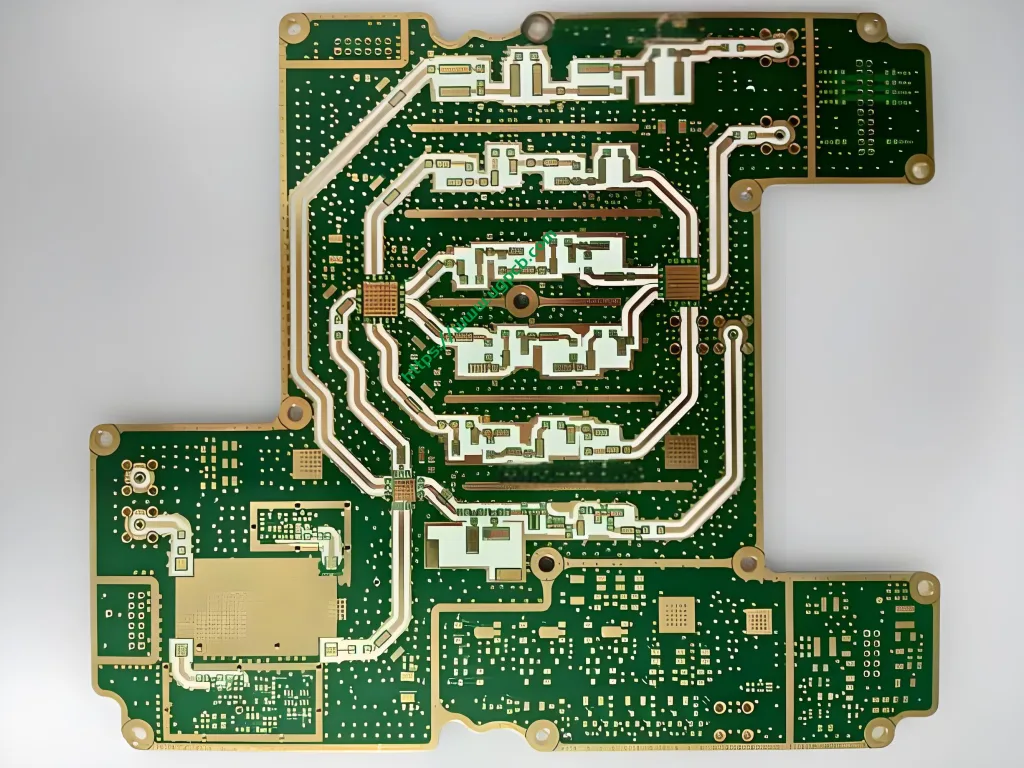
As 5G communication, radar de ondas milimétricas, and high-speed data transmission sweep the globe, standard circuit boards can no longer meet the demands of high-frequency signal transmission. When signal frequencies enter the GHz range, a tarjeta de circuito impreso‘s material and structure directly determine the device’s performance ceiling.
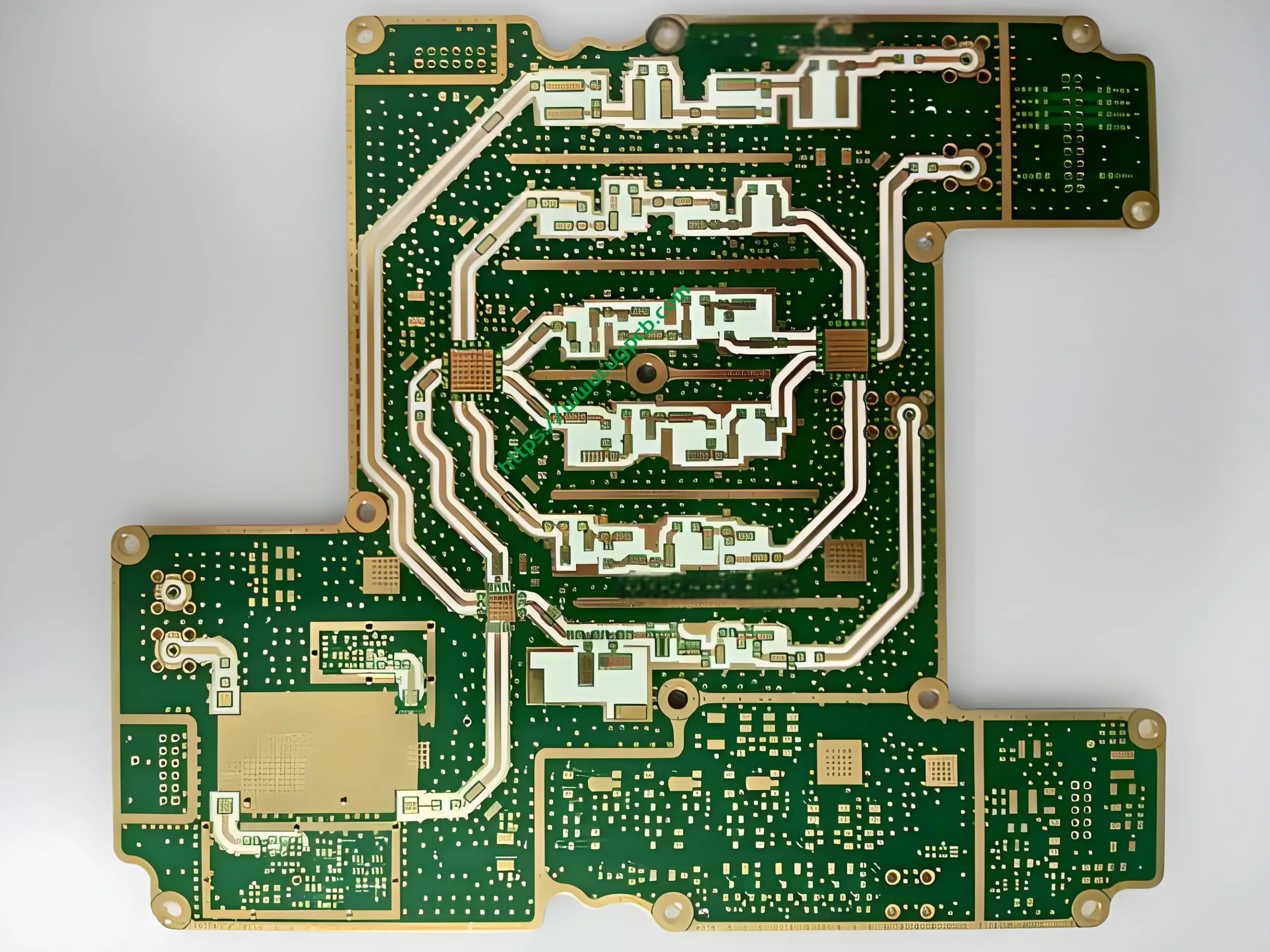
Hoy, UGPCB presents a flagship product designed for complex communication environments: el PCB de cobre integrado de alta frecuencia. This is not merely a tarjeta de circuitos. It represents an industrial artwork that resolves the conflict between heat dissipation and signal integrity.

1. Definición del producto
A PCB de cobre integrado de alta frecuencia combines high-frequency materials like Rogers RO4003C with copper base materials using specific prepregs such as 4450f. The copper section embeds into the tarjeta de circuito impreso‘s specific layers through hybrid lamination.
This technology perfectly merges the metal base’s excellent heat dissipation with the low-loss characteristics of high-frequency materials through an embedded structure. It specifically addresses thermal management challenges in high-power, high-frequency scenarios.
2. Core Parameters and Design Considerations
A superior PCB de alta frecuencia requires precise design and material selection. Consider UGPCB’s typical 4-layer board:
| Parámetro | Valor | Descripción |
|---|---|---|
| Recuento de capas | 4 capas | Standard multilayer configuration |
| Material dieléctrico | ROGERS RO4003C + 4450f | High-frequency laminate + bonding prepreg |
| Constante dieléctrica (Dk) | 3.38 | Stable Dk at 10GHz ensures signal speed consistency |
| Grosor del tablero terminado | 1.6milímetros | Total board thickness after fabrication |
| Espesor dieléctrico | 0.508milímetros | Precision impedance control layer |
| Base Copper Foil | ½ (18μm) HH/HH | RTF copper foil for better signal transmission |
| Espesor de cobre terminado | 1/0.5/0.5/1 (ONZ) | Top 1oz for current, inner 0.5oz for fine lines, bottom 1oz for heat sinking |
| Tratamiento superficial | Oro de inmersión (ACEPTAR) | Excellent flatness and oxidation resistance |
| Proceso Especial | High Frequency Embedded Copper | Core thermal management technology |
| Solicitud | Communication Equipment PCB | Primary market focus |
Consideraciones críticas de diseño
When designing such high-frequency PCB multicapa, preciso control de impedancia is essential. You must maintain continuous characteristic impedance, typically 50Ω single-ended or 100Ω differential. Además, managing gap filling between the embedded copper block and dielectric layers using 4450f’s resin flow prevents delamination.
3. Working Principle and Performance Advantages
Principio de trabajo
The device operates through electromagnetic and thermal dynamics coordination. High-frequency signals travel through RO4003C (Dk=3.38) with minimal loss. Mientras tanto, heat from power amplifiers conducts rapidly through vias or direct contact to the embedded copper base. This copper acts as a thermal “highway” with its high thermal conductivity of approximately 398 W/m·K, spreading heat quickly to external sinks.
Core Performance Features
-
Integridad de señal superior: Rogers RO4003C maintains stable dielectric constant up to 10GHz and beyond. Compared to standard FR-4, signal loss reduces significantly.
-
Revolutionary Heat Dissipation: The embedded copper structure positions cooling directly inside the tarjeta de circuito impreso. Thermal paths become shorter than traditional metal-base boards, improving cooling efficiency by over 50% and eliminating local hotspots in dense layouts.
-
Excellent Thermal-Mechanical Stability: RO4003C and copper base show optimized CTE matching. Combined with 4450f’s adhesive toughness, this ensures reliability through -40°C to +125°C thermal cycling.
4. Scientific Classification
Within UGPCB’s product system, this item falls under these specialized categories:
-
Por material: Frecuencia alta Hybrid Laminate PCB
-
Por estructura: Embedded Metal Core PCB (also called Copper Inlay PCB)
-
By Process: Multilayer Buried Copper Block PCB
5. Material and Structure Analysis
-
ROGERS RO4003C: A hydrocarbon ceramic-filled laminate. It stands as the “gold standard” for high-frequency applications, guaranteeing low-loss transmission.
-
4450f Prepreg: The RO4000 series bonding material. It offers excellent flow and filling properties, bonding RO4003C with the copper base and ensuring interlayer adhesion.
-
Embedded Copper Base: Typically uses T2 copper. Precision machining shapes it for embedding inside the tarjeta de circuito impreso, serving as the primary cooling channel.
-
Acabado de inmersión en oro.: The thick gold layer with dense nickel underneath protects circuits. It also provides excellent surface conductivity, essential for high-frequency skin effects.
6. Manufacturing Process Revealed
Creating this embedded copper PCB requires mastering three critical processes:
-
Cavity Creation: Use controlled-depth routing to mill precise cavities in the multilayer board after initial lamination.
-
Copper Block Embedding: Place treated copper blocks into cavities. Allow 4450f resin to fill gaps during pressing.
-
Secondary Lamination: Apply high temperature and pressure. Ensure void-free bonding between copper, dielectric, and circuit layers without delamination.
7. Aplicaciones típicas
-
Communication Equipment PCB: 5G base station power amplifiers, microwave backhaul modules.
-
Electrónica automotriz: Millimeter-wave radar (77GHz), LiDAR driver boards.
-
Aeroespacial: Satellite communication components, phased array radar systems.


8. Por qué elegir UGPCB?
With demanding communication equipment PCBs, UGPCB provides more than standard parameters. Ofrecemos one-stop custom services from engineering design and impedance simulation to volume production. In the high-speed world, a 0.1dB loss difference or a 1°C temperature variation can determine project success or failure.
[Llamado a la acción]
Is your next communication device searching for higher-performance tarjeta de circuito impreso soluciones?
Contact the UGPCB technical team today!
Send your design files or requirements. We will provide professional PCB de cobre integrado de alta frecuencia DFM analysis and quotation.