

UGPCB’s 0.22mm Ultra-Thin 6-Layer HDI Rigid-Flex PCB Présentation du produit
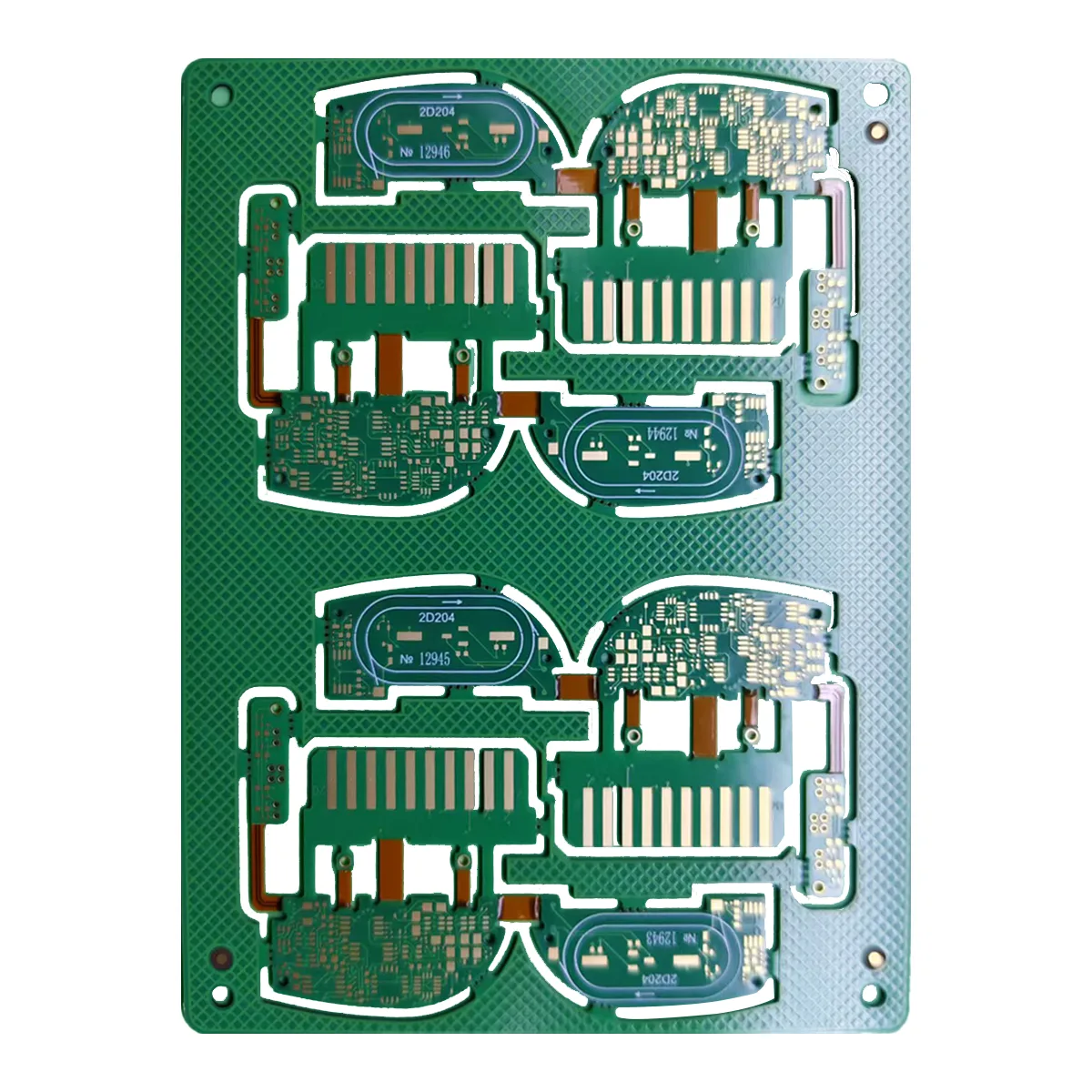
In the pursuit of extreme device miniaturization and high reliability, traditional rigid Cartes de circuits imprimés (PCB) are often insufficient. UGPCB combines advanced Interconnexion à haute densité (IDH) et Flex rigide technologies to present our flagship product: le 0.22mm Ultra-Thin 6-Layer HDI Rigid-Flex PCB. This board is a pinnacle of Fabrication de PCB et un high-performance interconnect solution engineered for wearable technology, advanced medical instruments, aérospatial, and premium consumer electronics. It seamlessly merges the stable support of rigid boards with the dynamic bending capability of flexible circuits, enabling complex electrical connections within minimal space.

Définition du produit & Classement scientifique
This is a high-layer-count PCB utilizing HDI toutes couches et rigid-flex construction. It can be accurately classified per industry standards:
-
Par structure: PCB rigide-flexible – Laminates rigid and flexible circuit layers into a single unit.
-
By Technology Level: PCB HDI avancé – Employs laser drilling, filled vias, and microvias (<0.15mm) for superior routing density.
-
Par nombre de couches: 6-Layer Circuit Board (comprising both rigid and flexible layers).
-
Par matériau: Specialty High-Performance Material PCB – Core build-up uses Panasonic RF-777 composite.
Les essentiels du design & Principe de fonctionnement
Les essentiels du design: The key to a successful rigid-flex board design lies in the rigid-to-flex transition zone. Precise calculation of bend radius, stress relief, and routing in flex areas is critical to prevent cracking during dynamic flexing. Simultanément, HDI blind and buried via design must coordinate with the stack-up structure to optimize signal integrity (ET) and power integrity (PI).
Principe de fonctionnement: Le PCB structure integrates rigid sections (for component mounting and mechanical support) with flexible sections (for 3D interconnection and movement) via stratification multicouche. Electrical signals travel through laser-drilled microvias et via filling plating technologies inherent to Cartes HDI, achieving the shortest and most reliable paths between layers, which minimizes signal loss and crosstalk.
Matériaux de base & Superior Performance
-
Matériau de base: We utilize the industry-premium Panasonic RF-777 35/50 composite material. Renowned for its exceptional stabilité dimensionnelle, superior performances haute fréquence, and excellent résistance à la chaleur, it is the ideal choice for manufacturing high-reliability rigid-flex circuit boards.
-
Finition de surface: The board features a 2-micron Electroless Nickel Immersion Gold (ACCEPTER) finition. This provides a flat surface, excellente soudabilité, and long-term oxidation resistance for PCB pads, making it perfect for mounting fine-pitch components like BGAs.
-
Key Performance Attributes:
-
Ultra-Thin 0.22mm Profile: Enables maximum compression of internal device space.
-
Haute fiabilité: Undergoes rigorous PCB reliability testing, capable of withstanding millions of dynamic bend cycles.
-
Excellent Signal Transmission: Conception IDH and premium materials ensure low-loss transmission for high-speed signals.
-
High-Density Assembly: Provides an ideal platform for Assemblage SMT, supporting miniaturized component layout.
-
Structure & Caractéristiques clés
-
PCB Structure: A typical 6-layer construction involving 2-4 layers of rigid FR-4 laminated with polyimide flexible cores. Le empilement is meticulously engineered to balance stiffness and flexibility.
-
Product Features:
-
3D Interconnection Freedom: Eliminates spatial constraints, enabling 3D assembly and reducing connectors and cables.
-
Léger & Miniaturization: The extreme thinness directly reduces product weight and size.
-
Enhanced System Reliability: Removes connection point failures, improving overall stability in vibrating or high-shock environments.
-
Simplified Assembly Process: En tant que custom Assemblage de circuits imprimés, it streamlines final product assembly, lowering labor costs.
-
Precision Manufacturing Process
UGPCB adheres to international quality standards like IPC-6013 (for flexible circuits) et IPC-2221/2223. Notre Processus de fabrication des PCB is precise and rigorous:
-
Forage au laser: Creates micron-level blind and buried vias in flexible and core layers.
-
Métallisation des trous & Placage: Vias are made conductive through chemical deposition and plating, avec via filling for planarization.
-
Transfert de motif & Gravure: Forms the intricate circuit board traces.
-
Alignement des calques & Laminage: Rigid layers, préampe, and flexible layers are precisely aligned and bonded under high heat and pressure. This is the core step in rigid-flex PCB manufacturing.
-
Finition des surfaces: Application of the ACCEPTER coating to protect pads and ensure solderability.
-
Rigorous Testing: Includes test de sonde volante, Inspection optique automatisée (Zone d'intérêt), and reliability testing to ensure every board’s quality.
Wide-Ranging Application Scenarios
Ce advanced PCB is the core skeleton for innovative products in:
-
Technologie portable: Smartwatches, AR/VR glasses, health monitors, requiring comfort and constant flexing.
-
Advanced Medical Electronics: Endoscopic capsules, hearing aids, portable monitors, demanding high reliability and miniaturization.
-
Aérospatial & Défense: Satellite components, UAV flight control systems, needing extreme environment endurance and low weight.
-
Precision Consumer Electronics: High-end smartphone camera modules, folding phone hinge areas, ultra-thin laptops.
-
Industriel & Électronique automobile: Compact sensors, robotic joint interconnection modules.


Contact a UGPCB PCB Technical Expert today for your 0.22mm Ultra-Thin HDI Rigid-Flex PCB solution! Make your product stand out in the competition for miniaturization and high performance.