Professional Product Overview
The UGPCB 12-Layer Rigid PCB is a high-end multilayer circuit board engineered for complex signal transmission, high-density interconnects (HDI), and demanding operating environments. Manufactured with high-performance FR-4 TU872SLK laminate and finished with 2-microinch Immersion Gold (ENIG), this board is a cornerstone solution for industrial control systems, telecommunications infrastructure, and advanced computing hardware, offering exceptional electrical performance, long-term reliability, and robust signal integrity.
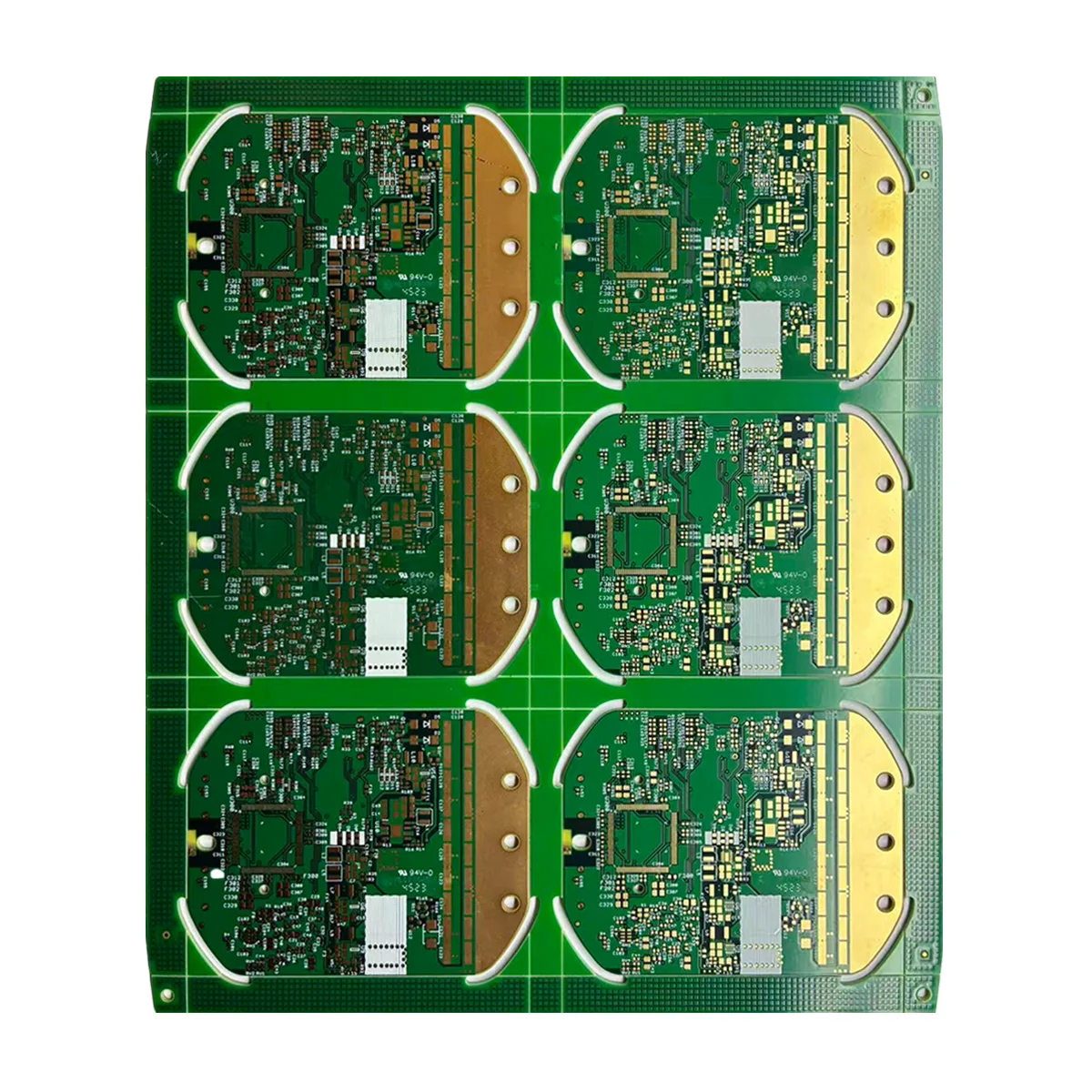

Product Definition & Classification
This product is classified as a High-Layer Count Rigid Printed Circuit Board. It can be further categorized as:
-
By Structure: Rigid PCB.
-
By Layer Count: 12-Layer Multilayer Board (mid-to-high layer count).
-
By Technology: Standard Multilayer PCB suitable for complex, non-extreme miniaturization designs.
-
By Application Class: Industrial/Telecom-Grade PCB, meeting requirements for high reliability and long-term stability.
Critical Design Considerations
Designing a 12-layer PCB requires meticulous attention to:
-
Stack-up Design: A rational stack-up sequence (e.g., alternating signal-ground-signal layers) is paramount for impedance control, crosstalk reduction, and Electromagnetic Compatibility (EMC). A proper 12-layer stack-up provides excellent power integrity and signal shielding.
-
Impedance Control: For high-speed digital signals (e.g., DDR, PCIe) or RF lines, precise calculation and control of trace characteristic impedance (e.g., 50Ω single-ended, 90Ω/100Ω differential) are essential. We utilize advanced EDA tools and precise process controls to ensure consistency.
-
Power & Ground Plane Management: Solid ground planes and optimized power segmentation ensure low-noise power delivery and clear return paths, which are critical for system stability.
-
Thermal Management: The 1.6mm board thickness and the thermal properties of FR-4 must align with component power dissipation. High-power areas may require thermal vias or integration with external cooling solutions.
How It Works
A PCB is a passive platform that provides mechanical support, electrical interconnection, and signal transmission pathways for electronic components. This 12-layer PCB facilitates a complete working system by connecting chips, resistors, capacitors, etc., through a complex network of etched copper traces. The multilayer architecture allows traces to cross on different layers without interference, significantly increasing circuit complexity and integration density. The ENIG surface finish guarantees reliable solder joints and long-term contact stability.
*(Image Suggestion: Detailed cross-sectional diagram of a 12-layer PCB stack-up)*
*Alt Text: Cross-sectional view of a 12-layer PCB stack-up showing alternating copper layers and dielectric, illustrating complex internal structure for high-density interconnect.*
Construction & Materials
-
Layer Structure: 12 conductive copper layers laminated with insulating prepreg.
-
Core Material: FR-4 TU872SLK. This is a high-performance epoxy glass laminate offering advantages over standard FR-4:
-
Higher Thermal Stability (High Tg, typically ≥170°C), providing better resistance to thermal expansion.
-
Superior Electrical Properties, with stable Dielectric Constant (Dk) and Dissipation Factor (Df) under high-temperature and high-frequency conditions.
-
Excellent CAF (Conductive Anodic Filament) Resistance, ideal for high-voltage, high-humidity environments, ensuring superior reliability.
-
-
Finished Thickness: 1.60mm (nominal), with tight tolerance control (typically ±10%).
-
Surface Finish: Electroless Nickel Immersion Gold (ENIG). Nickel thickness: 3-5μm; Gold thickness: 2 microinches (approx. 0.05μm). The gold layer protects the nickel from oxidation, providing a flat, solderable surface, while the nickel acts as a diffusion barrier between copper and gold.
Key Features & Performance
-
High Reliability: TU872SLK high-Tg material and ENIG finish ensure resistance to high temperatures, corrosion, and suitability for long-term operation in harsh environments.
-
Excellent Signal Integrity: Rigorous stack-up design and impedance control guarantee high-speed signal quality and lower bit error rates.
-
Strong Load-Bearing & Thermal Capacity: The 1.6mm thickness offers robust mechanical strength and substantial thermal load management.
-
Precision Solder Platform: The flat 2μ” ENIG surface is ideal for fine-pitch components (e.g., BGAs), resulting in strong, reliable solder joints with low defect rates.
-
High-Density Interconnect (HDI): Twelve routing layers support complex, dense circuit designs, enabling reduced product footprint.
Manufacturing Process Flow
Inner Layer Imaging → AOI Inspection → Lamination & Pressing → Drilling → Electroless Copper Deposition → Outer Layer Imaging → Pattern Plating → Etching → Solder Mask Application → ENIG Surface Finish → Routing & Profiling → Electrical Testing → Final Quality Control (FQC)
Applications & Use Cases
This PCB is widely used in stability and performance-critical fields:
-
Industrial Automation: PLC controllers, servo drives, industrial robot control boards.
-
Telecommunications Equipment: Routers, switches, base station cards, optical modules.
-
Medical Electronics: Control units for advanced medical imaging systems, patient monitors.
-
Test & Measurement Instruments: High-precision oscilloscopes, spectrum analyzers, signal generators.
-
Power & Energy: Inverter control boards, Battery Management System (BMS) boards, smart meters.
-
Automotive Electronics: High-end infotainment systems, Advanced Driver Assistance Systems (ADAS) domain controllers.