


1. Descripción general del producto
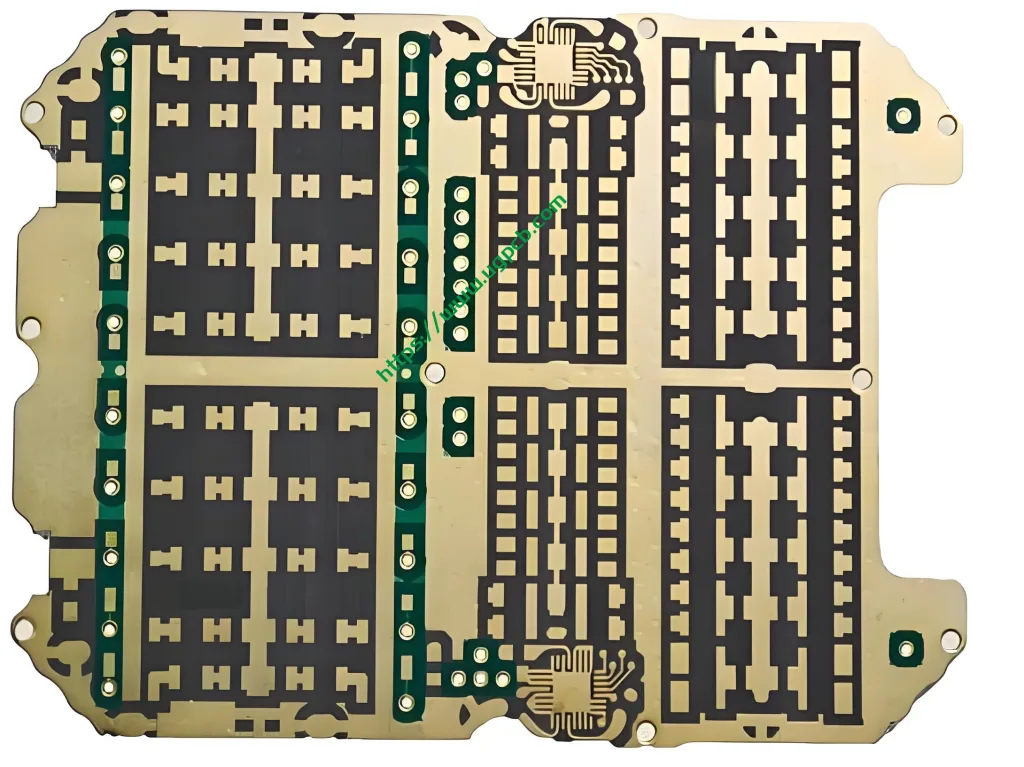
In modern wireless communication and high-speed digital designs, signal integrity and system reliability depend heavily on the material base de placa de circuito impreso. UGPCB introduces the RO4350B ceramic hybrid high frequency PCB. This is a 4-layer board that combines Rogers RO4350B high-frequency laminate with standard FR-4 material using advanced mixing press technology.
This product inherits the stable dielectric constant (Dk 3.48) and low-loss properties of RO4350B. It also leverages the mechanical support and cost benefits of FR-4. It is an ideal solution for communication base stations, instruments, and RF front-end modules.

2. Product Definition and Classification
2.1 Definición del producto
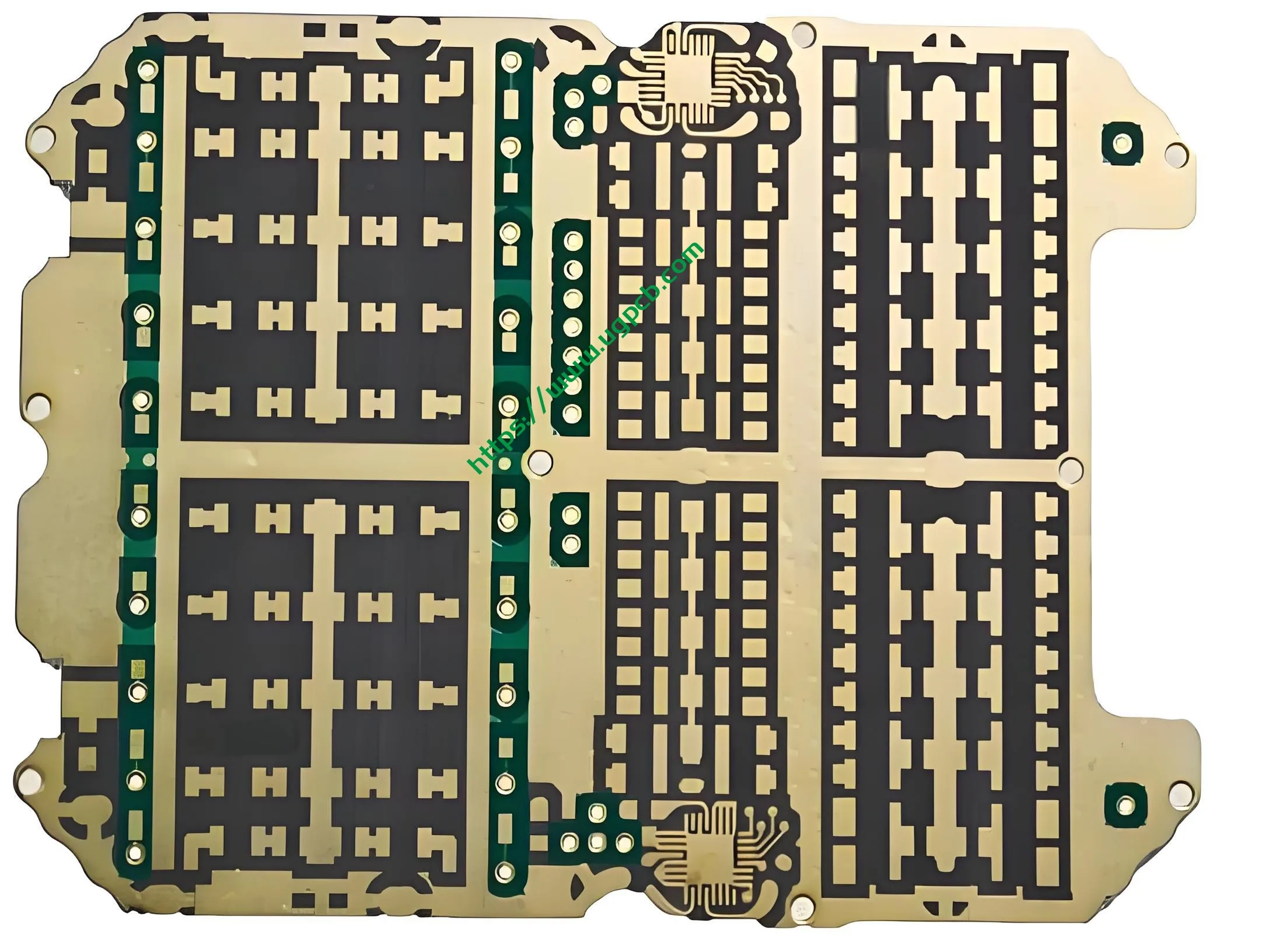
A RO4350B ceramic hybrid PCB de alta frecuencia uses both Rogers RO4350B high-frequency material and standard FR-4 within a single multilayer board stackup. The ceramic-filled hydrocarbon resin system ensures low-loss transmission for RF signals.
2.2 Scientific Classification
-
Por material: Composite dielectric PCB híbrido (Hybrid Laminate PCB).
-
By Application Frequency: Microondas RF PCB (typical operating range: 500 MHz a 10 GHz+).
-
Por recuento de capas: 4-layer multilayer hybrid board.
3. Core Parameters and Design Essentials
Below are the key specifications for this UGPCB product. All data is strictly controlled to ensure consistency between design and fabrication.
| Parámetro | Valor | Notas |
|---|---|---|
| Modelo | PCB de alta frecuencia híbrido cerámico RO4350B | |
| Material Combination | Rogers RO4350B + FR4 Mixing Press | |
| Recuento de capas | 4l | |
| Constante dieléctrica (Dk) | 3.48 ±0.05 @ 10 GHz | Tight tolerance for control de impedancia |
| Pérdida tangente (df) | 0.0037 @ 10 GHz | Ensures low signal attenuation |
| Espesor terminado | 1.2 mm ±5% | |
| Espesor de cobre | 1 ONZ (aprox. 35 μm) | |
| Single Dielectric Thickness | 0.508 milímetros | RO4350B core layer |
| Conductividad térmica | 0.69 W/m·K | Better heat dissipation than FR-4 |
| Calificación de inflamabilidad | 94 V-0 | Meets UL safety standards |
| Tratamiento superficial | Oro de inmersión (ACEPTAR) | Flat surface, reduces skin effect loss |
| CTE del eje Z | 32 ppm/°C | Enhances via reliability during thermal cycling |
Design Tips for Engineers:
In hybrid layer stackups, CTE mismatch (RO4350B CTE is lower than FR-4 CTE) can cause warpage during reflow. UGPCB engineers use symmetric stackup designs. We select compatible prepregs and control the lamination profile to keep warpage below 0.7%.
4. Principio de trabajo
Este tarjeta de circuito impreso serves two core functions: signal transmission and energy transfer.
Para señales de alta frecuencia, the conductor (cobre) and dielectric (RO4350B) form transmission lines (microstrip or stripline). The stable Dk (3.48) determines signal propagation speed. The low Df (0.0037) ensures minimal signal attenuation, preserving signal integrity.
5. Materials and Performance Analysis
5.1 Rogers RO4350B
-
Composición: Hydrocarbon resin system with ceramic fillers, reinforced with woven glass.
-
Performance Benefits:
-
Frequency Stability: Dk shows minimal variation with frequency, ideal for broadband applications.
-
Insertion Loss: Significantly lower than standard FR-4, suitable for 5G and microwave circuits.
-
Lead-Free Compatible: Withstands 260°C assembly temperatures.
-
5.2 FR-4
-
Composición: Epoxy resin with glass fabric.
-
Performance Benefits: Alta resistencia mecánica, menor costo. Used for power planes, ground layers, and non-critical signals. This reduces overall material costs.
5.3 Lámina de cobre
-
Tipo: 1 OZ electrolytic copper. It provides good peel strength (típico 5.0 lb/in).
5.4 Acabado superficial (Oro de inmersión / ACEPTAR)
-
Why ENIG? For high-frequency PCBs, ENIG offers a very flat surface. It minimizes skin effect losses for high-frequency signals. It also provides good solderability and oxidation resistance.
6. Características estructurales
-
Hybrid Laminate Structure: A typical 4-layer build uses a symmetric stackup. High-frequency signals route on the surface or RO4350B core layers. Power and ground are on FR-4 layers. This design ensures RF performance while using FR-4’s thermal stability.
-
Through-Hole Reliability: The Z-axis CTE of RO4350B (32 ppm/°C) is relatively close to copper’s CTE (alrededor 17 ppm/°C). During thermal cycles, the plated through-hole walls resist cracking. This greatly improves board lifetime.
7. Production Process Flow
UGPCB follows these critical steps for this hybrid product. This ensures material compatibility and high quality.
-
Incoming Inspection: Verify properties of RO4350B cores and FR-4 cores separately.
-
Inner Layer Imaging: Create inner layer circuits on each material.
-
Oxide Treatment: Apply special chemistry to RO4350B surfaces. This enhances bonding with prepregs.
-
Lay-Up (Critical Step): Precisely align RO4350B, crossgs, and FR-4 according to the symmetric stackup design.
-
Laminación: Use a stepped temperature curve. Control resin flow. Minimize internal stress and warpage caused by CTE differences.
-
Perforación & desmechar: Optimize drill bits and feed rates (RO4350B is brittle). Use plasma treatment to remove resin smear from hole walls.
-
Enchapado: Achieve reliable interlayer connections.
-
Outer Layer Imaging/Etching: Control line widths precisely to meet impedance targets.
-
Acabado superficial: Apply Immersion Gold (ACEPTAR).
-
Pruebas: 100% electrical test + impedance coupon test + prueba de estrés térmico.
8. Aplicaciones típicas
This hybrid PCB combines high-frequency performance with cost efficiency. It is widely used in these fields:
-
Communication Instruments: RF boards in signal analyzers and network analyzers.
-
Wireless Infrastructure: 5G base station antennas, Amplificadores de potencia, control circuits in RRU/AAU.
-
Electrónica automotriz: Signal processing boards for 77 GHz mmWave radar.
-
Automatización industrial: High-frequency data acquisition modules, microwave sensors.
-
Aeroespacial & Defense: Modules for satellite communication receivers and radar systems.

9. Por qué elegir UGPCB?
-
Precise Matching: We strictly control Dk within ±0.05 tolerance. We provide TDR impedance test reports. Electrical performance matches your design.
-
Hybrid Press Expertise: We have mature processes for RO4350B+FR4 hybrid lamination. We solve delamination and warpage issues caused by CTE mismatch.
-
Alta fiabilidad: We use Immersion Gold (ACEPTAR) acabado superficial. It supports precision soldering. It meets the strict reliability demands of communication instruments.
Get Your Quote. Drive Your RF Products to Market.
Do you need a 4-layer high-frequency board that meets Dk 3.48 requirements while also balancing cost?
UGPCB uses genuine Rogers RO4350B material. We also have mature FR-4 hybrid pressing processes. We help you maintain signal integrity while optimizing your BOM cost.
Free Engineering Review
Impedance Testing Support
Fast Prototyping & Volume Production
Click Here to Upload Your Gerber Files. Get your exclusive quote for RO4350B hybrid high frequency PCBs today!
Or email us at: [Your Sales Email]
Make UGPCB your most reliable partner for RF circuits!