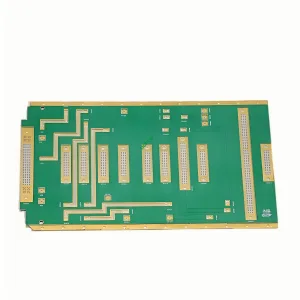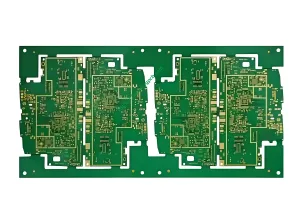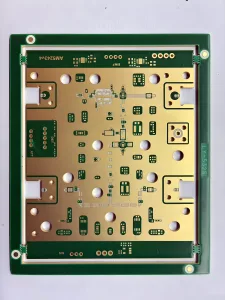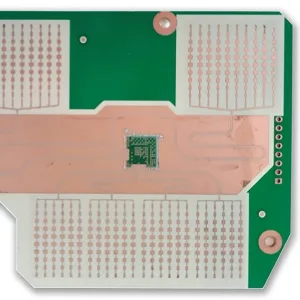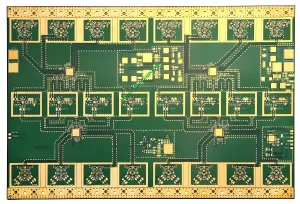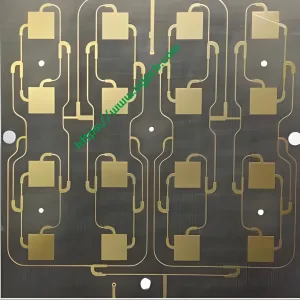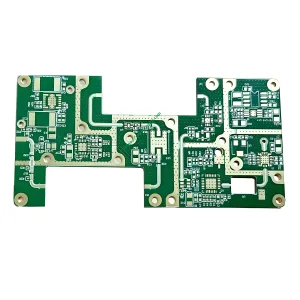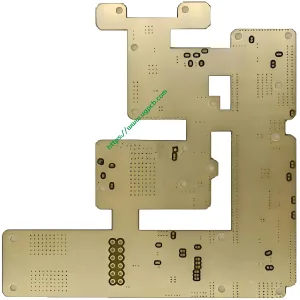
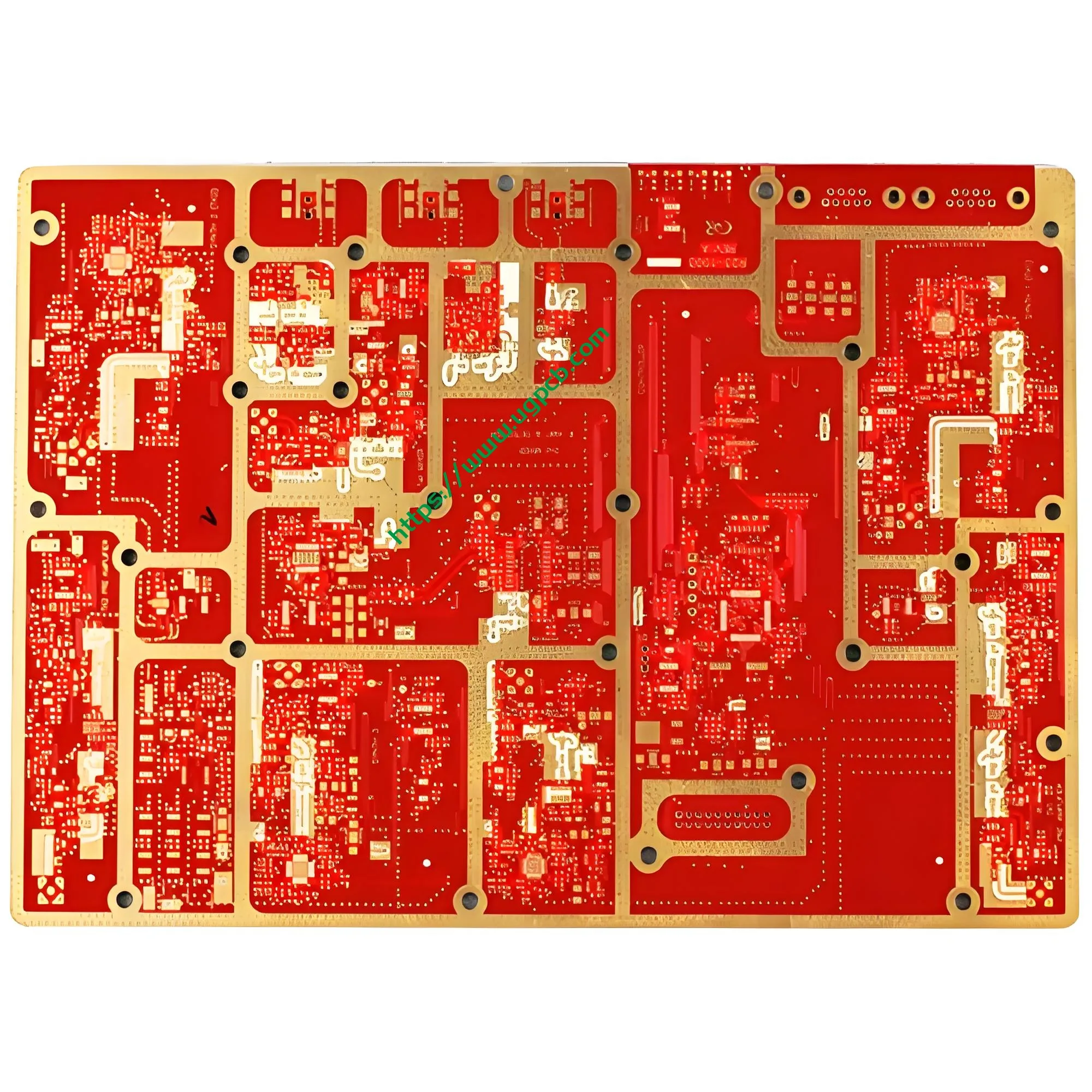
When digital and RF systems push beyond multiple GHz, conventional PCB materials hit bottlenecks in signal integrity, thermal stability, and impedance control. UGPCB’s communication high frequency hybrid PCB solves these challenges.
1. Product Overview
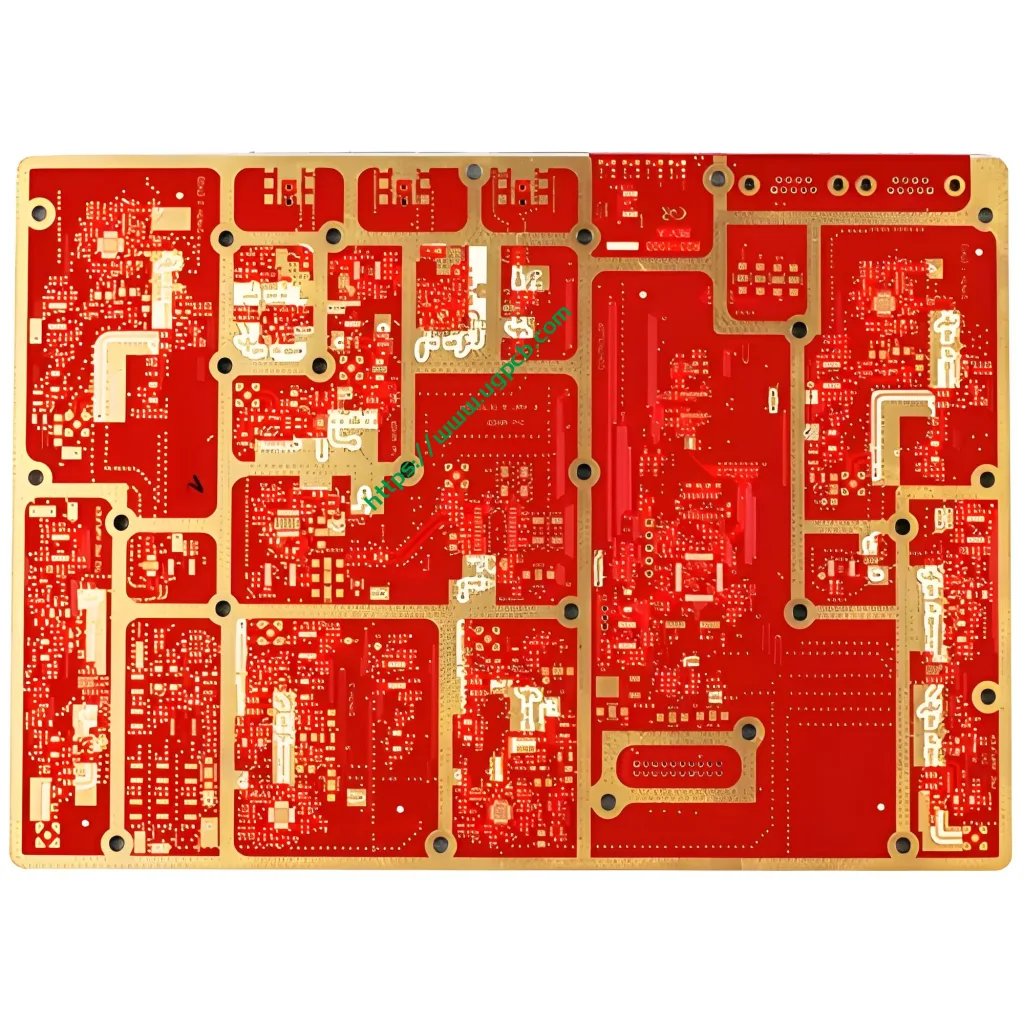
Product Name: UGPCB 6‑Layer Communication High Frequency Hybrid PCB
Model: UG‑HYBRID‑6L‑RF01
Key Specifications: 6 layers / Ro4350B+FR4 mixed dielectric / 1.6mm board thickness / 210mm × 280mm size / ENIG surface finish / minimum mechanical drilled hole 0.25mm
Positioning: A cost‑effective interconnect solution for RF front‑ends and high‑speed digital mixed circuits. By placing Rogers RO4350B high‑frequency laminate on the top RF signal layers and FR‑4 on the bottom power/ground and low‑speed digital layers, this design balances signal integrity, thermal stability, and manufacturing cost.
2. Definition – What is a High Frequency Hybrid PCB?
A high frequency hybrid PCB (also called mixed dielectric multilayer board) uses two or more materials with different dielectric properties in one multilayer printed circuit board.
This 6‑layer hybrid PCB has the following stackup:
| Layer | Function | Material | Key Parameter |
|---|---|---|---|
| L1 | RF signal | RO4350B (0.2mm) | Dk=3.48±0.05@10GHz, Df=0.0037 |
| L2 | RF ground | RO4350B | Low‑loss reference plane |
| L3 | High‑speed digital | RO4450™ bondply + FR‑4 | Transition, impedance matching |
| L4 | Power plane | FR‑4 | High Tg, low cost |
| L5 | Digital signal | FR‑4 | Standard epoxy glass |
| L6 | Digital ground | FR‑4 | Mechanical support and heat dissipation |
“Mixed dielectric construction significantly reduces cost – using high‑frequency material only on the layers that carry RF signals, and FR‑4 for the rest.”
3. Design Guidelines
3.1 Critical Material Parameters
This product uses Rogers RO4350B (ceramic‑filled hydrocarbon laminate) and FR‑4. Key RO4350B specifications (source: Rogers data sheet):
| Parameter | Typical Value | Test Condition | Reference |
|---|---|---|---|
| Process Dk | 3.48±0.05 | 10GHz | IPC‑TM‑650 2.5.5.5 |
| Design Dk | 3.66 | 10GHz | Copper roughness correction |
| Dissipation factor (Df) | 0.0037 | 10GHz | Low‑loss RF applications |
| Z‑axis CTE | 32 ppm/℃ | -55℃ to 288℃ | Matches copper (17 ppm/℃) |
| Thermal conductivity | 0.69 W/m·K | 50℃, ASTM D5470 | Better than FR‑4 |
| Flammability | UL 94 V‑0 | UL standard | For active and high‑power RF |
Data source: Rogers Corporation RO4350B™ Laminate Data Sheet
3.2 Impedance Control
Impedance control on a 6‑layer hybrid PCB is challenging because of the Dk discontinuity. Use a 3D electromagnetic solver and apply a copper roughness correction factor (typically 1.2–1.5). According to IPC‑2141A, characteristic impedance tolerance for RF PCBs should be within ±7%. UGPCB achieves ±5%.
3.3 Laminate Stackup Design (Total thickness 1.6mm)
- Top (L1‑L2): RO4350B 0.2mm × 2 = 0.4mm
- Middle (L3): RO4450™ prepreg 0.1mm + FR‑4 core 0.6mm = 0.7mm
- Bottom (L4‑L6): FR‑4 core + prepreg = 0.5mm
- Total: 1.6mm
Use a dynamic pressure curve during lamination to manage stress from CTE mismatch between RO4350B and FR‑4.
4. Working Principle
Signal integrity: Dielectric loss dominates high‑frequency loss. The medium attenuation constant is:
Where:
- = dielectric attenuation constant
- = relative permittivity (design value)
- = free‑space wavelength
- = dissipation factor (Df)
RO4350B has Df = 0.0037 vs. FR‑4’s 0.020. That reduces dielectric loss by about 80%, ensuring low‑loss transmission up to 30GHz.
Thermal‑mechanical stability: RO4350B’s Z‑axis CTE of 32 ppm/℃ matches copper (17 ppm/℃) far better than FR‑4 (50–70 ppm/℃). This improves plated through‑hole (PTH) reliability under thermal cycling. Tested per IPC‑TM‑650 2.6.7, the board survives 1000 cycles from -55℃ to 125℃ without delamination.
5. Primary Applications
UGPCB’s 6‑layer communication high frequency hybrid PCB serves five major areas:
5.1 5G Communication Base Stations (AAU/RRU)
- Frequency bands: 28GHz and 39GHz millimeter wave
- Requirement: Insertion loss < 0.31 dB/cm@40GHz, power handling >200 W/m²@38GHz
- Advantage: Hybrid construction cuts material cost by 30–40% vs. all‑high‑frequency material

5.2 77GHz/79GHz Automotive Radar
- Use cases: Autonomous driving 4D imaging radar, blind spot detection, adaptive cruise control
- Requirement: Range error <0.25m from -40℃ to 125℃, azimuth resolution 0.08°
- Performance: IMS 2025 report shows phase consistency of ±0.8° over full temperature range for 77GHz hybrid radar modules
5.3 Satellite Communication Payloads (Ka‑band)
- Frequency range: 17.7 – 31 GHz
- Advantage: 45% weight reduction vs. ceramic substrates while maintaining >85% efficiency
5.4 Fiber‑to‑the‑Home (FTTH) Equipment
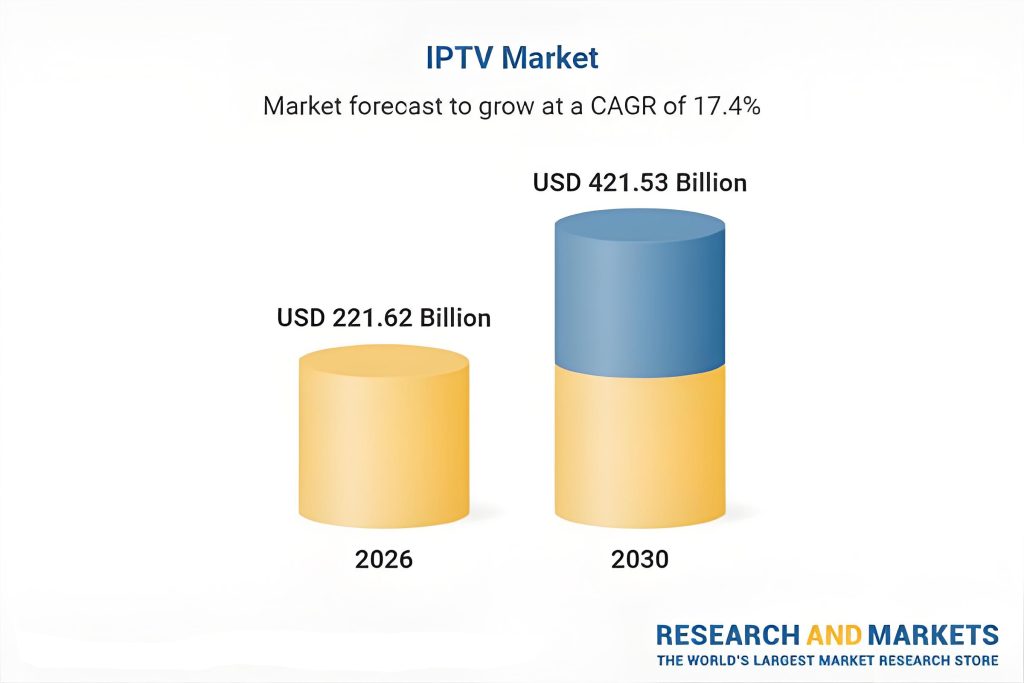
- Market trend: Global IPTV market from $189.25B (2025) to $421.53B (2030), CAGR 17.4%
- Impact: High‑bandwidth, low‑latency PCBs are essential
5.5 High‑Speed Digital Mixed‑Signal Systems
- Fields: Medical imaging, industrial high‑frequency inspection, military communication terminals
- Requirement: Coexist 10+ Gbps digital signals with GHz‑range RF signals
6. Scientific Classification (per IPC‑2221)
| Classification Dimension | Category | Basis |
|---|---|---|
| Material system | Mixed dielectric PCB | RO4350B + FR‑4 |
| Frequency characteristic | RF / Microwave PCB | Up to 30GHz |
| Layer count | 6‑layer multilayer board | 6 conductive layers |
| Technical difficulty | HDI hybrid lamination | Non‑expansion material matching |
| Application | Communication RF PCB | Telecom infrastructure |
| IPC performance class | IPC‑6012 Class 3 | High‑reliability equipment |
7. Materials in Detail
7.1 RO4350B High‑Frequency Laminate
- Glass‑reinforced hydrocarbon + ceramic filler
- Dk: 3.48±0.05@10GHz, temperature coefficient ~ -50 ppm/℃ (-50℃ to +150℃)
- Df: 0.0037@10GHz
- Z‑axis CTE: 32 ppm/℃ – matches copper for PTH reliability
- Thermal conductivity: 0.69 W/m·K (vs. FR‑4 0.25–0.35)
- UL 94 V‑0 – suitable for active and high‑power RF designs
- Process compatibility: Same FR‑4 processing; no special pre‑treatment needed (unlike PTFE)
7.2 FR‑4 Epoxy Glass Laminate
- Woven glass fabric + epoxy resin
- Dk: 4.2–4.8 (1MHz–1GHz), Df: 0.020–0.025
- Cost: 1/5 to 1/10 of RO4350B
7.3 RO4450™ High‑Frequency Bondply
- Bonding layer between RO4350B and FR‑4
- Dk: 3.52±0.05@10GHz (gradient transition)
- Df: 0.0040@10GHz
7.4 ENIG Surface Finish (Electroless Nickel Immersion Gold)
- Nickel thickness: 3–6μm (IPC‑4552 Class 2)
- Gold thickness: 0.05–0.10μm
- Advantages: Solderability, flatness, oxidation resistance, fine‑pitch BGA assembly
- Standard: IPC‑4552
8. Performance Specifications
8.1 Electrical Performance
| Parameter | Value | Test Method |
|---|---|---|
| Characteristic impedance (RF layers) | 50Ω ±5% (customizable) | IPC‑2141A |
| Dk (RF layers @10GHz) | 3.48±0.05 | IPC‑TM‑650 2.5.5.5 |
| Insertion loss | 0.31 dB/cm @40GHz | Microstrip line VNA |
| Dielectric strength | ≥40 kV/mm | IPC‑TM‑650 2.5.6 |
| Insulation resistance | >10⁹ Ω (normal condition) | IPC‑TM‑650 2.5.17 |
| Withstanding voltage | 1000 VDC, 60s no breakdown | IPC‑TM‑650 2.5.7 |
8.2 Mechanical Performance
| Parameter | Value | Test Method |
|---|---|---|
| Thickness tolerance | ±10% | IPC‑6012 |
| Dimensional stability | <0.3 mm/m | IPC‑TM‑650 2.2.4 |
| Peel strength (1oz copper) | ≥1.0 N/mm | IPC‑TM‑650 2.4.8 |
| Flexural strength | ≥350 MPa | IPC‑TM‑650 2.4.4 |
| Pad pull‑off force | ≥5.0 kg/cm² | IPC‑TM‑650 2.4.21 |
8.3 Thermal Performance
| Parameter | Value | Test Method |
|---|---|---|
| Tg (FR‑4 area) | ≥150℃ (TG150) | IPC‑TM‑650 2.4.25 |
| Thermal stress | 288℃, 10s × 5 cycles | IPC‑TM‑650 2.4.13 |
| Thermal cycling | -55℃ ↔ 125℃, 1000 cycles, no delamination | IPC‑TM‑650 2.6.7 |
| Lead‑free reflow | 260℃, 5 cycles | IPC/JEDEC J‑STD‑020 |
| Moisture sensitivity level | MSL 1 | IPC/JEDEC J‑STD‑020 |
8.4 Reliability Certifications
- IPC‑6012 Class 3 – high‑reliability equipment
- IPC‑6018B – qualification for high‑frequency (microwave) PCBs
- UL 94 V‑0
- MIL‑PRF‑31032 – 1000 thermal cycles from -55℃ to 125℃
100% flying probe electrical test + AOI. End‑product meets IPC‑A‑600 Class 3.
9. Structural Features
Asymmetric 6‑layer hybrid build:
- L1‑L2 (RO4350B): RF front‑end (PA, LNA, filters) – signal integrity critical zone
- L3 (transition): Impedance matching and signal layer change – isolates RF from high‑speed digital
- L4‑L6 (FR‑4): Power management, digital control, mechanical support – low‑cost conventional circuits
ENIG finish: Flat surface ensures consistent impedance control. Supports BGA, QFN, fine‑pitch packages. Gold layer protects copper and guarantees solderability after long storage.
Precision drilling & PTH: Minimum mechanical hole diameter 0.25mm (HDI microvias down to 0.1mm available). Hole copper thickness ≥20μm (IPC Class 3). Plasma treatment with different gas mixtures for RO4350B and FR‑4 layers.
10. Manufacturing Process Flow
18 key steps:
① IQC → ② Inner layer imaging (RF and digital separately) → ③ Brown oxide → ④ Pre‑lamination plasma activation → ⑤ Hybrid lay‑up → ⑥ High‑pressure lamination (dynamic pressure curve) → ⑦ X‑ray target drilling → ⑧ Mechanical drilling (0.25mm min) → ⑨ Plasma desmear (dual cycle) → ⑩ Electroless copper → ⑪ Outer layer imaging → ⑫ Pattern plating (copper + tin) → ⑬ Outer layer etching (tin strip) → ⑭ AOI → ⑮ Solder mask → ⑯ ENIG → ⑰ Electrical test → ⑱ Final inspection/packaging
Critical process details:
- Pre‑lamination plasma (step 4): CF₄‑N₂‑O₂ for FR‑4; helium (He) for RO4350B
- Lamination curve (step 6): Dynamic pressure – FR‑4 cures first (~180℃), then pressure and temperature rise to >200℃ for RO4350B
- Drilling (step 8): Step feed and tool life management handle hardness difference
- Desmear & PTH (steps 9‑10): Dual‑cycle process due to different chemical behaviors; hole copper ≥20μm
11. Competitive Advantages
Cost‑performance balance: All‑RO4350B 6‑layer material costs >$200/m². Hybrid uses RO4350B only on 25% of thickness → 30‑40% material cost reduction.
Reliability: RO4350B Z‑axis CTE = 32 ppm/℃ matches copper (17 ppm/℃). Full FR‑4 has 50‑70 ppm/℃. Hybrid reduces PTH stress. Passes 1000 cycles -55℃ to 125℃ (IPC‑TM‑650 2.6.7).
Dimensional stability: Low CTE reduces warpage, improves SMT yield.
| Direction | RO4350B CTE | FR‑4 CTE (typical) |
|---|---|---|
| X‑axis | 10 ppm/℃ | 14 ppm/℃ |
| Y‑axis | 12 ppm/℃ | 16 ppm/℃ |
| Z‑axis | 32 ppm/℃ | 50‑70 ppm/℃ |
Vs. full PTFE (e.g., Rogers RT/duroid):
| Feature | RO4350B+FR‑4 hybrid | Full PTFE |
|---|---|---|
| Process compatibility | Standard FR‑4 line | Special equipment & treatment |
| PTH metallization | Standard | Sodium naphthalene or plasma |
| Dimensional stability | Excellent (glass reinforced) | Poor, flows |
| Cost | 30‑50% lower | High |
12. Summary & Inquiry Guidance
UGPCB’s 6‑layer communication high frequency hybrid PCB is the ideal interconnect for RF/digital mixed signal systems. It serves 5G base stations, satellite Ka‑band payloads, 77GHz automotive radar, and high‑speed digital applications. By placing RO4350B only on the critical RF layers, we achieve optimal performance at a significantly lower cost.
Key data recap:
✅ Dk = 3.48 ± 0.05 @10GHz (Rogers official)
✅ Df = 0.0037 @10GHz
✅ Z‑axis CTE = 32 ppm/℃ (matches copper)
✅ Insertion loss ≤ 0.31 dB/cm @40GHz (IPC‑6018B verified)
✅ 30‑40% material cost reduction vs. all‑high‑frequency material
✅ Passes 1000 thermal cycles -55℃ ↔ 125℃
Limited‑time prototyping offer
📩 Get your custom quote and technical proposal
UGPCB offers a 7‑working‑day quick‑turn service for 4‑ to 10‑layer hybrid PCBs. We provide free DFM analysis.
👉 Send your Gerber files and stackup design to our technical support email. We will reply with a technical assessment and precise quote within 4 hours.
UGPCB – Your trusted hybrid high‑frequency PCB manufacturer. From prototype to volume production, we deliver one‑stop 6‑layer mixed dielectric solutions to accelerate your 5G and millimeter‑wave radar products.
*Data sources: Rogers Corporation RO4350B™ Data Sheet, IPC‑6012D/6018B standards, IPC‑TM‑650 test methods, GSMA 2026 telecom outlook, IMS 2025 International Microwave Symposium technical report.*