
プリント基板設計, 製造, プリント基板, PECVD, ワンストップサービスを使用したコンポーネントの選択

ダウンロード | について | 接触 | サイトマップ

PCB Via Parasitic Capacitance Optimization: Three Physical Mechanisms for Signal Integrity - UGPCB

プリント基板技術

小さな穴の隠れた落とし穴 – 寄生容量を介して PCB の 3 つの物理メカニズムとエンジニアリング ソリューションを突破する

Imagine a 高速PCB as a busy data city. The vias that carry signals between layers are like underground tunnels.

According to the industry-standard approximation from IPC-2251, a typical through-hole via has a parasitic capacitance between 0.3 pF and 0.8 pF. When signal frequencies exceed 10 Gbps, this small number can cause reflections and delays. It can turn a perfectly designed data link into a bit error storm.

This article analyzes the causes and optimization paths of via parasitic capacitance from three physical dimensions: 回路, field, and material.

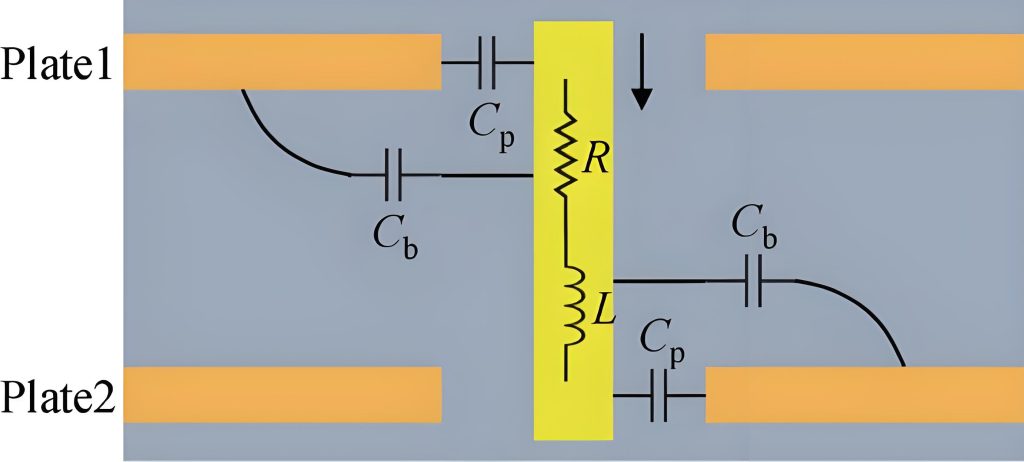
PCB via parasitic capacitance equivalent circuit

1. The Capacitance Attenuation Layer – Controlling Geometric Dimensions to Reduce Electric Field Leakage

The physical origin of via parasitic capacitance lies in the coupling between the via pad and the reference ground layer.

From an electromagnetic field perspective, the pad and ground plane form a parallel-plate capacitor. To reduce via parasitic capacitance, the most direct path is to shrink the effective plate area.

Industry practice follows minimum annular ring requirements. For IPC-6012 Class 3 高い信頼性, the outer layer minimum is 2 ミル, while the inner layer can be reduced to 1 ミル. This minimization strategy reduces the pad diameter and effectively compresses the coupling area with the ground plane.

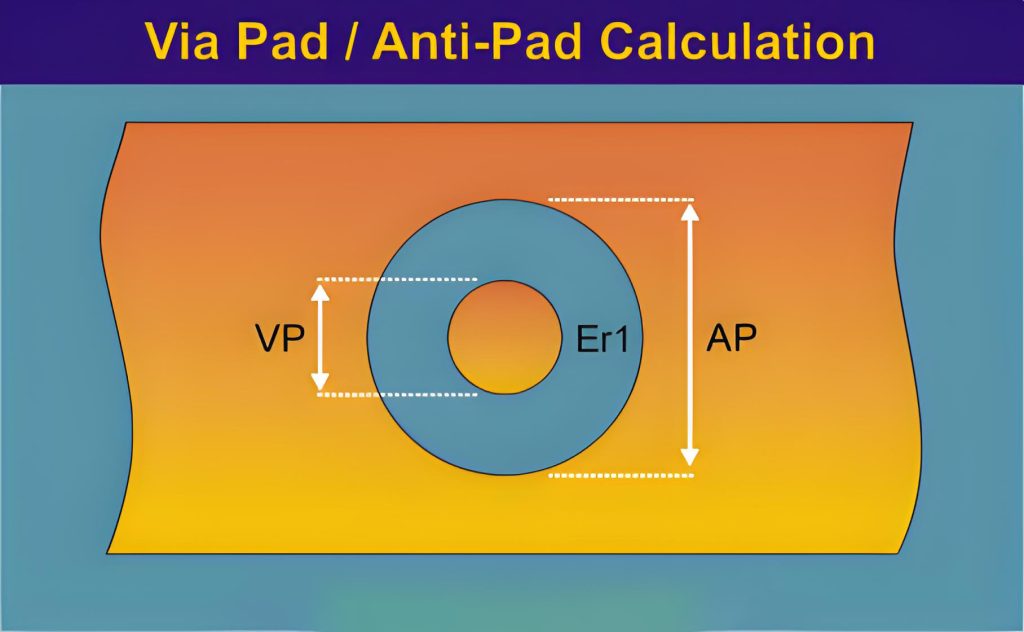
Increasing the hole-to-pad diameter difference provides another path to reduce capacitance. You must follow the formula:
Pad Diameter = Drill Diameter + 2 × Annular Ring

Drilling typically accounts for 30%–40% of PCB製造 料金. したがって, via dimension adjustments require close coordination with economic constraints.

For antipad treatment, removing copper around the pad on specific layers increases the spatial distance between conductors. しかし, excessive clearance may cause crosstalk on adjacent traces and discontinuity in the reference plane.

PCB via pad and antipad design dimension relationship

2. The Dielectric Parameter Layer – TheSignal Slowdown Zonein Material Selection

標準 FR-4材 has a relative dielectric constant Dk ≈ 4.2–4.8 at 1 GHz. で 10 GHz, the Dk value may drop by 5%–10%.

Low Dk materials (Dk ≤ 3.5) effectively reduce via parasitic capacitance because capacitance is directly proportional to the dielectric constant. しかし, these materials cost more and require harder processing. For ordinary low-speed circuits, you do not need to adopt this solution. IPC-4101 defines the technical boundaries for material selection. High-frequency designs must refer to the relevant Slash Sheet specifications in this standard.

3. The Electromagnetic Boundary Layer – Letting Signals Pass with Precision

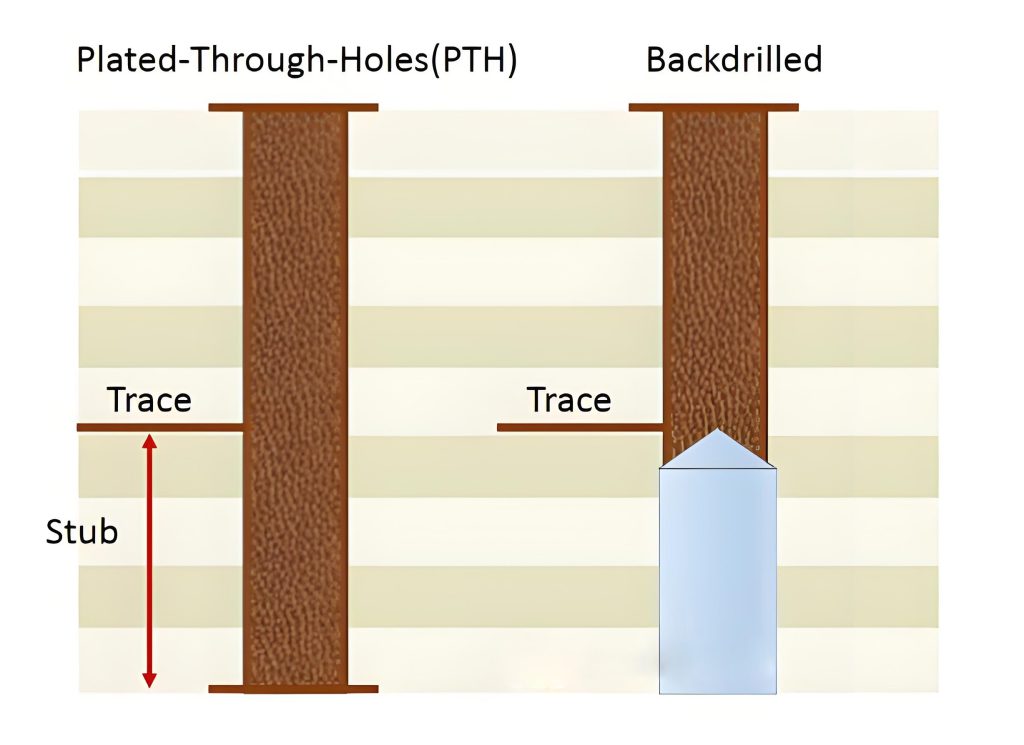
Controlling via stub length is a critical method for breaking through high-speed bottlenecks.

Engineering Threshold for Back Drilling

のために 10 Gbps or higher SerDes channels, a stub length exceeding 10 ミル (について 0.254 mm) can cause observable insertion loss notches. Commercial back drilling processes can reliably control stub length between 4 mil and 8 ミル (0.1 mm to 0.2 mm).

PCB via stub back drilling process comparison before and after removal of stub structure for high-speed signal integrity

A via stub acts as an open-circuited transmission line stub. When the stub length equals one-quarter of the dielectric guided wavelength, it excites a high-Q series resonance. The return loss S11 can locally deteriorate beyond –8 dB.

Quantitative Judgment of Reflection Coefficient

The reflection coefficient formula is:
Γ = (Z₂ − Z₁) / (Z₂ + Z₁)

どこ:

  • Z₁ = line impedance before the reflection point
  • Z₂ = line impedance after the reflection point

In an ideal case, Γ → 0 means full absorption with no reflection. Γ → ±1 means total reflection. When a via introduces additional parasitic parameters, Γ deviates from zero. Design must keep this deviation within an acceptable range through impedance control.

Via Barrel Wall Design Principles

At the microstructural level, via inner diameter, アスペクト比 (ボードの厚さ / 穴径), and copper plating thickness directly determine via mechanical reliability. Standard hole wall copper thickness ranges from 2.5 mil to 3.0 ミル. The mechanical drilling limit for hole diameter is 6 ミル (0.15 mm). Laser drilling can reach 4 ミル (0.1 mm). When the aspect ratio exceeds 8:1, the plating solution cannot fully penetrate the hole center, and voids or cracks rise sharply.

Cost Trade-off for Blind and Buried Vias

Blind and buried vias can reduce parasitic capacitance to 1/3 または 1/5 of a through-hole via. しかし, their fabrication cost per square inch is about 1.3 に 2.0 times higher than that of through-hole boards. Industry data shows that drilling accounts for 30%–40% of total PCB fabrication cost. Blind vias significantly increase this percentage due to their process complexity. Recommend using blind/buried vias only in these scenarios: system data rate ≥56 Gbps PAM4, HDI any-layer interconnect for high routing density, or small packaging areas that cannot accommodate through-holes.

Summary of Optimization Measures

The table below summarizes all solutions and their cost impact based on the source material.

Optimization CategorySpecific MeasureCost Impact
Via dimension designReduce pad diameter; increase hole-to-pad diameter differenceMinor – but watch mechanical strength and reliability
Dielectric and isolation designIncrease dielectric distance; remove antipad; use low Dk materialMedium to High – low Dk material costs more
Via placement designKeep away from ground plane edges; control spacing to adjacent conductorsMinor – but requires safe clearance
Via structure selectionBack drilling to remove stub; use blind/buried vias; reduce layer transition countMedium to High – blind/buried vias cost 1.3–2.0x of through-holes

Get Professional Support for Your High-Frequency Via Optimization

When your design team faces tough via optimization challenges for high-frequency signals, you need an experienced PCBAサプライヤー. We offer precise impedance simulation quotes and high-yield back drilling samples. Our fabrication capabilities meet IPC-6012 Class 3 high reliability standards and include mature HDI via structures. Click the button to request your custom design and manufacturing support.

References

[1] IPC-2251, Design Guide for the Packaging of High Speed Electronic Circuits, IPC, 2003.

[2] IPC-4101E/21, Specification for Base Materials for Rigid and Multilayer Printed Boards, IPC.

[3] IPC-6012D, リジッドプリント基板の認定および性能仕様, IPC.

[4] IPC-D-317A4, Design Standard for Printed Board Assemblies, IPC.

[5] IPC-TM-650, Test Methods Manual, IPC.

前へ:

返信を残す

伝言を残す