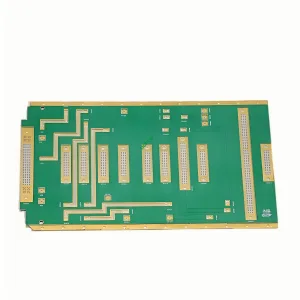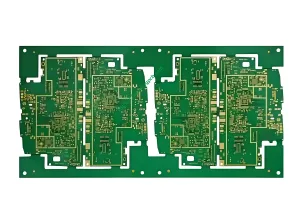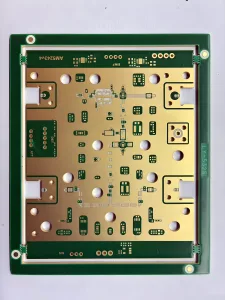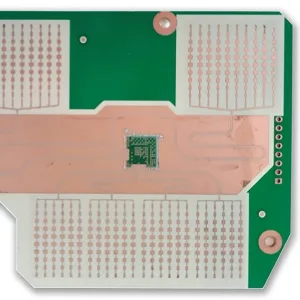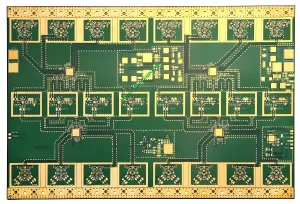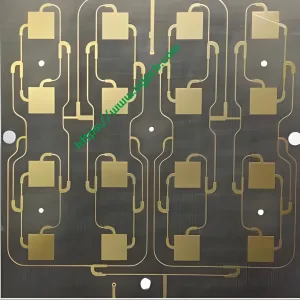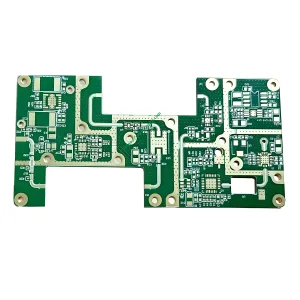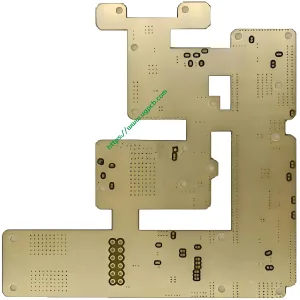
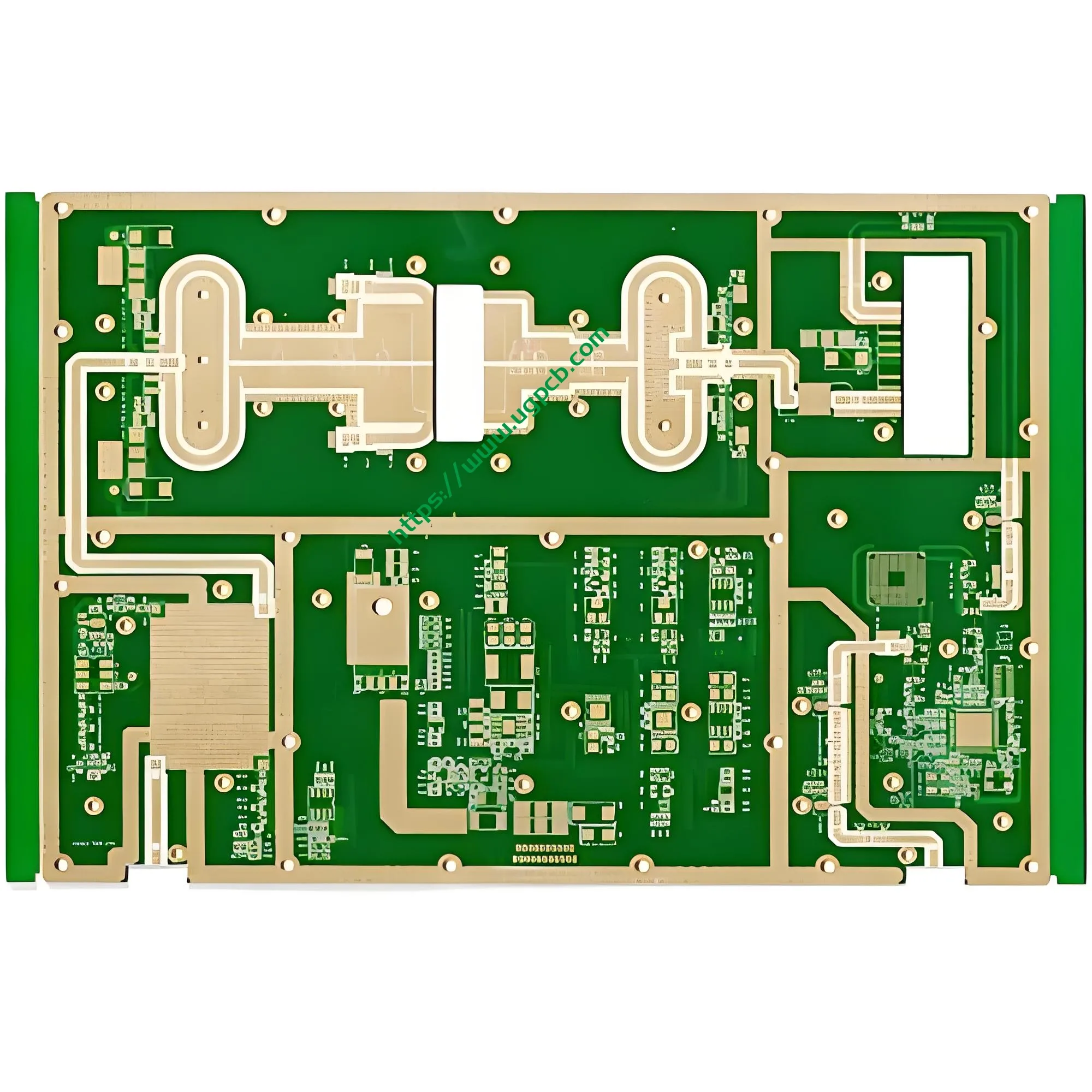
Com o rápido crescimento da comunicação 5G, Radar de onda milimétrica, e comunicações satélites, Projeto de PCB engenheiros enfrentam um dilema clássico. Usando materiais de alta frequência de alta qualidade como Rogers RO4350B para toda a placa oferece excelente desempenho elétrico, mas torna-se muito caro. Usar o FR4 padrão para toda a placa economiza custos, mas a perda de sinal de alta frequência é alta e a constante dielétrica é instável.
A placa híbrida de alta frequência Rogers RO4350B + FR4 da UGPCB resolve esse problema perfeitamente. Este artigo cobre a visão geral do produto, diretrizes de projeto, princípios de funcionamento, Parâmetros técnicos, processo de fabricação, e aplicações. Ele fornece uma referência confiável para engenheiros de RF e tomadores de decisão de compras.
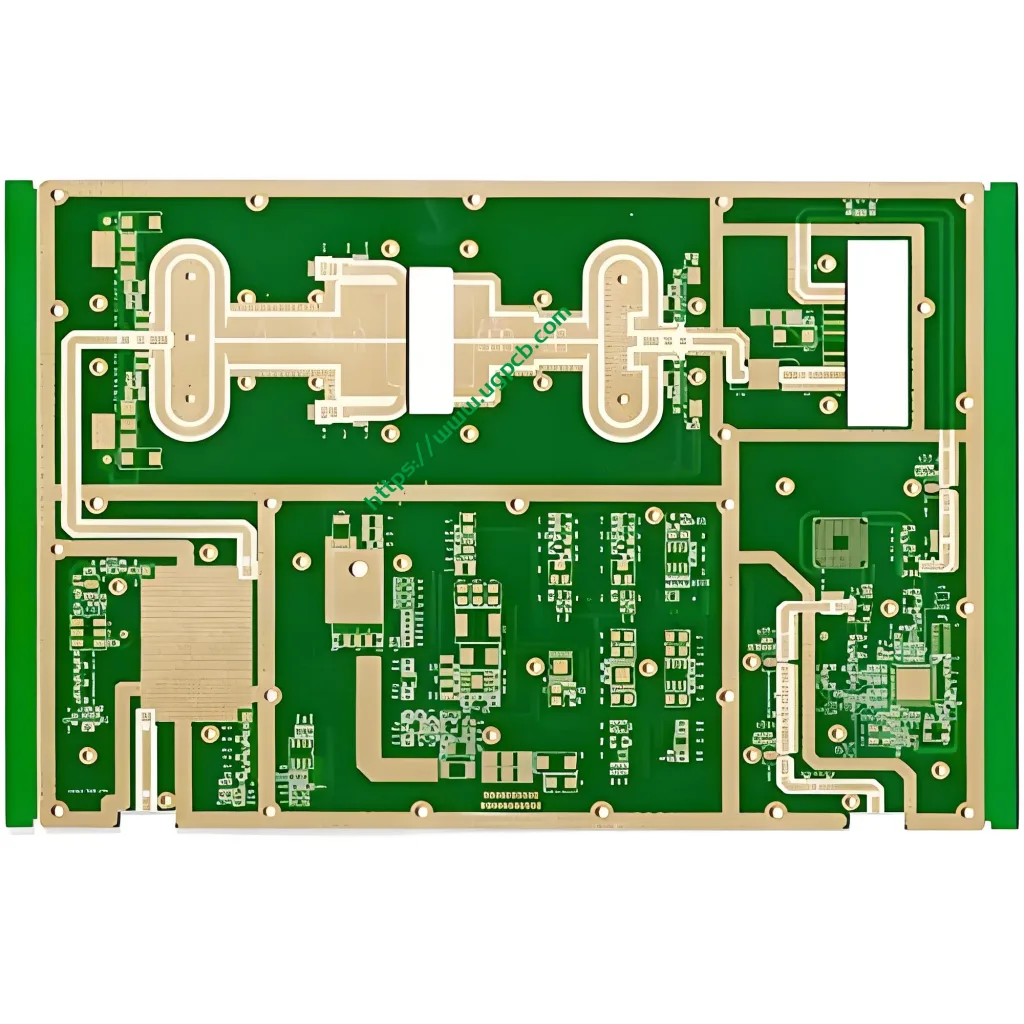
1. Visão geral do produto: O que é uma PCB híbrida de alta frequência Rogers RO4350B + FR4?
1.1 Definição
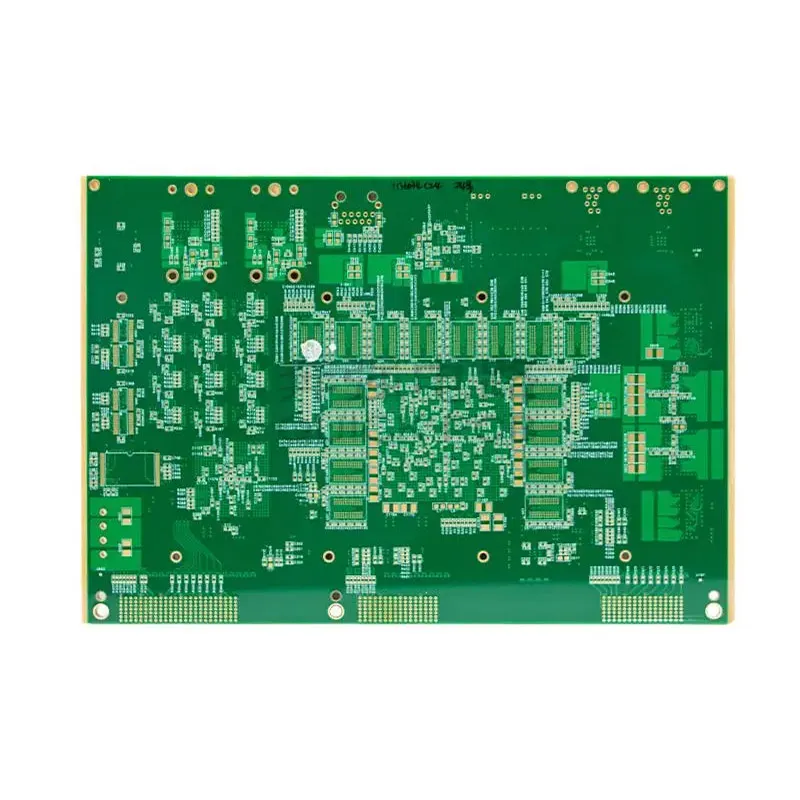
Uma PCB híbrida de alta frequência Rogers RO4350B + FR4 usa laminado de alta frequência Rogers RO4350B e tecido de vidro epóxi FR-4 padrão na mesma placa de circuito. O produto da UGPCB usa um empilhamento simétrico de 4 camadas: duas camadas externas de Rogers RO4350B para roteamento de sinal RF, e duas camadas internas de FR4 para distribuição de energia e planos de aterramento. Isso cria um padrão “sinal – terra – potência – sinal” empilhar.
1.2 Proposta de valor central
Esse PCB híbrido solução oferece equilíbrio preciso entre desempenho e custo. Ele usa material Rogers de alto desempenho apenas nas camadas externas por onde os sinais de alta frequência viajam. Utiliza FR4 de baixo custo nas camadas internas. Isto reduz significativamente o total Fabricação de placas de circuito impresso custo sem sacrificar o desempenho de RF. As estimativas da indústria mostram uma redução de custos de material de 30% a 50% em comparação com uma placa Rogers completa.
2. Principais parâmetros técnicos (Dados oficiais de Rogers & Especificações UGPCB)
| Parâmetro | Valor | Condição de teste / Padrão | Fonte |
|---|---|---|---|
| Combinação de materiais | 2 camadas Rogers RO4350B + 2 camadas FR4 | 4-empilhamento simétrico de camadas | UGPCB |
| Espessura da placa acabada | 1.2 milímetros | - | UGPCB |
| Espessura da folha de cobre | 1 OZ externo / 1 OZ interno | Cobre acabado | UGPCB |
| Espessura dielétrica | 0.508 milímetros | - | UGPCB |
| Constante dielétrica Dk | 3.48 ± 0.05 @ 10 GHz | IPC-TM-650 | Ficha técnica oficial de Rogers |
| Fator de dissipação Df | 0.0037 @ 10 GHz | IPC-TM-650 | Ficha técnica oficial de Rogers |
| Condutividade térmica λ | 0.69 W/m·K @ 50°C | ASTM D5470 | Ficha técnica oficial de Rogers |
| Classificação de inflamabilidade | UL 94 V-0 | UL 94 | Ficha técnica oficial de Rogers |
| Resistividade volumétrica ρ_v | 1.2 × 10¹⁰ Mohm·cm | - | Ficha técnica oficial de Rogers |
| Resistividade superficial ρ_s | 5.7 × 10⁹ Mohm | - | Ficha técnica oficial de Rogers |
| Zis Z CTE | 32 ppm/°C | -55°C a 288 °C | Ficha técnica oficial de Rogers |
| Densidade | 1.9 g/cm³ | - | Ficha técnica oficial de Rogers |
3. Diretrizes de projeto para PCBs híbridos Rogers RO4350B + FR4
Os engenheiros devem se concentrar nesses pontos técnicos importantes ao projetar uma PCB híbrida com Rogers RO4350B e FR4.
3.1 Projeto de correspondência de impedância
A diferença constante dielétrica entre RO4350B e FR4 é significativa. RO4350B tem Dk = 3.48 no 10 GHz, enquanto o FR4 padrão tem Dk entre 4.2 e 4.8. A impedância da linha de sinal muda dependendo da camada de material.
Exemplo para uma linha microstrip de 50Ω:
- Na camada RO4350B (Dk=3,48, 1 OZ cobre), 50Ω largura do traço ≈ 0.4 milímetros
- Na camada FR4 (Dk≈4,5, mesmo cobre), 50Ω largura do traço ≈ 0.25 milímetros
Recomendações de projeto:
- Mantenha os traços de sinal de alta frequência inteiramente dentro das camadas de sinal do RO4350B. Evite cruzar os limites do material onde a impedância muda repentinamente.
- Se uma transição entre camadas for inevitável, use largura de traço cônica no limite RO4350B-FR4. Ou use simulação eletromagnética para minimizar a reflexão do sinal causada pela mudança repentina de Dk.
3.2 Design de empilhamento simétrico
Evitar o empenamento da placa é uma preocupação central no design de empilhamento híbrido. RO4350B tem eixo X/Y CTE de cerca de 10/12 ppm/°C, enquanto FR4 tem cerca de 16 ppm/°C. Essa incompatibilidade é significativa.
UGPCB segue estritamente um princípio de empilhamento simétrico. Usamos uma distribuição de espessura de cobre de:
1 OZ RO4350B (sinal superior) - 0.5 OZ FR4 (chão) - 0.5 OZ FR4 (poder) - 1 OZ RO4350B (sinal inferior).
Isso faz com que a tensão térmica seja distribuída mesmo durante a laminação e reduz bastante o risco de empenamento.
3.3 Seleção de linha de transmissão para PCBs de RF
Para aplicações de alta frequência, recomendamos guia de onda coplanar aterrado (GCPW) em vez das linhas microstrip tradicionais. GCPW coloca densos através de cercas em ambos os lados da linha de sinalização. Isso protege eficazmente a diafonia e reduz a interferência eletromagnética. Funciona especialmente bem para ondas milimétricas 5G e 77 Radar automotivo GHz.
3.4 Processo de Perfuração e Desmear
UGPCB usa parâmetros de perfuração recomendados por Rogers para RO4350B. Também otimizamos o processo de desmearização do material misturado. Resíduos de resina FR4 podem causar paredes ásperas. Portanto, estendemos o tempo de desmearização do plasma em cerca 30% em comparação com placas Rogers puras. Isso garante paredes limpas e metalização de alta qualidade.
4. Princípio de funcionamento e desempenho elétrico
4.1 Estabilidade Constante Dielétrica
RO4350B pertence aos laminados preenchidos com hidrocarbonetos/cerâmica da série RO4000 da Rogers. Sua principal característica é a tolerância constante dielétrica rígida de ±0,05 em uma ampla faixa de frequência. A variação Dk com a temperatura é apenas +50 ppm/°C (menor que 0.4% mudar de -50°C para 150°C). Isso garante a operação estável dos equipamentos de comunicação em toda a faixa de temperatura.
4.2 Análise de perda de sinal
No 10 GHz, o fator de dissipação Df do RO4350B é 0.0037. Isto é muito menor do que o FR4 comum na mesma frequência (Df ≈ 0,015–0,025). Esta propriedade de baixa perda mantém a integridade do sinal em longas distâncias para sinais de ondas milimétricas. Na banda de ondas milimétricas 5G (acima 24 GHz), A placa híbrida da UGPCB normalmente mostra perda de inserção abaixo 0.5 dB/polegada e perda de retorno acima 15 dB (os usuários devem verificar com um VNA seu design específico).
4.3 Condutividade Térmica e Gerenciamento Térmico
RO4350B tem uma condutividade térmica de 0.69 W/m · k, cerca de duas vezes maior que o FR4 comum (≈0,3 W/m·K). Isso permite que o PCB híbrido de alta frequência conduza com eficiência o calor de dispositivos de alta potência, como amplificadores de potência. (PA) para camadas de cobre e vias térmicas, em seguida, espalhe-o pelos planos internos de cobre do FR4. Isto proporciona uma excelente solução de gerenciamento térmico para módulos amplificadores de potência de RF.
5. Classificação do Produto
| Dimensão de Classificação | Categoria |
|---|---|
| Tipo de material | PCB dielétrico híbrido / Placa laminada híbrida de alta frequência |
| Contagem de camadas | 4-PCB multicamadas de camada |
| Frequência de aplicação | PCB de RF/microondas, cobrindo bandas de ondas milimétricas (79 GHz máx.) |
| Processo de fabricação | Laminação mista multicamadas |
| Classificação de inflamabilidade | UL 94 V-0 PCB avaliado |
UGPCB manufactures and tests according to IPC-6012 (Especificação de qualificação e desempenho para placas impressas rígidas) and IPC-4101 (Especificação de materiais básicos para placas impressas rígidas e multicamadas).
6. Stack-up Structure of the 4-Layer 1.2mm Hybrid PCB
UGPCB’s 1.2mm thick 4-layer Rogers RO4350B+FR4 high frequency hybrid board uses a standard symmetrical stack-up:
- L1 (Top layer): Rogers RO4350B, 1 OZ finished copper – RF signal layer
- L2 (Camada 2): FR4, 1 OZ copper – Ground plane
- L3 (Camada 3): FR4, 1 OZ copper – Power distribution / low-frequency control signals (power plane)
- L4 (Camada inferior): Rogers RO4350B, 1 OZ finished copper – RF signal layer
Total dielectric thickness is 0.508 milímetros. Finished board thickness is 1.2 milímetros.
Acabamento superficial: CONCORDAR (Ouro de imersão em níquel eletrolítico) – meets high-reliability soldering and oxidation resistance requirements.
7. Análise de Materiais
7.1 Rogers RO4350B High Frequency Material
RO4350B is a composite laminate of hydrocarbon resin, enchimento cerâmico, and woven glass fabric. Its main advantages include:
- Compatibilidade de processos: Fabrication is nearly the same as FR-4. No special hole wall treatment needed (unlike PTFE materials). O custo de fabricação é muito menor do que os laminados tradicionais para micro-ondas.
- UL 94 V-0 Classificação inflamabilidade: Adequado para dispositivos ativos e designs de RF de alta potência.
- CTE de baixo eixo Z (32 ppm/°C): Garante alta confiabilidade de furos passantes revestidos (PTH) em circuitos multicamadas.
7.2 Substrato FR4
Usamos material FR4 de alta Tg (Tg ≥ 170°C) para combinar com a janela de processamento térmico do Rogers RO4350B. O FR4 atua como as camadas de alimentação e aterramento na placa híbrida. Seu custo é apenas 1/5 para 1/3 o do material de Rogers, reduzindo bastante o total PCB custo de fabricação.
8. Processo de fabricação de PCBs híbridos de alta frequência
UGPCB segue um rigoroso processo de controle de qualidade para placas híbridas de alta frequência:
- Cortar e dourar: Aplique tratamento de escurecimento aos núcleos RO4350B e núcleos FR4 para melhorar a adesão da camada.
- Padronização de circuito de camada interna: Crie padrões de camada de aterramento e energia nas camadas internas do FR4.
- Laminação híbrida (etapa crítica): Use um perfil de laminação de temperatura escalonada (por exemplo, 120°C → 170°C → 220°C). Selecione pré-impregnados compatíveis com ambos os materiais. Controle rigorosamente a taxa de rampa e o tempo de prensagem para evitar delaminação ou vazios.
- Perfuração e desmear: Use os parâmetros de perfuração recomendados por Rogers. Aumentar o tempo de desmear do plasma em cerca de 30% para materiais mistos para garantir paredes de furos limpas.
- Banhado através do furo (PTH): Asse as tábuas a 150°C por 2 horas antes da deposição de cobre sem eletrólito para compensar as diferenças de absorção de umidade (Absorção de água FR4 >0,1%, RO4350B <0.02%).
- Padronização de circuito da camada externa: Forme traços de sinal nas camadas superior e inferior do RO4350B.
- Máscara de solda e acabamento superficial: Sem máscara de solda nas aberturas da antena. Usar CONCORDO (Ouro de imersão em níquel eletrolítico).
- Teste elétrico e inspeção de confiabilidade: 100% teste elétrico, AOI inspeção óptica, Verificação de alinhamento de camada a camada de raios X, além de medição e correção de planicidade antes do envio.
9. Performance and Features of the Hybrid PCB
9.1 Core Performance Values
- Constante dielétrica Dk: 3.48 ± 0.05 @ 10 GHz (Oficial de Rogers)
- Fator de dissipação Df: 0.0037 @ 10 GHz
- Condutividade térmica: 0.69 W/m·K @ 50°C (ASTM D5470)
- Faixa de temperatura operacional: -50°C a +150°C
- Classificação de inflamabilidade: UL 94 V-0
- Resistividade de volume: 1.2 × 10¹⁰ Mohm·cm
- Resistividade superficial: 5.7 × 10⁹ Mohm
- Densidade: 1.9 g/cm³
9.2 Recursos do produto (Why choose this 4-layer RF microwave PCB)
- ✅ Best performance-cost balance: Saves 30%–50% material cost vs. full Rogers solution.
- ✅ Constante dielétrica estável: ±0.05 tight tolerance, minimal variation with temperature/frequency.
- ✅ Low-loss transmission: Df=0.0037 @ 10 GHz, excellent millimeter-wave signal integrity.
- ✅ FR4-compatible process: No special hole wall treatment, high manufacturing efficiency.
- ✅ Good thermal management: Condutividade térmica 0.69 W/m · k, effective heat dissipation.
- ✅ V-0 Classificação inflamabilidade: Atende à UL 94 V-0 safety standard.
- ✅ Flexible customization: 1.2 mm espessura, supports multiple surface finishes.
10. Applications of Rogers RO4350B+FR4 High Frequency Hybrid PCBs
Thanks to excellent RF performance and cost advantages, this hybrid PCB serves many key fields:
10.1 5Infraestrutura de Comunicação G
- 5Placas de antena de estação base macro G e módulos amplificadores de potência (Camada PA usa RO4350B, camadas de energia/terra usam alta Tg FR4 com 2+ onças de cobre grosso)
- Microondas ponto a ponto (P2P) equipamento de conexão
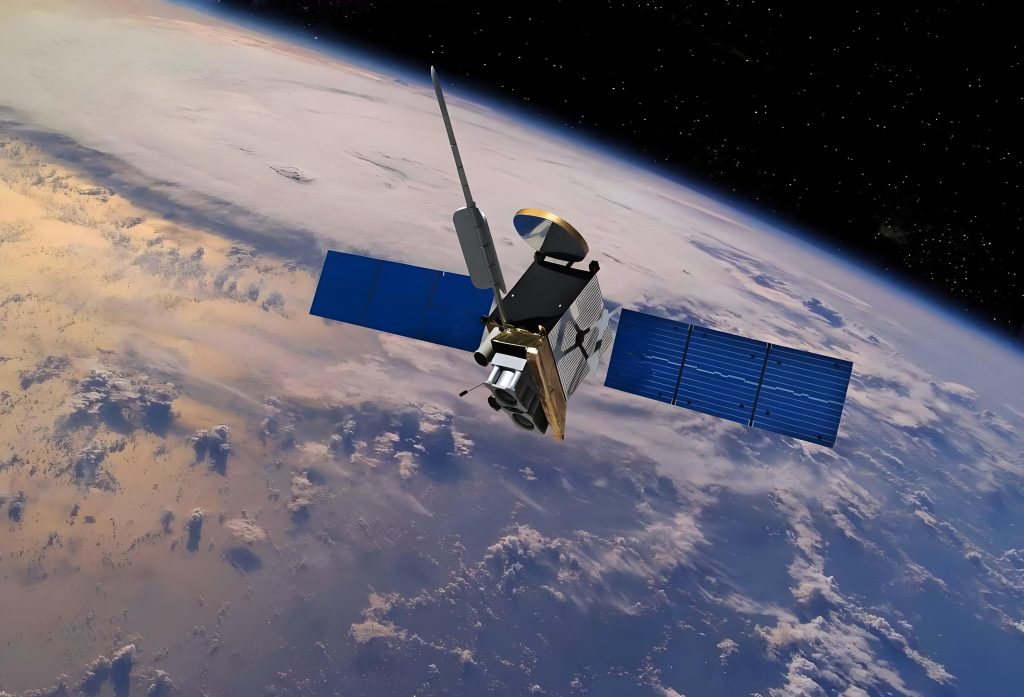
- LNBs terminais terrestres de comunicação via satélite
10.2 Eletrônica Automotiva e Direção Autônoma
- 77 GHz / 79 Radar automotivo de ondas milimétricas de GHz – componente central de detecção para ADAS e direção autônoma; requer qualificação AEC-Q100
- Veículo para tudo (V2X) módulos de comunicação
- 24 Sensores de radar de detecção de ponto cego GHz
10.3 Módulos Front-End RF
- Amplificadores de potência (PA) e amplificadores de baixo ruído (LNA) módulos
- Front-ends do transceptor RF
- Módulos T/R de antena phased array de ondas milimétricas
10.4 Equipamentos Industriais e Médicos
- Leitores e etiquetas RFID
- Circuitos de processamento de sinais de alta frequência em imagens médicas (ressonância magnética, TC)
- Instrumentos de inspeção e medição de precisão
10.5 IoT e eletrônicos de consumo
- 5G-CPE (equipamento nas instalações do cliente)
- Sistemas de comunicação indutiva sem fio
- Módulos de antena Wi-Fi 6E/7
11. Por que escolher UGPCB para sua PCB híbrida de alta frequência?
A UGPCB possui sistemas de processos maduros e rica experiência prática em alta frequência placa híbrida fabricação.
- 🔧 Processo maduro: Domine as técnicas de laminação híbrida central – ciclos de prensagem escalonados, desmembramento de plasma, controle de alinhamento camada a camada.
- 📋 100% testado: Controle total de qualidade do processo, 100% teste elétrico, Inspeção óptica AOI, Verificação de alinhamento de raios X.
- ⚡ Entrega rápida: Estoque suficiente de matéria-prima de RO4350B e FR4 garante prazos de entrega controláveis.
- 📞 Suporte técnico profissional: Suporte de engenharia completo, desde consultoria de projeto de empilhamento até simulação de impedância.
- 🏭 Ampla experiência em fabricação: Muitos anos em PCB de alta frequência produção, atendendo clientes globais.
Obtenha um orçamento rápido & Consulta Técnica
UGPCB oferece consultoria gratuita em projeto de impedância e fabricação de amostras de alta precisão.
📧Envie perguntas para: vendas@ugpcb.com
📝Solicite um orçamento rápido: Forneça arquivos Gerber, Especificação de material (RO4350B+FR4), contagem de camadas (4 camadas), espessura da placa (1.2milímetros), espessura do cobre (1 OZ), e quaisquer outros requisitos de processo
🔧Suporte técnico: Entre em contato com a equipe de engenharia da UGPCB para projeto de empilhamento, cálculos de correspondência de impedância, e parâmetros do processo de laminação híbrida.
💡 Dica de consulta: Para garantir uma cotação precisa, inclua arquivos Gerber completos (com camada de perfuração), requisitos de empilhamento, largura/espaçamento mínimo do traço, e especificação de acabamento superficial.
Isenção de responsabilidade & Declaração de precisão de dados
Todos os parâmetros técnicos neste documento foram verificados manualmente em relação à folha de dados oficial da Rogers (2025-2026 edição), Padrões IPC, e documentação de certificação UL. Dados principais – Dk=3,48 (@10 GHz), Df=0,0037 (@10 GHz), condutividade térmica 0.69 W/m · k (@50°C conforme ASTM D5470) – vem diretamente da folha de dados Rogers RO4350B. Este artigo segue as diretrizes de uso justo para citação e foi razoavelmente adaptado e reestruturado.
© 2026 UGPCB. Todos os direitos reservados. | Design de PCB híbrido de alta frequência & Especialista em Fabricação