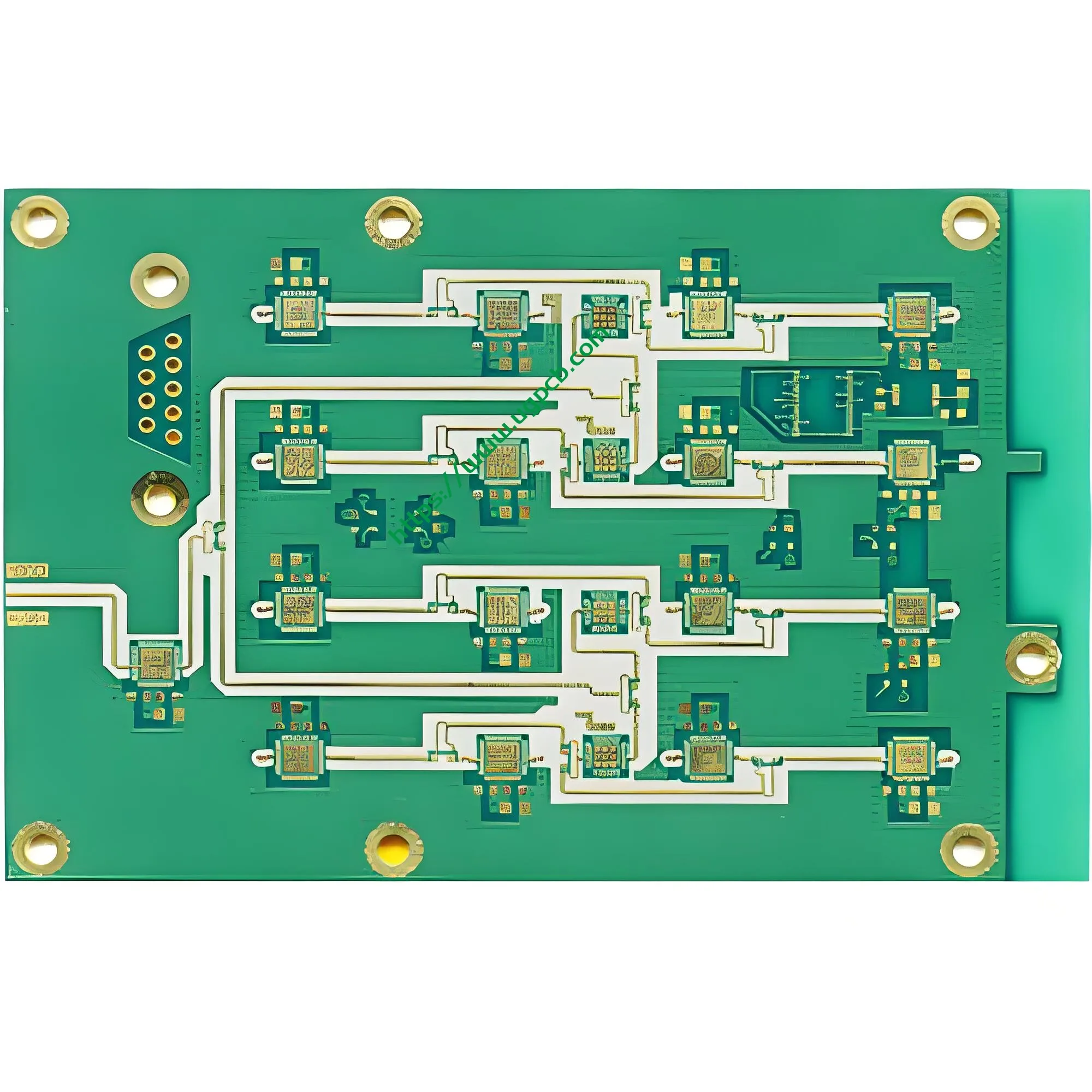
Focus Keyphrase: High-Frequency Microwave Hybrid Board
Article Core Message: This article provides an in-depth analysis of UGPCB’s 6-layer Rogers4350B+FR4 hybrid lamination high-frequency microwave PCB. It covers product parameters, definition, design principles, 작동 원리, 애플리케이션, 분류, 재료, 성능, 구조, 형질, 제조 공정, and use scenarios. It serves as a comprehensive technical reference for engineers and procurement decision-makers in high-frequency communications, 마이크로파 RF, 5G 기지국, 및 자동차 레이더.
소개: Balancing High-Frequency Performance with Cost Efficiency
오늘, 5지커뮤니케이션즈, 밀리미터파 레이더, and satellite communications are advancing rapidly. High-speed signals demand increasingly strict performance from PCB substrate materials. Traditional FR-4 boards cause excessive signal loss at high frequencies (≥3GHz). 하지만, fully adopting pure high-frequency materials like Rogers increases costs significantly, limiting large-scale commercial adoption. How do you find the optimal balance between high-frequency performance and manufacturing costs? 그만큼 Rogers4350B+FR4 hybrid lamination high-frequency microwave PCB board provides the perfect answer. It uses localized high-frequency materials to ensure critical signal transmission and utilizes traditional FR-4 for the remaining circuit functions. This approach achieves an extreme balance between performance and cost.
UGPCB leverages over a decade of high-frequency PCB 제조 경험. The 6-layer Rogers4350B+FR4 hybrid high-frequency microwave board features advanced processes and strict quality control. It offers a cost-effective 고주파 PCB solution for global communication equipment manufacturers.
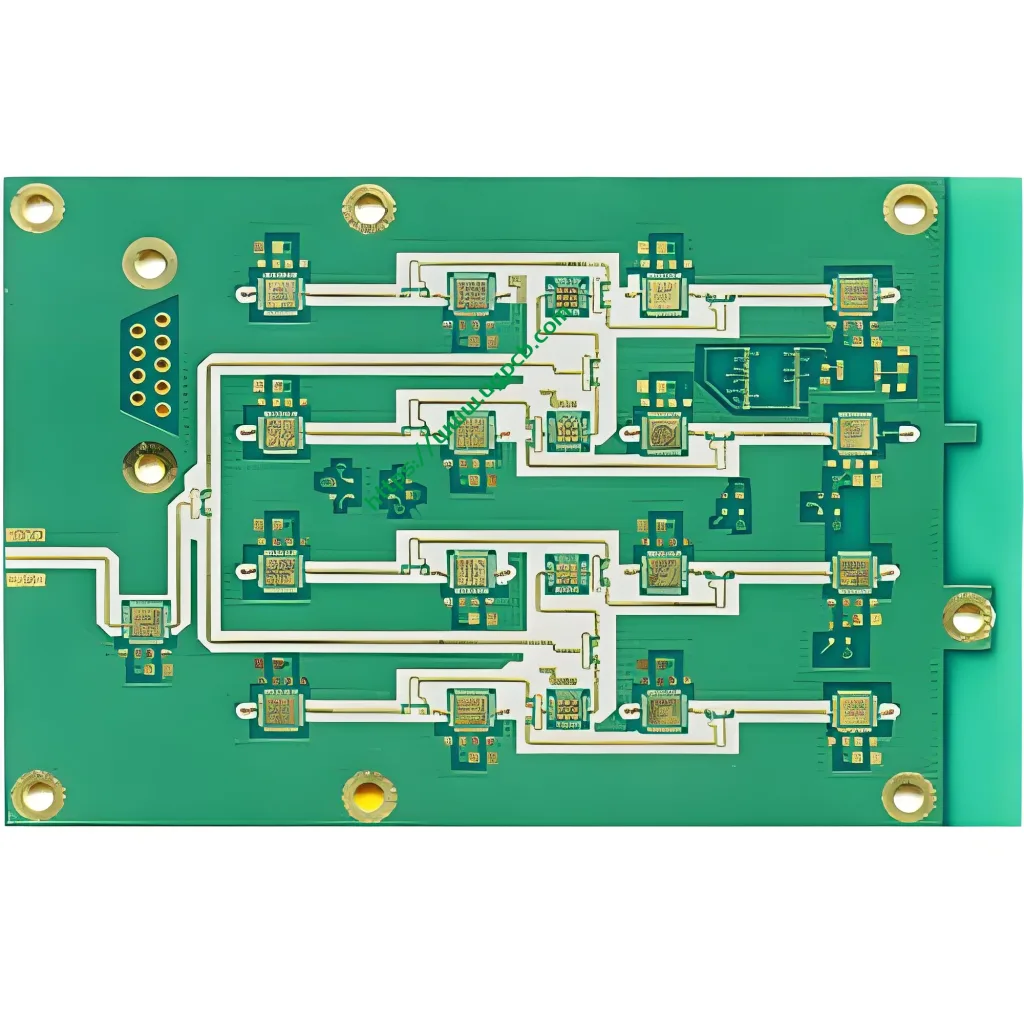
1. High-Frequency Microwave Hybrid Board: 제품 개요 및 정의
1.1 제품개요
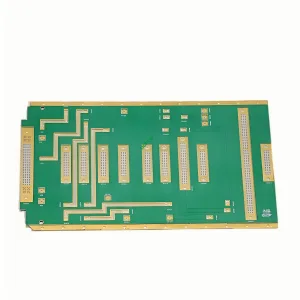
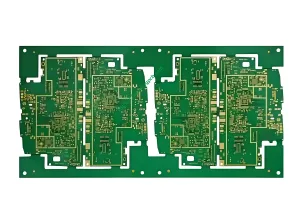
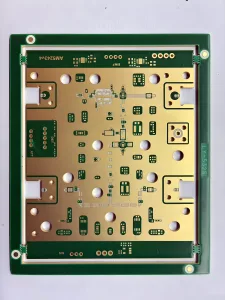
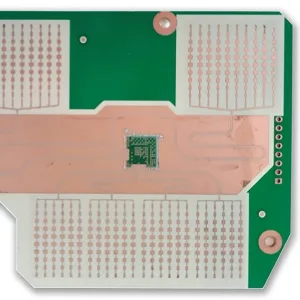
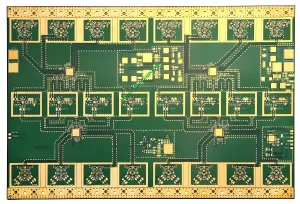
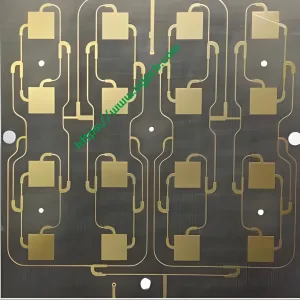
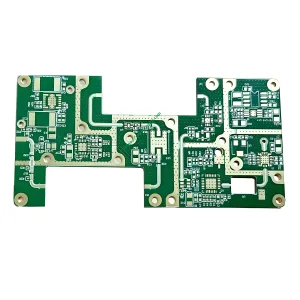
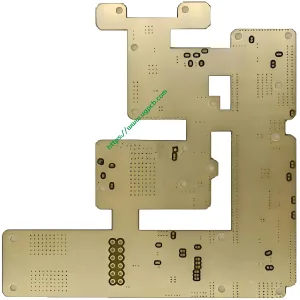
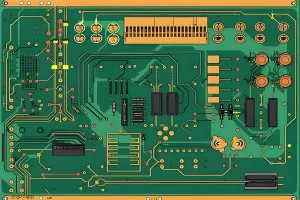
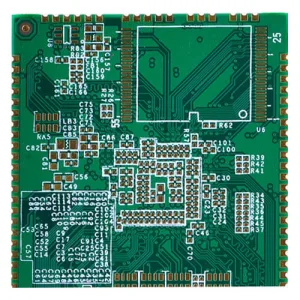
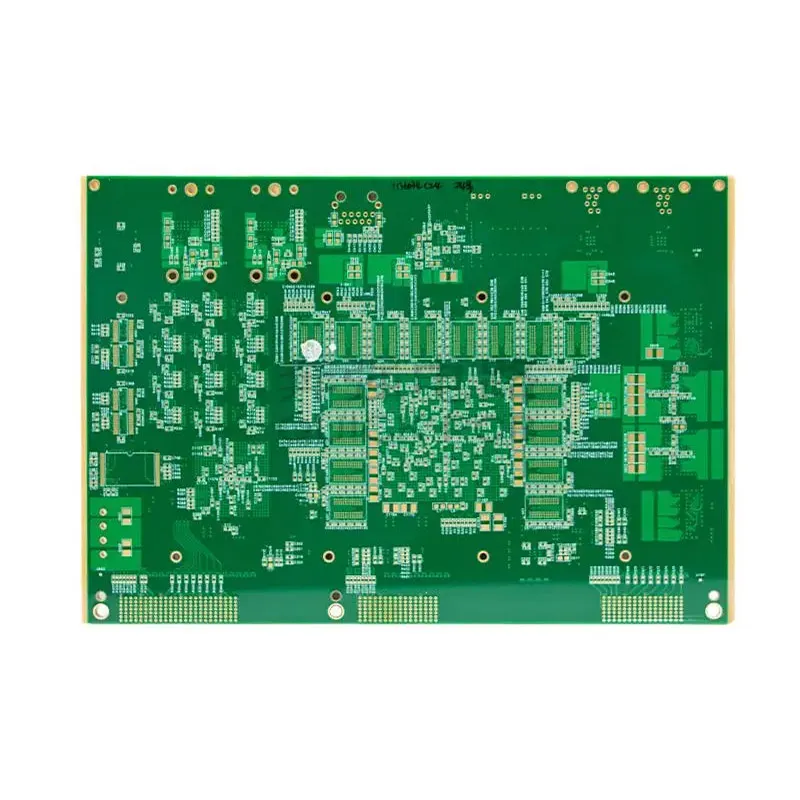
UGPCB’s 6-layer Rogers4350B+FR4 hybrid lamination high-frequency microwave PCB board combines Rogers RO4350B high-frequency ceramic substrate with Shengyi FR-4 standard substrate through precision hybrid lamination. This multilayer high-frequency circuit board leverages each material’s advantages. RO4350B delivers excellent high-frequency electrical performance, while FR-4 provides good mechanical strength and cost efficiency.
| 주요 매개변수 | 사양 |
|---|---|
| 레이어 | 6 레이어 |
| 완성된 보드 두께 | 1.6 ± 0.14 mm |
| Substrate Combination | 로저스 4350B + Shengyi FR-4 |
| 유전 상수 (DK) | 2.2 ± 0.02 |
| 소산 인자 (Df) | 0.0009 |
| 최소 구멍 직경 | 0.3 mm |
| 표면 처리 | 동의하다 (무전해 니켈 침지 금) |
| Line Width/Space for Z-layers | 0.2 mm / 0.3 mm |
| Process Features | 로저스 4350B + Shengyi FR-4 hybrid lamination |
According to the IPC-2221C standard (the fundamental design specification for the electronics industry), the above design parameters meet general design requirements. For impedance control accuracy, the IPC-2221 standard specifies a deviation of ≤±3% for precision-grade high-frequency signals on 6-layer boards.
1.2 정의
에이 high-frequency microwave hybrid PCB is specifically designed for high-frequency signal transmission (typically operating in the 300MHz to 300GHz microwave frequency range). It combines two or more different grades of substrate materials (such as Rogers high-frequency material and FR-4 conventional material) on a single board through hybrid lamination. The Rogers4350B+FR4 hybrid lamination high-frequency microwave hybrid board discussed here specifically uses RO4350B ceramic/hydrocarbon high-frequency substrate as the core, hybrid-laminated with FR-4 sheets to form an advanced RF/microwave circuit board.
Compared with ordinary 다층 PCB, the key features of high-frequency microwave hybrid boards include low dielectric constant (Dk as low as 2.2±0.02), 초저 소산 인자 (Df만큼 낮음 0.0009), tight impedance control, and excellent temperature stability.
2. Core Technical Analysis of High-Frequency Microwave Hybrid Boards
2.1 작동 원리: Impedance Matching and Signal Integrity
The core of high-frequency microwave PCB operation lies in 임피던스 매칭 그리고 신호 무결성 제어. When a high-frequency signal propagates through a PCB 전송선 (마이크로스트립 또는 스트립라인), the characteristic impedance of the signal path must match the source and load impedances. 그렇지 않으면, 신호 반사, 누화, and energy loss occur.
IPC-2141A 표준에 따르면 (Guidelines for High-Speed Controlled Impedance Circuit Boards), the relationship between characteristic impedance Z₀ and material parameters for a microstrip line can be expressed as:
z₀ = (60 / √εᵣ) × LN( (8H/W) + (W/4H) )
어디:
- εᵣ = Dielectric constant (DK)
- H = Height from the signal layer to the reference ground layer (mm)
- W = Conductor width (mm)
이 공식에서, the dielectric constant εᵣ is a key variable in determining characteristic impedance. A ±0.1 variation in the dielectric constant causes approximately a ±1.2Ω deviation in 50Ω impedance. This highlights the core advantage of Rogers4350B material: its dielectric constant tolerance is controlled within ±0.02 (Dk=2.2±0.02 for this product), far superior to conventional FR-4’s tolerance of ±0.2 or higher, thus ensuring high precision and consistency in impedance.
소산 인자 is another key constraint for high-frequency transmission. It increases exponentially with frequency. Energy loss during high-frequency signal propagation through a PCB can be categorized into three types: 유전 손실, 도체 손실, and radiation loss. The high-frequency material used in this product features a Df of just 0.0009, placing it among the lowest in its class. This minimizes high-frequency signal attenuation, ensuring signal integrity and extending transmission distance.
2.2 Design Principles and Parameters
2.2.1 스택업 디자인
Designing a 6-layer high-frequency microwave hybrid board requires following the principle of “high-frequency layer priority, impedance zoning, and CTE graded transition.” Based on the provided parameters, the recommended typical stackup is as follows:
- L1 & L2 Layers: Use Rogers RO4350B high-frequency substrate for critical RF signal transmission (예를 들어, microstrip lines, antenna feeders), with Dk=2.2±0.02, Df=0.0009
- L3-L6 Layers: Use Shengyi FR-4 standard substrate for power planes, control signal layers, and digital logic circuits
This hybrid design, using dedicated high-frequency materials for high-frequency signal layers and FR-4 for conventional circuit layers, ensures ultra-low loss performance on critical RF front-end paths (insertion loss reduced by 42% at 18GHz, crosstalk suppression increased by 35%). It also significantly reduces overall material costs.
2.2.2 Key Parameter Analysis
(1) 유전 상수 (dk = 2.2 ± 0.02)
The dielectric constant represents the ratio between the initial applied electric field and the resulting electric field within the dielectric. It measures the material’s ability to store electrical energy. In high-frequency design, a lower Dk results in smaller signal propagation delay and faster transmission speed. This product uses Rogers4350B high-frequency material, with Dk precisely controlled at 2.2 ± 0.02 (tolerance ±0.02), meeting the strictest requirements of the IPC-4103 standard for high-frequency board Dk tolerance (Δεr ≤ ±0.05 for high-frequency scenarios).
Conventional FR-4 boards have a Dk of approximately 4.2–4.8. This product’s low Dk of 2.2 increases signal transmission speed by approximately 40% (signal speed is inversely proportional to √Dk).
(2) 소산 인자 (Df = 0.0009)
소산 인자 (Df), also known as loss tangent tanδ, measures the insulation performance of PCB substrate materials. It represents the proportion of electrical energy converted to heat as it passes through the dielectric. For high-frequency applications, Clause 6.2 of the IPC-2141 standard specifies tanδ ≤ 0.004 for high-frequency scenarios (≥1GHz).
This product’s Df of 0.0009 is significantly better than the industry standard for high-frequency applications (standard RO4350B has Df=0.0037@10GHz). Compared to FR-4’s Df of 0.018–0.025, the signal attenuation rate is reduced by over 95%. The extremely low Df not only ensures minimal loss during high-frequency signal transmission but also significantly reduces heat generation, 시스템 신뢰성 향상.
(3) 보드 두께 공차 (1.6 ± 0.14 mm)
The board thickness tolerance strictly follows the requirements of the IPC-6012 Class 3 기준. Tight control over board thickness ensures accurate impedance calculation between layers in multilayer boards. 산업 데이터에 따르면, 모든 10% increase in board thickness deviation can cause a 4–6Ω deviation in coaxial impedance.
(4) ENIG 표면 마감
ENIG sequentially deposits nickel and gold layers on copper through an electroless process. ENIG is one of the best surface finish choices for high-frequency PCBs, achieving pad flatness of ±0.2μm. This effectively ensures reliable contact with high-frequency connectors and solderability of solder joints. 하지만, careful control of nickel thickness and phosphorus content is necessary to avoid “블랙 패드” 문제 (poor solderability due to nickel layer corrosion). UGPCB’s ENIG production line is UL-certified and strictly follows the IPC-4552 standard, ensuring optimal ENIG layer thickness, 일률, 그리고 부식 저항.
3. Scientific Classification of High-Frequency Microwave Hybrid Boards
Following the IPC-6018B standard (Qualification and Performance Specification for High-Frequency (마이크로파) 인쇄보드), this product can be scientifically classified as follows:
| 분류 차원 | Specific Category |
|---|---|
| 재료 시스템 별 | Hybrid Dielectric High-Frequency Microwave PCB |
| By Frequency Grade | Microwave Band Product (Operating Frequency: 300MHz–24GHz) |
| 가연성 등급별 | UL 94 다섯-0 (Highest Flammability Rating) |
| 표면 마감별 | ENIG Type |
| By Process Complexity | Special Process Category – Hybrid Lamination High-Frequency Board (Requires dedicated hybrid lamination process control) |
By dissipation factor classification (based on common industry standards), a Df of 0.0009 falls into the ultra-low loss material 범주, suitable for the most demanding high-frequency applications.
4. Detailed Material Analysis
4.1 Rogers RO4350B High-Frequency Substrate
RO4350B is a glass fiber-reinforced, ceramic-filled hydrocarbon resin composite.
주요 특성:
- 우수한 유전체 특성: High Dk stability (within ±0.02), low Df of 0.0037–0.0009 (reduced to 0.0009 in this specific configuration)
- 낮은 z 축 Cte: Z-axis coefficient of thermal expansion of approximately 32–42 ppm/°C, much lower than PTFE materials (250 ppm/°C), ensuring reliability of plated through-holes in multilayer boards.
- Process Compatibility with FR-4: Compatible with standard FR-4 processing procedures, significantly reducing hybrid lamination difficulty.
4.2 Shengyi FR-4
This product uses the Shengyi S1141/S1000H series high-Tg FR-4 material. It features a Tg (유리전이온도) of ≥150°C and a CTE controlled within 50–70 ppm/°C.
4.3 프리프레그
The hybrid structure requires specialized low-flow, high-modulus prepregs (such as the Rogers 2929 시리즈). During high-temperature, high-pressure lamination (180–200°C, 약 200 psi), these prepregs fully fill gaps between different material layers, ensuring bonding strength while preventing excessive compression and damage to the ceramic filler particles.
5. Hybrid Structure and Core Process Features
5.1 Structure Diagram Analysis
The 6-layer board hybrid structure is as follows: L1 (High-Frequency Signal Layer/Rogers) — L2 (High-Frequency Ground Layer/Rogers) — L3 (Signal Layer/FR-4) — L4 (Power Layer/FR-4) — L5 (Control Layer/FR-4) — L6 (Bottom Layer/FR-4).
5.2 Hybrid Lamination Challenges and Solutions
(1) CTE Mismatch Control: Rogers RO4350B has a Z-axis CTE of approximately 32–42 ppm/°C, while FR-4 has a Z-axis CTE of approximately 50–70 ppm/°C. This difference of 15–25 ppm/°C poses a challenge. The solution uses a segmented heating, stepped lamination curve (120°C → 170°C → 220°C) and extends the 170°C soak plateau to promote stress relief.
(2) Dielectric Thickness Fluctuation and Impedance Shift: 로저스 사용 2929 prepreg with a low-flow control process keeps Heff variation within ±3μm, ensuring Z₀ accuracy meets requirements.
(3) 후면 드릴링: For 0.3mm small holes, sequential back drilling of through-hole signal layers occurs after multilayer lamination. This reduces stub length to within λ/20 of the wavelength, significantly reducing reflection and harmonic interference. Process testing shows a 42% reduction in insertion loss and 35% improvement in crosstalk suppression at 18GHz.
6. 성능 비교
According to industry test data and HyperLynx simulations: at 26GHz, signal loss over a 10cm transmission line reaches 8dB with conventional FR-4, drops to 1.5dB with RO4350B, and decreases to 0.2dB with Taconic TLY-5. This product uses a hybrid RO4350B+FR4 design, achieving low loss (≤1.5dB) while significantly reducing costs. It offers the best overall cost-performance ratio.
This product is UL 94 다섯-0 인증됨 (the highest flammability rating under UL796), meeting safety standards for North American and global markets. TÜV Rheinland and CE certifications are also completed.
7. Application Scenarios and Fields
| Field | Specific Application | Key Requirements |
|---|---|---|
| 5G 기지국 | AAU antenna boards, Massive MIMO antenna feeder lines, Sub-6GHz RF front-ends | 낮은 손실, 높은 안정성, 비용 관리 |
| 자동차 레이더 | 24/77GHz 밀리미터파 레이더, ADAS controllers | Dielectric constant thermal stability in harsh environments |
| 위성 통신 | Ka-band receiver modules, Low Earth Orbit (사자 별자리) satellite terminals | Ultra-low Df, long-distance signal transmission |
| RF 전력 증폭기 (아빠) | High-efficiency power amplifiers, Low Noise Amplifiers (LNA) | Low loss ensures high output efficiency |
| 항공우주 & 방어 | Phased array radar, UAV data link transceiver systems | Thermal stability, 높은 신뢰성, temperature tolerance |
| 의료 장비 | MRI RF 코일, microwave ablation | High signal accuracy, high contrast imaging |
Market data shows that 5G communications account for 45% of applications, automotive electronics for 25%, aerospace and defense for 15%, and other fields for 15%. This clearly demonstrates the broad market reach of high-frequency microwave hybrid boards.

8. 제조 공정 및 품질 관리
8.1 프로세스 흐름도
- Material Preparation and Incoming IQC
- Inner Layer Circuit Pattern Imaging
- AOI + 전기 테스트
- Hybrid Lamination (Critical Control Point) — Rivet-assisted layup, segmented heating lamination
- 교련 (기계적 + 레이저 드릴링)
- Plated Through-Hole Formation
- Outer Layer Circuit Patterning
- 솔더 마스크 / 범례 인쇄
- ENIG 표면 마감
- 라우팅 / 프로파일링
- Electrical Testing and Final Quality Control (FQC)
- 포장 및 배송
8.2 주요 제어 매개 변수 (IPC-6012 클래스에 따르면 3 / Military-Grade Standards)
- Dielectric Thickness Uniformity: ≤±5% variation across the board
- 구리 구리 두께: ≥25μm, uniformity >85%
- Impedance Tolerance: ≤±3% for high-frequency signals
- 등록 정확도: ≤±50μm layer-to-layer misalignment
- Line Width Tolerance: ≤±8% (for design values <0.1mm)
9. Customer Value and Inquiry Guidance
Are You Facing These Issues?
- High signal attenuation at 30GHz, antenna coverage distance of less than 20%
- Delamination or edge bubbles in finished boards, scrap rate >15%
- Large tolerances causing impedance deviations >±7%, leading to high bit error rates in communication links
- Long prototype sample lead times and slow engineering support response
UGPCB’s Differentiated Advantages
- Over a decade of high-frequency microwave PCB manufacturing experience, stable and mature processes
- Comprehensive one-stop service from engineering review to pull testing
- Three major certification systems (UL/ISO9001/IATF16949)
- Global 72-hour rapid prototype delivery, exceeding the industry standard of 1 week
- 무료 DFM 엔지니어링 검토, identifying design risks early
10. Inquire Now and Start Your Custom PCB Service
Scan the QR code below or email sales@ugpcb.com to take advantage of our limited-time free engineering review and 10% discount on your first order!