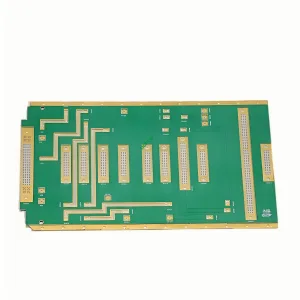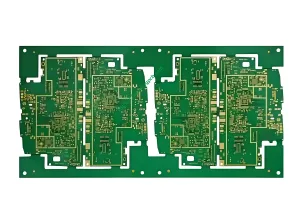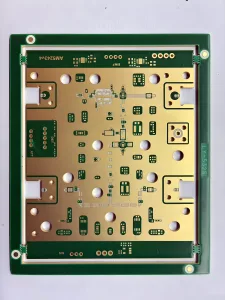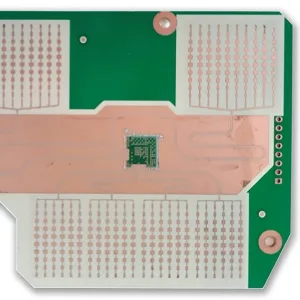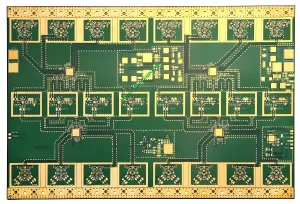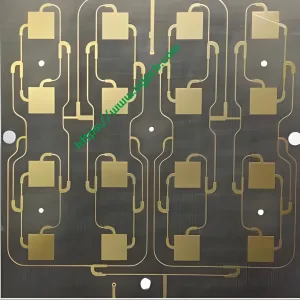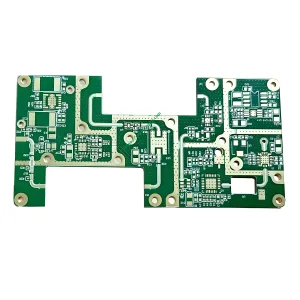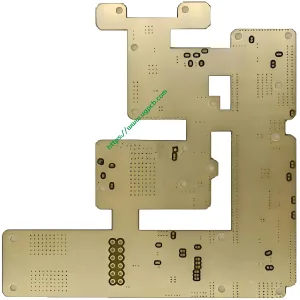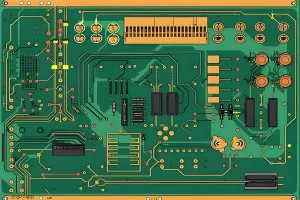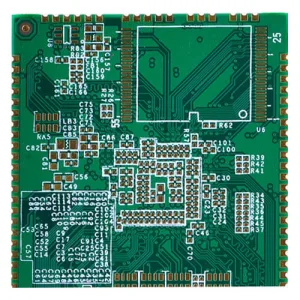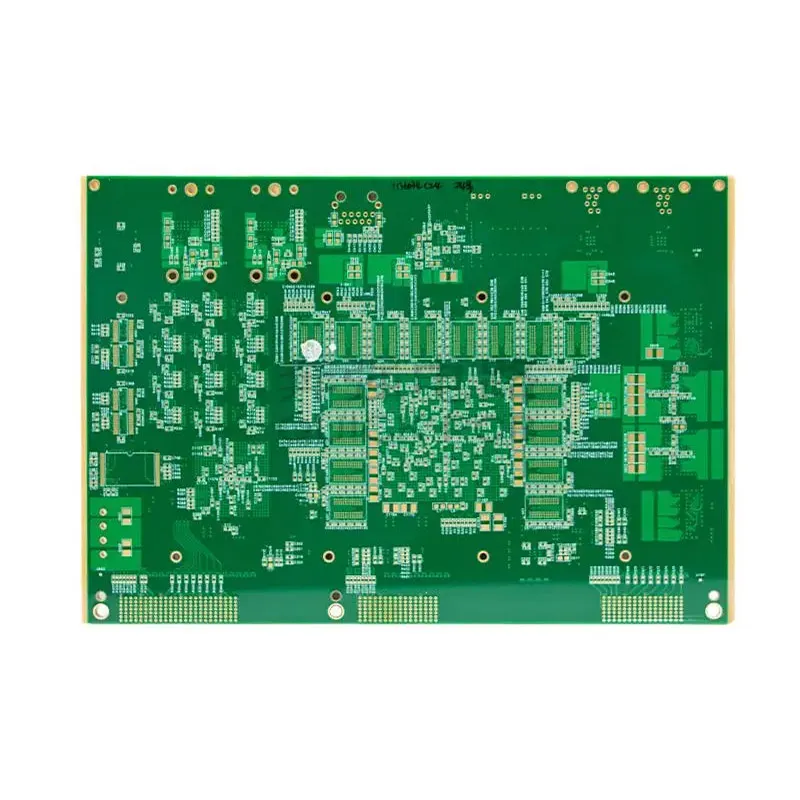
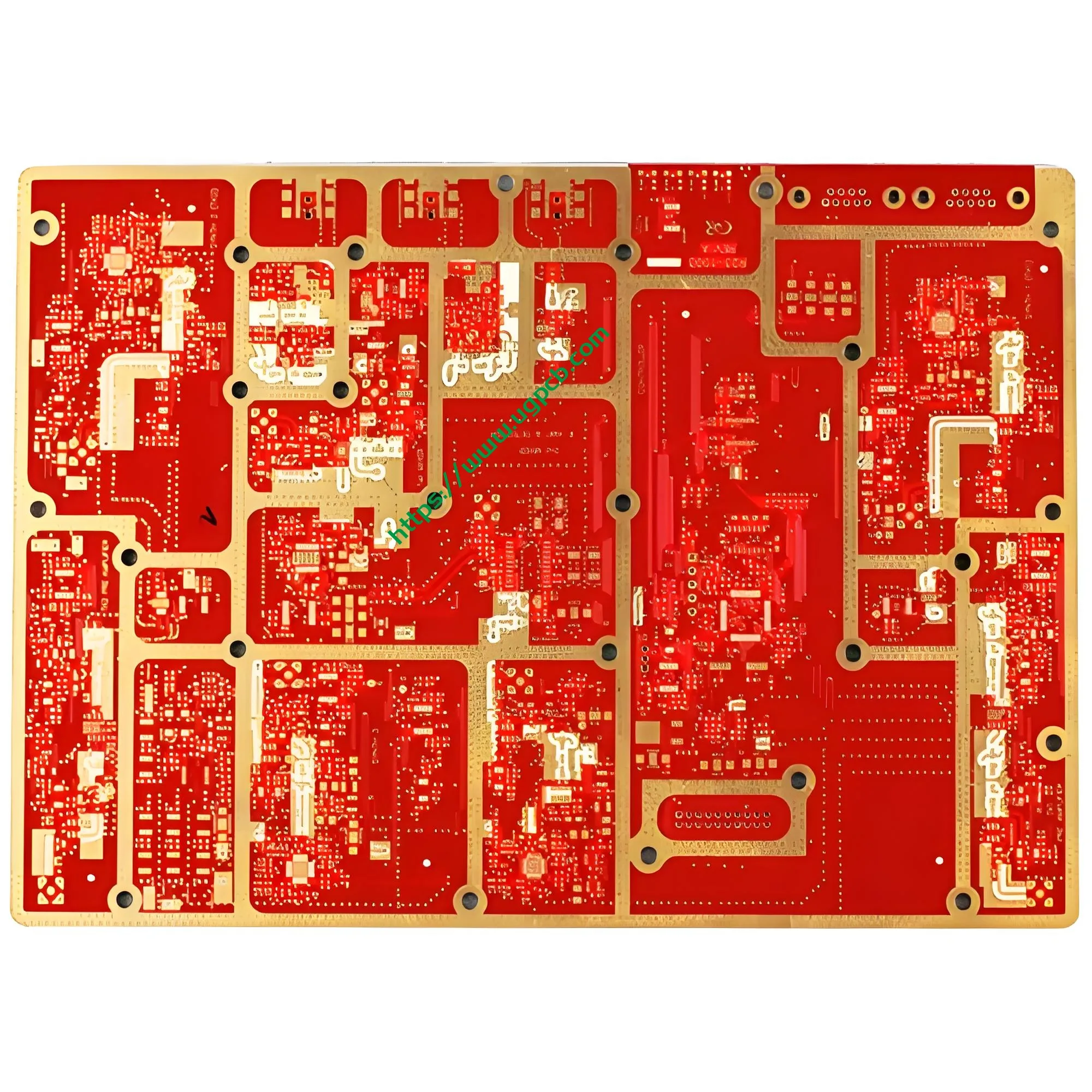
Când sistemele digitale și RF depășesc mai mulți GHz, convenţional Materiale PCB a lovit blocaje în integritatea semnalului, stabilitate termică, şi controlul impedanței. PCB-ul hibrid de înaltă frecvență de comunicare al UGPCB rezolvă aceste provocări.
1. Prezentare generală a produsului
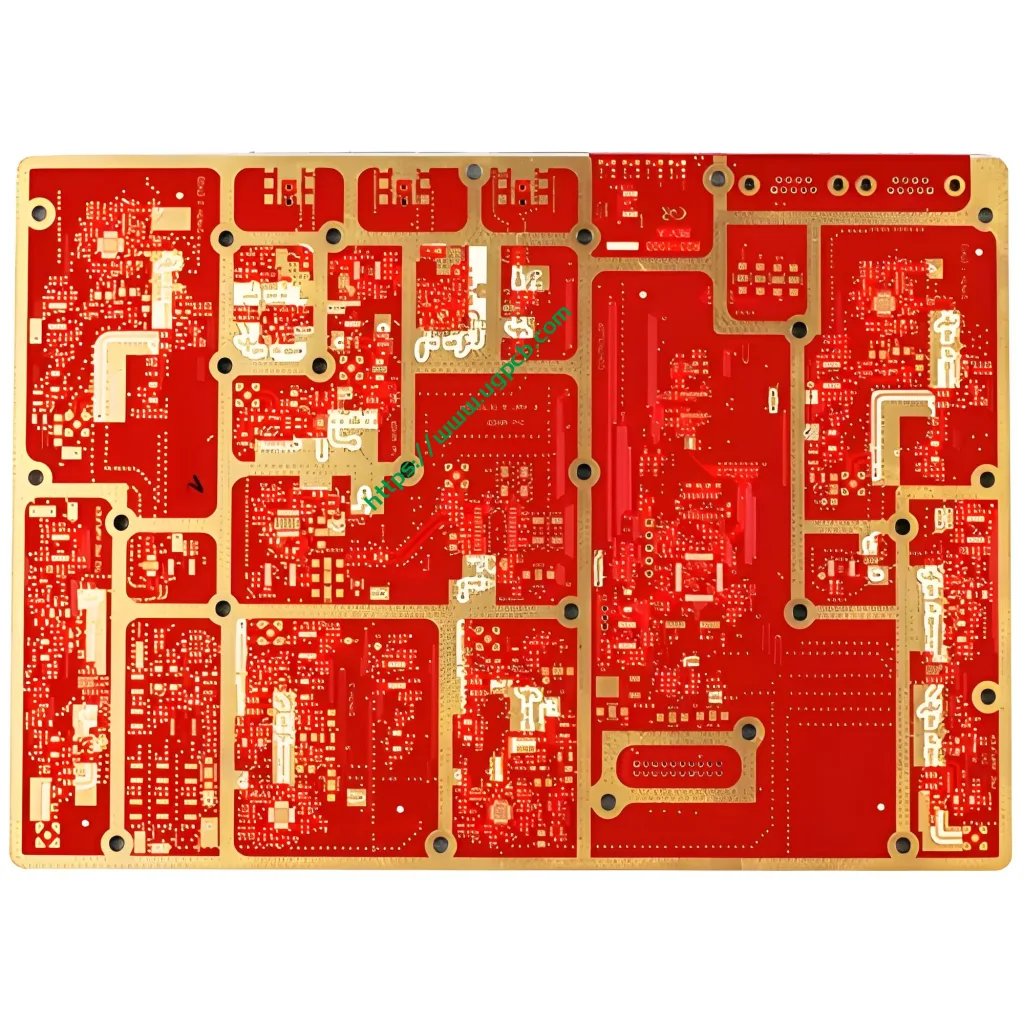
Numele produsului: PCB hibrid de înaltă frecvență de comunicare în 6 straturi UGPCB
Model: UG‑HYBRID‑6L‑RF01
Specificații cheie: 6 straturi / Ro4350B+FR4 dielectric mixt / 1.6mm grosimea plăcii / 210mm × 280 mm dimensiune / Finisajul suprafeței ENIG / gaură mecanică minimă 0,25 mm
Poziționare: O soluție de interconectare rentabilă pentru front-end-uri RF și circuite mixte digitale de mare viteză. Prin plasarea laminatului de înaltă frecvență Rogers RO4350B pe straturile superioare de semnal RF și FR-4 pe straturile inferioare de putere/sol și digital de viteză redusă, acest design echilibrează integritatea semnalului, stabilitate termică, si costul de fabricatie.
2. Definiție – Ce este un PCB hibrid de înaltă frecvență?
O PCB hibrid de înaltă frecvență (numit si placă multistrat dielectric mixt) folosește două sau mai multe materiale cu proprietăți dielectrice diferite într-unul placă de circuit imprimat multistrat.
Acest PCB hibrid cu 6 straturi are următorul stivuire:
| Strat | Funcţie | Material | Parametru cheie |
|---|---|---|---|
| L1 | semnal RF | RO4350B (0.2mm) | Dk=3,48±0,05@10GHz, Df=0,0037 |
| L2 | Masa RF | RO4350B | Plan de referință cu pierderi reduse |
| L3 | Digital de mare viteză | RO4450™ bondply + FR-4 | Tranziţie, potrivirea impedanței |
| L4 | Avion de putere | FR-4 | Tg ridicat, cost scăzut |
| L5 | Semnal digital | FR-4 | Sticla epoxidica standard |
| L6 | Pământ digital | FR-4 | Suport mecanic și disipare a căldurii |
„Construcția dielectrică mixtă reduce semnificativ costurile – folosind material de înaltă frecvență numai pe straturile care transportă semnale RF, și FR-4 pentru restul.”
3. Ghid de proiectare
3.1 Parametrii critici ai materialelor
Acest produs foloseste Rogers RO4350B (laminat cu hidrocarburi umplut cu ceramică) și FR-4. Specificații cheie RO4350B (sursă: Fișa tehnică Rogers):
| Parametru | Valoare tipică | Condiție de testare | Referinţă |
|---|---|---|---|
| Procesul Dk | 3.48± 0,05 | 10GHz | IPC‑TM‑650 2.5.5.5 |
| Design Dk | 3.66 | 10GHz | Corecția rugozității cuprului |
| Factor de disipare (Df) | 0.0037 | 10GHz | Aplicații RF cu pierderi reduse |
| CTE pe axa Z | 32 ppm/℃ | -55℃ până la 288℃ | Se potrivește cu cupru (17 ppm/℃) |
| Conductivitate termică | 0.69 W/m·K | 50℃, ASTM D5470 | Mai bun decât FR-4 |
| Inflamabilitate | Ul 94 V-0 | Standardul UL | Pentru RF activ și de mare putere |
Sursa datelor: Rogers Corporation RO4350B™ Fișă tehnică laminată
3.2 Controlul impedanței
Controlul impedanței pe un PCB hibrid cu 6 straturi este o provocare din cauza discontinuității Dk. Utilizați un solutor electromagnetic 3D și aplicați un factor de corecție a rugozității cuprului (de obicei 1,2–1,5). Conform IPC-2141A, toleranța de impedanță caracteristică pentru PCB-urile RF ar trebui să fie în ±7%. UGPCB atinge ±5%.
3.3 Design de stivuire laminat (Grosimea totala 1,6 mm)
- Top (L1-L2): RO4350B 0,2 mm × 2 = 0,4 mm
- Mijloc (L3): RO4450™ preimpregnat 0,1 mm + Miez FR-4 0,6 mm = 0,7 mm
- Fund (L4-L6): Miez FR-4 + preimpregnat = 0,5 mm
- Total: 1.6mm
Utilizați o curbă dinamică de presiune în timpul laminării pentru a gestiona stresul din nepotrivirea CTE între RO4350B și FR-4.
4. Principiul de lucru
Integritatea semnalului: Pierderea dielectrică domină pierderea de înaltă frecvență. Constanta medie de atenuare este:
Unde:
- = constanta de atenuare dielectrică
- = permisivitatea relativă (valoarea de proiectare)
- = lungimea de undă în spațiul liber
- = factor de disipare (Df)
RO4350B are Df = 0.0037 vs. FR-4 0.020. Aceasta reduce pierderea dielectrică cu aproximativ 80%, asigurând o transmisie cu pierderi reduse de până la 30 GHz.
Stabilitate termo-mecanica: CTE pe axa Z al RO4350B 32 ppm/℃ se potrivește cu cupru (17 ppm/℃) mult mai bine decât FR-4 (50–70 ppm/℃). Acest lucru îmbunătățește orificiul traversant placat (PTH) fiabilitate sub ciclul termic. Testat conform IPC‑TM‑650 2.6.7, placa supraviețuiește 1000 cicluri de la -55℃ la 125℃ fără delaminare.
5. Aplicații primare
PCB hibrid de înaltă frecvență de comunicare cu 6 straturi UGPCB deservește cinci domenii majore:
5.1 5G Stații de bază de comunicații (AAU/RRU)
- Benzi de frecventa: 28GHz și undă milimetrică de 39 GHz
- Cerinţă: Pierderea de inserție < 0.31 dB/cm@40GHz, Manevrarea puterii >200 W/m²@38GHz
- Avantaj: Construcția hibridă reduce costul materialului cu 30-40% față de. material de înaltă frecvență

5.2 77Radar auto GHz/79GHz
- Cazuri de utilizare: Radar de imagine 4D cu conducere autonomă, detectarea punctului mort, Cruise control adaptiv
- Cerinţă: Eroare de interval <0.25m de la -40℃ la 125℃, rezoluție azimutală 0,08°
- Performanţă: IMS 2025 raportul arată o consistență de fază de ± 0,8 ° pe întregul interval de temperatură pentru modulele radar hibride de 77 GHz
5.3 Sarcini utile de comunicații prin satelit (Coechipieri)
- Gama de frecvente: 17.7 – 31 GHz
- Avantaj: 45% scăderea în greutate vs. substraturi ceramice menținând în același timp eficiența >85%.
5.4 Fibră până la casă (FTTH) Echipament
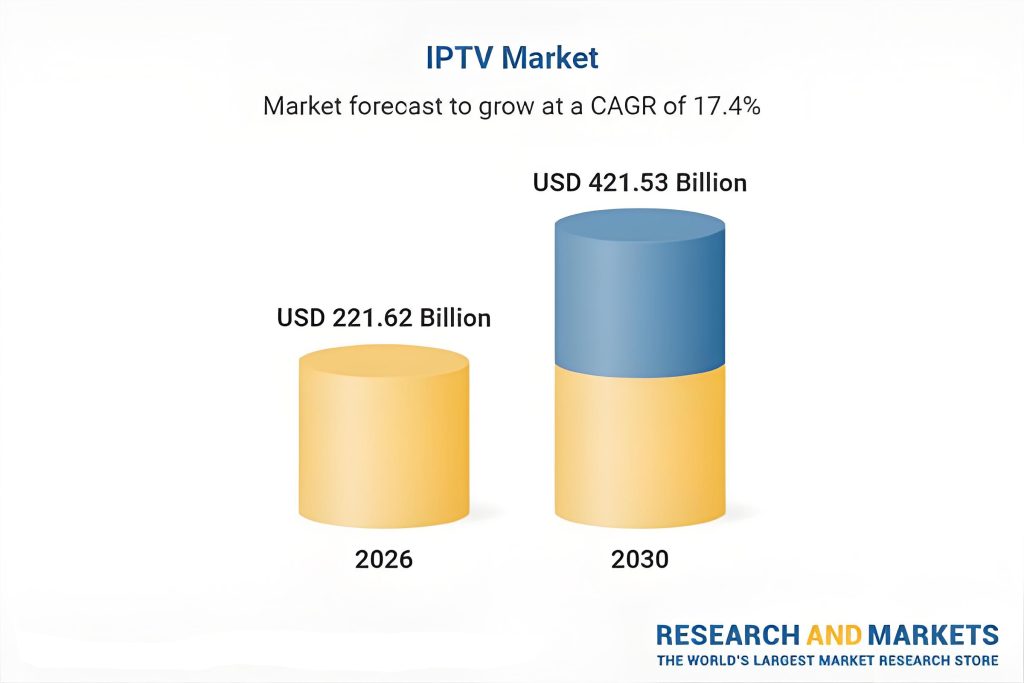
- Tendința pieței: Piața globală IPTV de la 189,25 miliarde USD (2025) până la 421,53 miliarde USD (2030), CAGR 17.4%
- Impact: Lățime de bandă mare, PCB-urile cu latență scăzută sunt esențiale
5.5 Sisteme digitale de semnal mixt de mare viteză
- Câmpuri: Imagistica medicală, inspecție industrială de înaltă frecvență, terminale de comunicații militare
- Cerinţă: Coexista 10+ Semnale digitale Gbps cu semnale RF în gama GHz
6. Clasificarea științifică (pentru IPC-2221)
| Dimensiunea de clasificare | Categorie | Bază |
|---|---|---|
| Sistem material | PCB dielectric mixt | RO4350B + FR-4 |
| Caracteristica de frecvență | RF / PCB pentru cuptorul cu microunde | Până la 30 GHz |
| Număr de straturi | 6placă cu mai multe straturi | 6 straturi conductoare |
| Dificultate tehnică | Laminare hibridă HDI | Potrivirea materialului fără expansiune |
| Aplicație | PCB de comunicație RF | Infrastructura de telecomunicații |
| Clasa de performanță IPC | Clasa IPC‑6012 3 | Echipamente de înaltă fiabilitate |
7. Materiale în detaliu
7.1 RO4350B laminat de înaltă frecvență
- Hidrocarbură armată cu sticlă + umplutură ceramică
- DK: 3.48±0,05@10GHz, coeficient de temperatură ~ -50 ppm/℃ (-50℃ până la +150℃)
- Df: 0.0037@10GHz
- CTE pe axa Z: 32 ppm/℃ – se potrivește cu cuprul pentru fiabilitatea PTH
- Conductivitate termică: 0.69 W/m·K (vs. FR-4 0,25–0,35)
- Ul 94 V-0 – potrivit pentru modele RF active și de mare putere
- Compatibilitate cu procese: Aceeași procesare FR-4; nu este nevoie de un pre-tratament special (spre deosebire de PTFE)
7.2 Laminat din sticlă epoxidică FR-4
- Țesătură din sticlă + rasina epoxidica
- DK: 4.2–4,8 (1MHz–1GHz), Df: 0.020–0,025
- Cost: 1/5 la 1/10 de RO4350B
7.3 RO4450™ Bondply de înaltă frecvență
- Strat de lipire între RO4350B și FR-4
- DK: 3.52±0,05@10GHz (tranziție de gradient)
- Df: 0.0040@10GHz
7.4 Finisaj de suprafață ENIG (Imersie de aur cu nichel electroless)
- Grosimea nichelului: 3-6μm (Clasa IPC-4552 2)
- Grosimea aurului: 0.05–0,10μm
- Avantaje: Sudabilitate, planeitatea, rezistenta la oxidare, ansamblu BGA cu pas fin
- Standard: IPC-4552
8. Specificații de performanță
8.1 Performanță electrică
| Parametru | Valoare | Metoda de testare |
|---|---|---|
| impedanta caracteristica (Straturi RF) | 50Ω ±5% (personalizabil) | IPC-2141A |
| DK (Straturi RF @10GHz) | 3.48± 0,05 | IPC‑TM‑650 2.5.5.5 |
| Pierderea de inserție | 0.31 dB/cm @40GHz | Microstrip line VNA |
| rigiditate dielectrică | ≥40 kV/mm | IPC‑TM‑650 2.5.6 |
| Rezistenta de izolare | >10Oh (stare normală) | IPC‑TM‑650 2.5.17 |
| Rezistenta la tensiune | 1000 VDC, 60nu e nicio defecțiune | IPC‑TM‑650 2.5.7 |
8.2 Performanță mecanică
| Parametru | Valoare | Metoda de testare |
|---|---|---|
| Toleranta la grosime | ±10% | IPC-6012 |
| Stabilitate dimensională | <0.3 mm/m | IPC‑TM‑650 2.2.4 |
| Coajă de rezistență (1oz cupru) | ≥1,0 N/mm | IPC‑TM‑650 2.4.8 |
| Rezistența la încovoiere | ≥350 MPa | IPC‑TM‑650 2.4.4 |
| Forța de tragere a plăcuței | ≥5,0 kg/cm² | IPC‑TM‑650 2.4.21 |
8.3 Performanta termica
| Parametru | Valoare | Metoda de testare |
|---|---|---|
| TG (zona FR-4) | ≥150℃ (TG150) | IPC‑TM‑650 2.4.25 |
| Stresul termic | 288℃, 10s × 5 cicluri | IPC‑TM‑650 2.4.13 |
| Ciclul termic | -55℃ ↔ 125℃, 1000 cicluri, Fără delaminare | IPC‑TM‑650 2.6.7 |
| Reflow fără plumb | 260℃, 5 cicluri | IPC/JEDEC J-STD-020 |
| Nivel de sensibilitate la umiditate | MSL 1 | IPC/JEDEC J-STD-020 |
8.4 Certificari de fiabilitate
- Clasa IPC‑6012 3 – echipamente de înaltă fiabilitate
- IPC-6018B – calificare pentru înaltă frecvență (cuptor cu microunde) PCB -uri
- Ul 94 V-0
- MIL-PRF-31032 – 1000 cicluri termice de la -55℃ la 125℃
100% test electric al sondei zburătoare + Aoi. Produsul final îndeplinește clasa IPC-A-600 3.
9. Caracteristici structurale
Construcție hibridă asimetrică cu 6 straturi:
- L1-L2 (RO4350B): Front-end RF (PA, Lna, filtre) – zona critică a integrității semnalului
- L3 (tranziţie): Potrivirea impedanței și schimbarea stratului de semnal – izolează RF de digitalul de mare viteză
- L4-L6 (FR-4): Gestionarea energiei, control digital, suport mecanic – circuite convenționale ieftine
Finisaj ENIG: Suprafața plană asigură un control constant al impedanței. Suporta BGA, Qfn, pachete cu pas fin. Stratul de aur protejează cuprul și garantează lipirea după depozitare îndelungată.
Găurire de precizie & PTH: Diametrul minim al orificiului mecanic 0,25 mm (Microvias HDI de până la 0,1 mm disponibile). Grosimea găurii de cupru ≥20μm (Clasa IPC 3). Tratament cu plasmă cu diferite amestecuri de gaze pentru straturi RO4350B și FR-4.
10. Fluxul procesului de fabricație
18 pași cheie:
① IQC → ② Imagini din stratul interior (RF și digital separat) → ③ Oxid maro → ④ Activare plasmă prelaminare → ⑤ Laminare hibridă → ⑥ Laminare la presiune înaltă (curba dinamică a presiunii) → ⑦ Forare țintă cu raze X → ⑧ Forare mecanică (0.25mm min) → ⑨ De frotiu cu plasmă (ciclu dublu) → ⑩ Cupru electroless → ⑪ Imagistica stratului exterior → ⑫ Placare cu model (cupru + staniu) → ⑬ Gravarea stratului exterior (bandă de tablă) → ⑭ AOI → ⑮ Mască de lipit → ⑯ ENIG → ⑰ Test electric → ⑱ Inspecție finală/ambalare
Detalii critice ale procesului:
- Plasmă de prelaminare (pas 4): CF₄-N₂-O₂ pentru FR-4; heliu (El) pentru RO4350B
- Curba de laminare (pas 6): Presiune dinamică – FR-4 se întărește mai întâi (~180℃), apoi presiunea și temperatura cresc la >200℃ pentru RO4350B
- Foraj (pas 8): Alimentarea în trepte și gestionarea duratei de viață a sculei gestionează diferența de duritate
- Defrânjează & PTH (pașii 9-10): Proces cu ciclu dublu datorită diferitelor comportamente chimice; gaura de cupru ≥20μm
11. Avantaje competitive
Echilibrul cost-performanță: Costurile materialelor cu 6 straturi All‑RO4350B >$200/m². Hybrid folosește doar RO4350B 25% de grosime →30-40% reducere a costurilor materialelor.
Fiabilitate: RO4350B CTE axa Z = 32 ppm/℃ se potrivește cu cupru (17 ppm/℃). FR-4 complet are 50-70 ppm/℃. Hibridul reduce stresul PTH. Treci 1000 cicluri de la -55℃ la 125℃ (IPC‑TM‑650 2.6.7).
Stabilitate dimensională: CTE scăzut reduce deformarea, îmbunătățește randamentul SMT.
| Direcţie | RO4350B CTE | FR‑4 CTE (tipic) |
|---|---|---|
| axa X | 10 ppm/℃ | 14 ppm/℃ |
| axa Y | 12 ppm/℃ | 16 ppm/℃ |
| axa Z | 32 ppm/℃ | 50-70 ppm/℃ |
Vs. PTFE complet (De ex., Rogers RT/DUROID):
| Caracteristică | RO4350B+FR-4 hibrid | PTFE complet |
|---|---|---|
| Compatibilitate cu procese | Linie standard FR-4 | Echipament special & tratament |
| Metalizarea PTH | Standard | Naftalină de sodiu sau plasmă |
| Stabilitate dimensională | Excelent (armat cu sticla) | Sărac, curge |
| Cost | 30-50% mai mic | Ridicat |
12. Rezumat & Ghid de anchetă
PCB hibrid de înaltă frecvență de comunicare cu 6 straturi UGPCB este interconectarea ideală pentru sistemele de semnal mixt RF/digital. Deservește stații de bază 5G, încărcături utile în bandă Ka prin satelit, 77radar auto GHz, și aplicații digitale de mare viteză. Prin plasarea RO4350B numai pe straturile RF critice, obținem performanțe optime la un cost semnificativ mai mic.
Recapitulare a datelor cheie:
✅ Nu știu = 3.48 ± 0.05 @10GHz (Oficial Rogers)
✅ Df = 0.0037 @10GHz
✅ CTE axa Z = 32 ppm/℃ (se potrivește cu cupru)
✅ Pierdere de inserție ≤ 0.31 dB/cm @40GHz (IPC‑6018B verificat)
✅30-40% reducere a costurilor materialelor vs. material de înaltă frecvență
✅ Abonamente 1000 cicluri termice -55℃ ↔ 125℃
Oferta de prototipare pe timp limitat
📩 Obțineți oferta dvs. personalizată și propunerea tehnică
UGPCB oferă a 7‑serviciu de turnare rapidă în zile lucrătoare pentru 4 până la 10 straturi PCB-uri hibride. Noi oferim analiză DFM gratuită.
👉 Trimiteți fișierele dvs. Gerber și designul de stivuire la e-mailul nostru de asistență tehnică. Vă vom răspunde cu o evaluare tehnică și o ofertă precisă 4 ore.
UGPCB – Producătorul tău de PCB hibrid de înaltă frecvență de încredere. De la prototip la producție în volum, oferim soluții dielectrice mixte cu 6 straturi pentru a vă accelera produsele radar cu unde milimetrice și 5G.
*Surse de date: Rogers Corporation RO4350B™ Fișă de date, Standardele IPC‑6012D/6018B, Metode de testare IPC‑TM‑650, GSMA 2026 perspectiva telecom, IMS 2025 Raport tehnic International Microwave Symposium.*