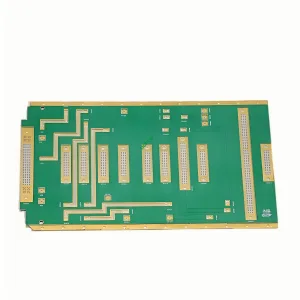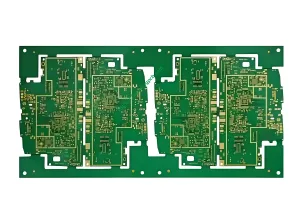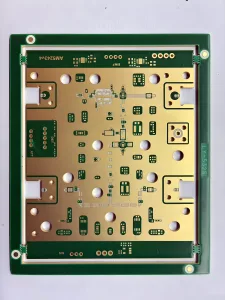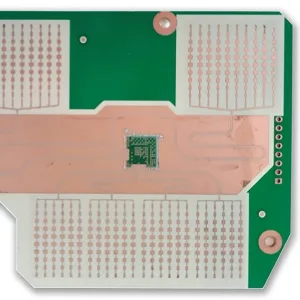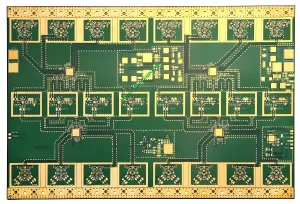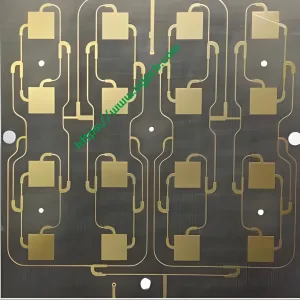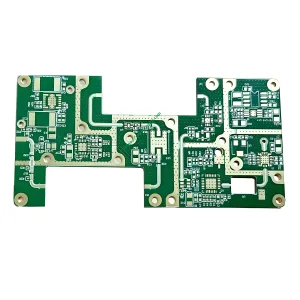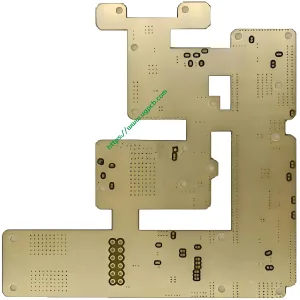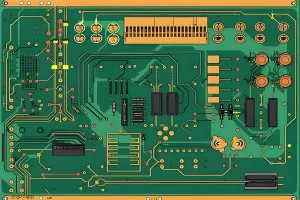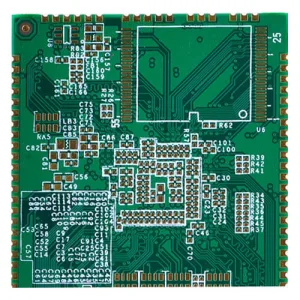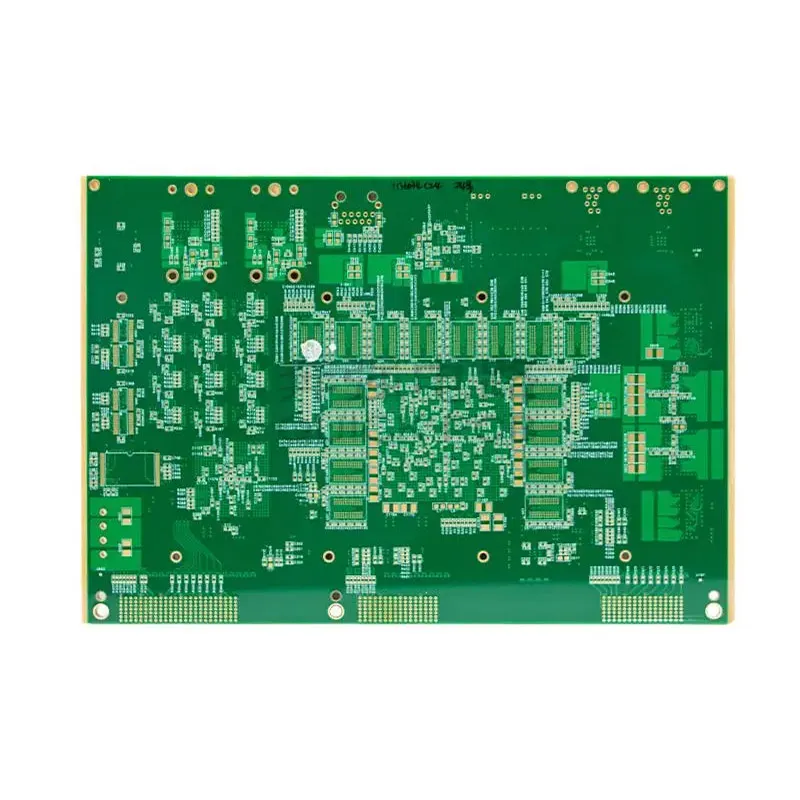
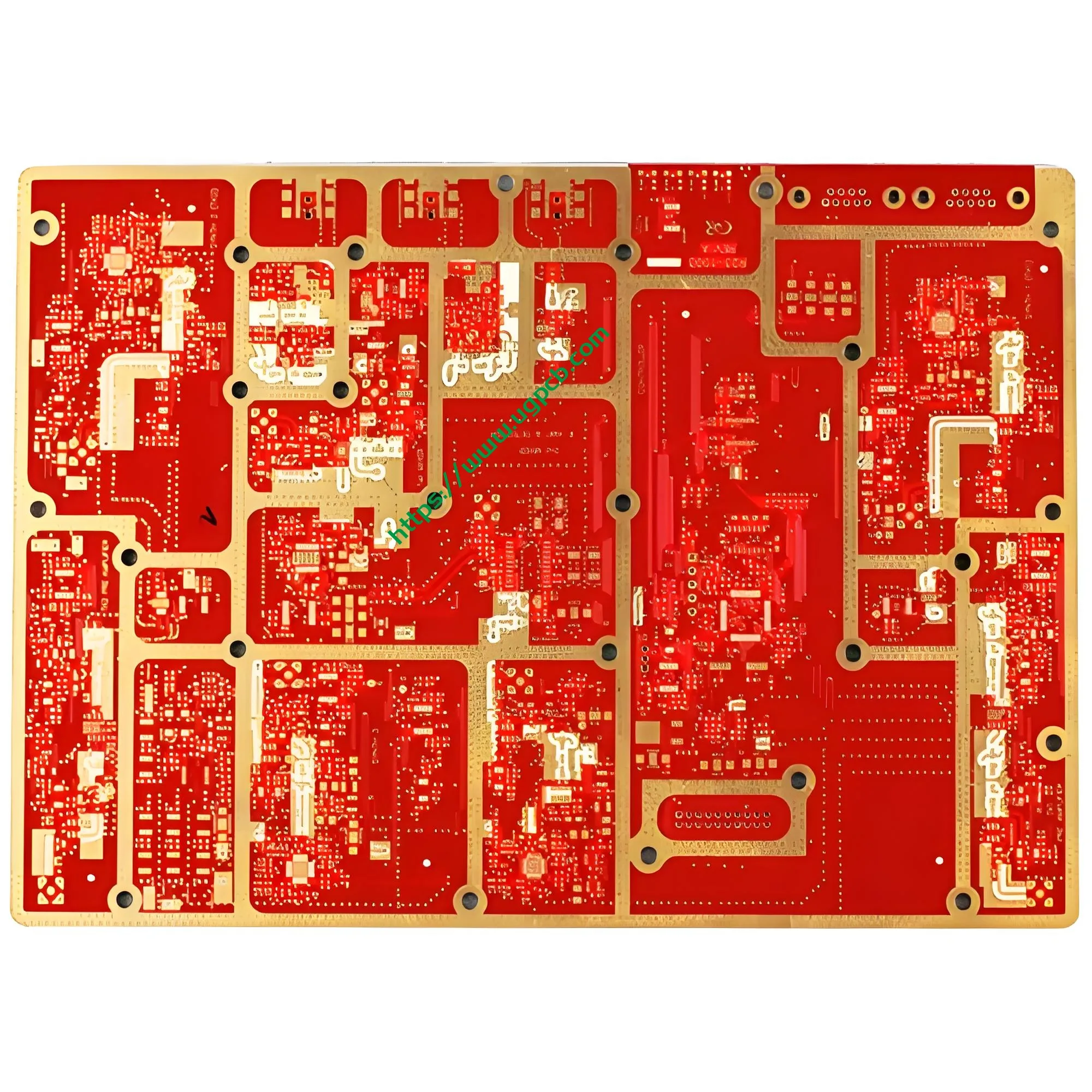
Wenn digitale und HF-Systeme über mehrere GHz hinausgehen, konventionell PCB -Materialien Es kommt zu Engpässen bei der Signalintegrität, Wärmestabilität, Und Impedanzkontrolle. Die Kommunikations-Hochfrequenz-Hybridplatine von UGPCB löst diese Herausforderungen.
1. Produktübersicht
Produktname: UGPCB 6-Layer-Kommunikations-Hochfrequenz-Hybridplatine
Modell: UG-HYBRID-6L-RF01
Schlüsselspezifikationen: 6 Schichten / Gemischtes Dielektrikum Ro4350B+FR4 / 1.6mm Plattenstärke / 210Größe: mm × 280 mm / ENIG-Oberflächenveredelung / minimales mechanisches Bohrloch 0,25 mm
Positionierung: Eine kostengünstige Verbindungslösung für HF-Frontends und digitale Hochgeschwindigkeits-Mischschaltungen. Durch die Platzierung des Hochfrequenzlaminats Rogers RO4350B auf den oberen HF-Signalschichten und FR-4 auf den unteren Strom-/Masse- und Low-Speed-Digitalebenen, Dieses Design gleicht die Signalintegrität aus, Wärmestabilität, und Herstellungskosten.
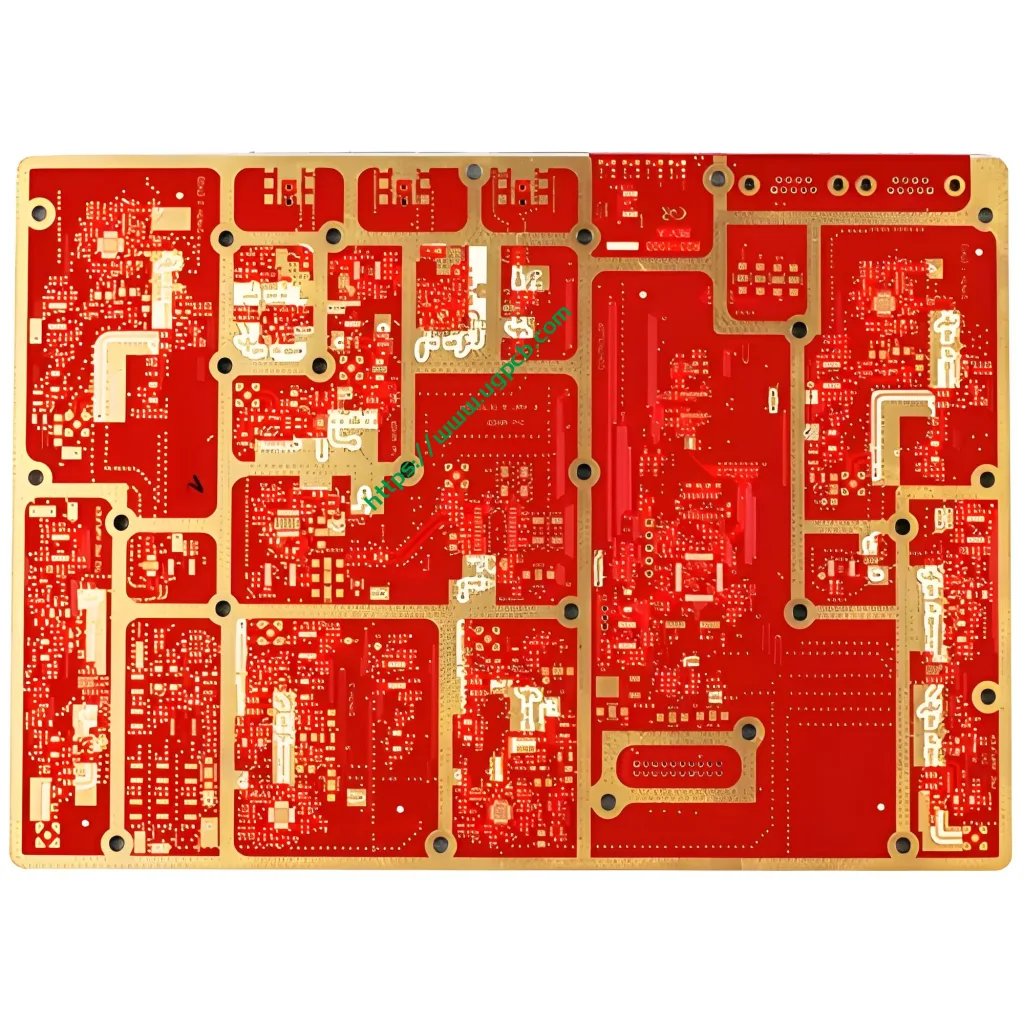
2. Definition – Was ist eine Hochfrequenz-Hybrid-Leiterplatte??
A Hochfrequenz-Hybrid-Leiterplatte (auch genannt Mehrschichtplatte mit gemischtem Dielektrikum) verwendet zwei oder mehr Materialien mit unterschiedlichen dielektrischen Eigenschaften in einem Multilayer Printed Circuit Board.
Diese 6-Lagen-Hybridplatine hat den folgenden Aufbau:
| Schicht | Funktion | Material | Schlüsselparameter |
|---|---|---|---|
| L1 | HF-Signal | RO4350B (0.2mm) | Dk=3,48 ± 0,05 bei 10 GHz, Df = 0,0037 |
| L2 | HF-Erde | RO4350B | Verlustarme Referenzebene |
| L3 | High-Speed-Digital | RO4450™ Bondply + FR-4 | Übergang, Impedanzanpassung |
| L4 | Motorflugzeug | FR-4 | Hoher Tg, niedrige Kosten |
| L5 | Digitales Signal | FR-4 | Standard-Epoxidglas |
| L6 | Digitaler Boden | FR-4 | Mechanische Unterstützung und Wärmeableitung |
„Die Konstruktion mit gemischten Dielektrika senkt die Kosten erheblich, da Hochfrequenzmaterial nur auf den Schichten verwendet wird, die HF-Signale übertragen, und FR-4 für den Rest.“
3. Entwurfsrichtlinien
3.1 Critical Material Parameters
Dieses Produkt verwendet Rogers RO4350B (ceramic‑filled hydrocarbon laminate) and FR‑4. Key RO4350B specifications (Quelle: Rogers data sheet):
| Parameter | Typischer Wert | Testbedingung | Referenz |
|---|---|---|---|
| Process Dk | 3.48± 0,05 | 10GHz | IPC-TM-650 2.5.5.5 |
| Design Dk | 3.66 | 10GHz | Copper roughness correction |
| Dissipationsfaktor (Df) | 0.0037 | 10GHz | Low‑loss RF applications |
| CTE der Z-Achse | 32 ppm/℃ | -55℃ to 288℃ | Matches copper (17 ppm/℃) |
| Wärmeleitfähigkeit | 0.69 W/m · k | 50℃, ASTM D5470 | Better than FR‑4 |
| Entflammbarkeit | UL 94 V-0 | UL-Standard | For active and high‑power RF |
Datenquelle: Rogers Corporation RO4350B™ Laminate Data Sheet
3.2 Impedanzkontrolle
Impedance control on a 6‑layer hybrid PCB is challenging because of the Dk discontinuity. Use a 3D electromagnetic solver and apply a copper roughness correction factor (typically 1.2–1.5). According to IPC‑2141A, characteristic impedance tolerance for RF PCBs should be within ±7%. UGPCB achieves ±5%.
3.3 Laminate Stackup Design (Total thickness 1.6mm)
- Spitze (L1-L2): RO4350B 0.2mm × 2 = 0.4mm
- Middle (L3): RO4450™ prepreg 0.1mm + FR‑4 core 0.6mm = 0.7mm
- Unten (L4-L6): FR-4-Kern + Prepreg = 0,5 mm
- Gesamt: 1.6mm
Verwenden Sie während der Laminierung eine dynamische Druckkurve, um die Belastung durch CTE-Fehlanpassungen zwischen RO4350B und FR-4 zu bewältigen.
4. Arbeitsprinzip
Signalintegrität: Der dielektrische Verlust dominiert den Hochfrequenzverlust. Die mittlere Dämpfungskonstante beträgt:
Wo:
- = dielektrische Dämpfungskonstante
- = Relative Permittivität (Designwert)
- = Freiraumwellenlänge
- = Verlustfaktor (Df)
RO4350B hat Df = 0.0037 vs. FR‑4’s 0.020. Das reduziert den dielektrischen Verlust um etwa 80%, Gewährleistung einer verlustarmen Übertragung bis 30 GHz.
Thermisch-mechanische Stabilität: Der CTE der Z-Achse des RO4350B beträgt 32 ppm/℃ entspricht Kupfer (17 ppm/℃) weitaus besser als FR-4 (50–70 ppm/℃). Dies verbessert die Durchkontaktierung von Löchern (PTH) Zuverlässigkeit bei Temperaturwechsel. Getestet gemäß IPC-TM-650 2.6.7, Die Tafel ist erhalten geblieben 1000 Zyklen von -55℃ bis 125℃ ohne Delamination.
5. Primäranwendungen
Die 6-lagige Kommunikations-Hochfrequenz-Hybridplatine von UGPCB bedient fünf Hauptbereiche:
5.1 5G-Kommunikationsbasisstationen (AAU/RRU)
- Frequenzbänder: 28GHz- und 39-GHz-Millimeterwelle
- Erfordernis: Einfügedämpfung < 0.31 dB/cm bei 40 GHz, Belastbarkeit >200 W/m² bei 38 GHz
- Vorteil: Hybridbauweise senkt die Materialkosten um 30–40 % gegenüber. reines Hochfrequenzmaterial

5.2 77GHz/79GHz-Automobilradar
- Anwendungsfälle: Autonom fahrendes 4D-Bildgebungsradar, Erkennung des toten Winkels, adaptive Geschwindigkeitsregelung
- Erfordernis: Bereichsfehler <0.25m von -40℃ bis 125℃, Azimutauflösung 0,08°
- Leistung: IMS 2025 Der Bericht zeigt eine Phasenkonsistenz von ±0,8° über den gesamten Temperaturbereich für 77-GHz-Hybridradarmodule
5.3 Nutzlasten der Satellitenkommunikation (Teamkollegen)
- Frequenzbereich: 17.7 - - 31 GHz
- Vorteil: 45% Gewichtsreduktion vs. Keramiksubstrate bei gleichzeitiger Beibehaltung eines Wirkungsgrades von >85 %
5.4 Fiber-to-the-Home (FTTH) Ausrüstung
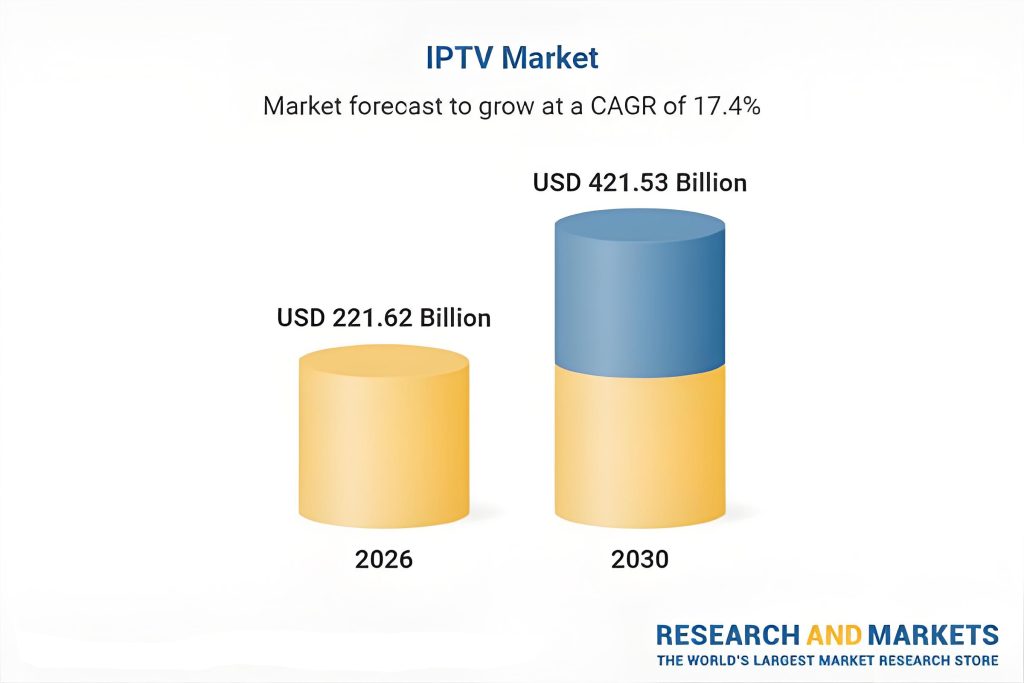
- Markttrend: Globaler IPTV-Markt ab 189,25 Milliarden US-Dollar (2025) auf 421,53 Milliarden US-Dollar (2030), CAGR 17.4%
- Auswirkungen: Hohe Bandbreite, Leiterplatten mit geringer Latenz sind unerlässlich
5.5 Digitale Hochgeschwindigkeits-Mixed-Signal-Systeme
- Felder: Medizinische Bildgebung, Industrielle Hochfrequenzprüfung, militärische Kommunikationsterminals
- Erfordernis: Koexistieren 10+ Digitale Gbit/s-Signale mit HF-Signalen im GHz-Bereich
6. Wissenschaftliche Klassifikation (für IPC‑2221)
| Klassifizierungsdimension | Kategorie | Basis |
|---|---|---|
| Materialsystem | Gemischte dielektrische Leiterplatte | RO4350B + FR-4 |
| Frequenzcharakteristik | Rf / Mikrowellen-PCB | Bis zu 30 GHz |
| Anzahl der Ebenen | 6‑Lagen-Mehrschichtplatine | 6 leitfähige Schichten |
| Technische Schwierigkeit | HDI-Hybrid-Laminierung | Passende Nicht-Expansionsmaterialien |
| Anwendung | Kommunikations-HF-Leiterplatte | Telekommunikationsinfrastruktur |
| IPC-Leistungsklasse | IPC-6012-Klasse 3 | Hochzuverlässige Ausrüstung |
7. Materialien im Detail
7.1 RO4350B Hochfrequenzlaminat
- Glasfaserverstärkter Kohlenwasserstoff + Keramikfüller
- Dk: 3.48±0,05 bei 10 GHz, Temperaturkoeffizient ~ -50 ppm/℃ (-50℃ bis +150℃)
- Df: 0.0037@10ghz
- CTE der Z-Achse: 32 ppm/℃ – matches copper for PTH reliability
- Wärmeleitfähigkeit: 0.69 W/m · k (vs. FR‑4 0.25–0.35)
- UL 94 V-0 – suitable for active and high‑power RF designs
- Prozesskompatibilität: Same FR‑4 processing; no special pre‑treatment needed (unlike PTFE)
7.2 FR‑4 Epoxy Glass Laminate
- Woven glass fabric + Epoxidharz
- Dk: 4.2–4,8 (1MHz–1GHz), Df: 0.020–0,025
- Kosten: 1/5 Zu 1/10 of RO4350B
7.3 RO4450™ High‑Frequency Bondply
- Bonding layer between RO4350B and FR‑4
- Dk: 3.52±0,05 bei 10 GHz (gradient transition)
- Df: 0.0040@10ghz
7.4 ENIG-Oberflächenfinish (Elektrololes Nickel -Eintauchgold)
- Nickeldicke: 3–6μm (IPC‑4552 Class 2)
- Goldstärke: 0.05–0.10μm
- Vorteile: Lötbarkeit, Ebenheit, Oxidationsbeständigkeit, fine‑pitch BGA assembly
- Standard: IPC-4552
8. Leistungsspezifikationen
8.1 Elektrische Leistung
| Parameter | Wert | Testmethode |
|---|---|---|
| Charakteristische Impedanz (RF layers) | 50Ω ±5% (anpassbar) | IPC-2141A |
| Dk (RF layers @10GHz) | 3.48± 0,05 | IPC-TM-650 2.5.5.5 |
| Einfügedämpfung | 0.31 dB/cm bei 40 GHz | Microstrip line VNA |
| Dielectric strength | ≥40 kV/mm | IPC-TM-650 2.5.6 |
| Isolationsresistenz | >10⁹ Ω (normaler Zustand) | IPC-TM-650 2.5.17 |
| Withstanding voltage | 1000 VDC, 60s no breakdown | IPC-TM-650 2.5.7 |
8.2 Mechanische Leistung
| Parameter | Wert | Testmethode |
|---|---|---|
| Dicke Toleranz | ± 10% | IPC-6012 |
| Dimensionsstabilität | <0.3 mm/m | IPC-TM-650 2.2.4 |
| Schälfestigkeit (1Oz Kupfer) | ≥1,0 N/mm | IPC-TM-650 2.4.8 |
| Flexural strength | ≥350 MPa | IPC-TM-650 2.4.4 |
| Pad pull‑off force | ≥5.0 kg/cm² | IPC-TM-650 2.4.21 |
8.3 Wärmeleistung
| Parameter | Wert | Testmethode |
|---|---|---|
| Tg (FR‑4 area) | ≥150℃ (TG150) | IPC-TM-650 2.4.25 |
| Thermische Belastung | 288℃, 10s × 5 Zyklen | IPC-TM-650 2.4.13 |
| Thermalradfahren | -55℃ ↔ 125℃, 1000 Zyklen, Keine Delaminierung | IPC-TM-650 2.6.7 |
| Bleifreies Reflow | 260℃, 5 Zyklen | IPC/JEDEC J-STD-020 |
| Feuchtigkeitsempfindlichkeitsstufe | MSL 1 | IPC/JEDEC J-STD-020 |
8.4 Zuverlässigkeitszertifizierungen
- IPC-6012-Klasse 3 – Hochzuverlässige Ausrüstung
- IPC-6018B – Qualifikation für Hochfrequenz (Mikrowelle) Leiterplatten
- UL 94 V-0
- MIL-PRF-31032 - - 1000 Temperaturzyklen von -55℃ bis 125℃
100% Elektrischer Flying-Probe-Test + AOI. Das Endprodukt entspricht der IPC-A-600-Klasse 3.
9. Strukturelle Merkmale
Asymmetrischer 6-Lagen-Hybridaufbau:
- L1-L2 (RO4350B): HF-Frontend (PA, Lna, Filter) – Kritische Signalintegritätszone
- L3 (Übergang): Impedanzanpassung und Signalschichtwechsel – isoliert HF vom Hochgeschwindigkeits-Digitalsignal
- L4-L6 (FR-4): Energieverwaltung, digitale Steuerung, mechanische Unterstützung – kostengünstige konventionelle Schaltungen
ENIG-Abschluss: Die flache Oberfläche sorgt für eine gleichmäßige Impedanzkontrolle. Unterstützt BGA, QFN, Fine-Pitch-Pakete. Die Goldschicht schützt das Kupfer und garantiert die Lötbarkeit nach längerer Lagerung.
Präzisionsbohren & PTH: Minimaler mechanischer Lochdurchmesser 0,25 mm (HDI-Mikrovias bis zu 0,1 mm verfügbar). Lochkupferdicke ≥20μm (IPC-Klasse 3). Plasmabehandlung mit verschiedenen Gasmischungen für RO4350B- und FR-4-Schichten.
10. Ablauf des Herstellungsprozesses
18 Schlüsselschritte:
① IQC → ② Bildgebung der inneren Schicht (RF und digital getrennt) → ③ Braunes Oxid → ④ Plasmaaktivierung vor der Laminierung → ⑤ Hybrid-Layup → ⑥ Hochdrucklaminierung (dynamische Druckkurve) → ⑦ Röntgenzielbohren → ⑧ Mechanisches Bohren (0.25mm min) → ⑨ Plasmadesmear (Doppelzyklus) → ⑩ Chemisches Kupfer → ⑪ Bildgebung der äußeren Schicht → ⑫ Musterbeschichtung (Kupfer + Zinn) → ⑬ Ätzen der äußeren Schicht (Zinnstreifen) → ⑭ AOI → ⑮ Lötmaske → ⑯ ENIG → ⑰ Elektrischer Test → ⑱ Endkontrolle/Verpackung
Kritische Prozessdetails:
- Vorlaminierungsplasma (Schritt 4): CF₄-N₂-O₂ für FR-4; Helium (Er) für RO4350B
- Laminierungskurve (Schritt 6): Staudruck – FR-4 härtet zuerst aus (~180℃), Dann steigen Druck und Temperatur bei RO4350B auf >200℃
- Bohren (Schritt 8): Stufenvorschub und Werkzeugstandzeitmanagement berücksichtigen Härteunterschiede
- Desmear & PTH (Schritte 9–10): Zweitaktprozess aufgrund unterschiedlichen chemischen Verhaltens; Lochkupfer ≥20μm
11. Wettbewerbsvorteile
Kosten-Leistungs-Verhältnis: All-RO4350B 6-Lagen-Materialkosten >$200/m². Hybrid verwendet nur RO4350B 25% der Dicke →30‑40 % Materialkostenreduzierung.
Zuverlässigkeit: RO4350B Z-Achse CTE = 32 ppm/℃ entspricht Kupfer (17 ppm/℃). Full FR‑4 has 50‑70 ppm/℃. Hybrid reduces PTH stress. Passes 1000 cycles -55℃ to 125℃ (IPC-TM-650 2.6.7).
Dimensionsstabilität: Low CTE reduces warpage, improves SMT yield.
| Direction | RO4350B CTE | FR‑4 CTE (typisch) |
|---|---|---|
| X-Achse | 10 ppm/℃ | 14 ppm/℃ |
| Y-Achse | 12 ppm/℃ | 16 ppm/℃ |
| Z‑axis | 32 ppm/℃ | 50‑70 ppm/℃ |
Vs. full PTFE (z.B., Rogers RT/duroid):
| Besonderheit | RO4350B+FR‑4 hybrid | Full PTFE |
|---|---|---|
| Prozesskompatibilität | Standard FR‑4 line | Special equipment & Behandlung |
| PTH-Metallisierung | Standard | Sodium naphthalene or plasma |
| Dimensionsstabilität | Exzellent (glass reinforced) | Arm, flows |
| Kosten | 30‑50% lower | Hoch |
12. Zusammenfassung & Anfrageleitfaden
UGPCB’s 6‑layer communication high frequency hybrid PCB is the ideal interconnect for RF/digital mixed signal systems. It serves 5G base stations, satellite Ka‑band payloads, 77GHz-Automobilradar, and high‑speed digital applications. By placing RO4350B only on the critical RF layers, we achieve optimal performance at a significantly lower cost.
Key data recap:
✅ Dk = 3.48 ± 0.05 @10ghz (Rogers-Beamter)
✅ Df = 0.0037 @10ghz
✅ CTE der Z-Achse = 32 ppm/℃ (passt zu Kupfer)
✅ Einfügedämpfung ≤ 0.31 dB/cm bei 40 GHz (IPC-6018B verifiziert)
✅30‑40 % Materialkostenreduzierung vs. reines Hochfrequenzmaterial
✅ Pässe 1000 Temperaturzyklen -55↔ 125℃
Zeitlich begrenztes Prototyping-Angebot
📩 Holen Sie sich Ihr individuelles Angebot und Ihren technischen Vorschlag
UGPCB bietet a 7Schnellservice an Werktagen für 4- bis 10-lagig Hybrid-Leiterplatten. Wir bieten kostenlose DFM-Analyse.
👉 Senden Sie Ihre Gerber-Dateien und Ihr Stackup-Design per E-Mail an unseren technischen Support. Wir werden Ihnen umgehend mit einer technischen Bewertung und einem genauen Kostenvoranschlag antworten 4 Std..
UGPCB – Ihr vertrauenswürdiger Hersteller von Hybrid-Hochfrequenz-Leiterplatten. Vom Prototyp bis zur Serienproduktion, Wir liefern 6-lagige gemischte dielektrische Lösungen aus einer Hand, um Ihre 5G- und Millimeterwellenradarprodukte zu beschleunigen.
*Datenquellen: Rogers Corporation RO4350B™ Datenblatt, IPC-6012D/6018B-Standards, IPC-TM-650-Testmethoden, GSMA 2026 Aussichten für die Telekommunikation, IMS 2025 Technischer Bericht des International Microwave Symposium.*