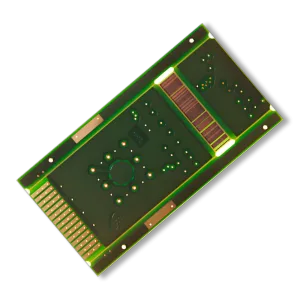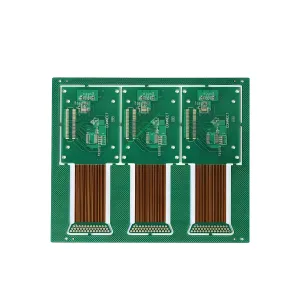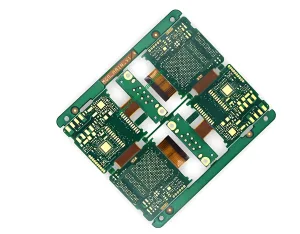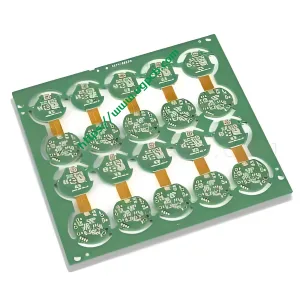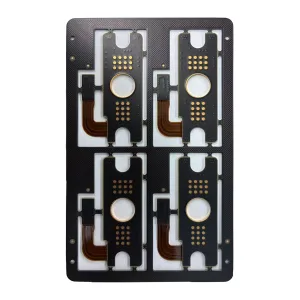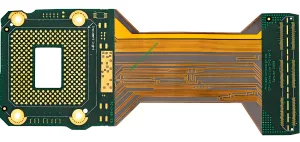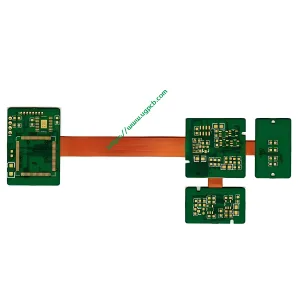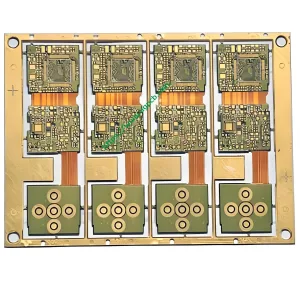
1. Présentation du produit: Technology Trends in Rigid-Flex PCBs
Le PCB rigide-flexible combines rigid board strength with flexible circuit adaptability. Market data shows the global rigid-flex PCB market reached RMB 19.061 milliards dans 2026. It will reach RMB 27.545 milliards 2033, grandir à un 5.40% TCAC. This growth comes from aerospace, dispositifs médicaux, électronique automobile, et électronique grand public. These sectors need high-density interconnect (IDH) and 3D space optimization.
UGPCB leverages over ten years of manufacturing experience. We follow IPC-6013E for flexible and rigid-flex board qualification. Our 1L+1L rigid-flex PCB uses an FR4+PI composite core. It supports prototype to mass production. This product leads in dynamic bend life, fine-line processing, and plated through-hole (PTH) métallisation. It is an ideal interconnect carrier for high-performance electronic devices.
2. Definition and Classification of Rigid-Flex PCBs
2.1 Définition
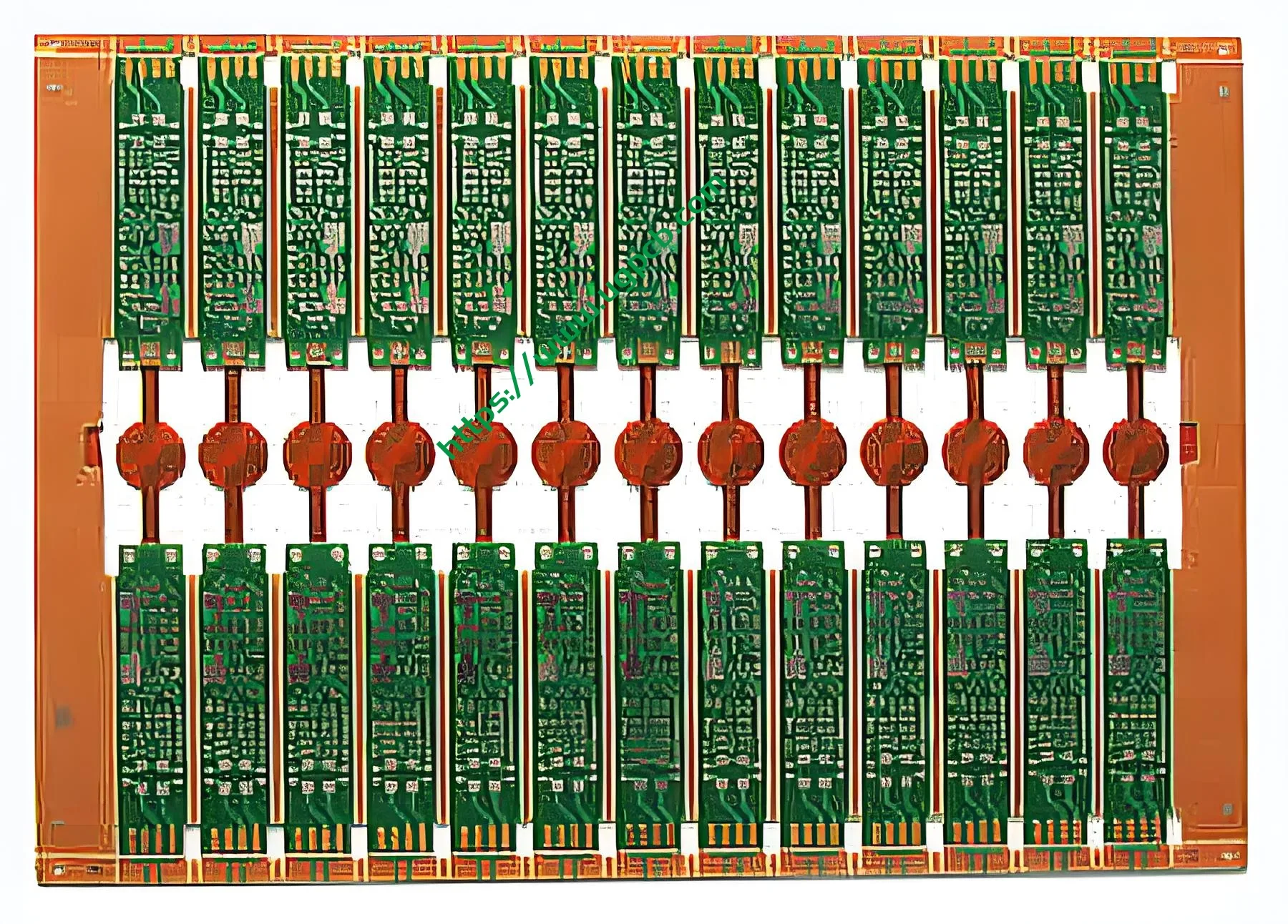
UN PCB rigide-flexible integrates rigid and flexible substrates through lamination. The rigid area (FR4) supports high-density composant placement. The flexible area (PI) enables 3D folding and dynamic bending. It replaces traditional board-to-board connectors and wiring harnesses. Selon IPC-2223, rigid-flex multilayer boards can include plated through-holes, Microvias, et vias aveugles/enterrés. They can form IDH couches.
2.2 Classement scientifique
Based on bending characteristics, rigid-flex PCBs fall into two categories:
| Taper | Fonctionnalité | Application typique |
|---|---|---|
| Flex-to-install (courbure statique) | One-time or limited bending during assembly or maintenance; fixed after bending | Single-use medical endoscope, aerospace harness integration |
| Dynamic flex type | Continuous cyclic bending during device operation; high-cycle fatigue resistance | Foldable phone hinge, printer printhead, wearable device |
UGPCB’s 1L+1L rigid-flex PCB belongs to the dynamic flex type. Its flexible area uses precision lamination and stress optimization. It withstands over 100,000 virages dynamiques (meeting IPC-6013D Class 3). This ensures long-term reliability for demanding applications like consumer and automotive electronics.
3. Principe de fonctionnement: Interconnection Mechanisms
Two key mechanisms enable rigid-flex PCB operation: stress relief at the rigid-flex interface and electrical interconnection through plated holes.
3.1 Stress Relief at the Rigid-Flex Transition Zone
FR4 and PI have different coefficients of thermal expansion (CTE) and elastic moduli. FR4’s CTE is 14–17 ppm/°C (X-Y direction). PI’s CTE is 12–16 ppm/°C. Under thermal cycling, they generate different thermal stresses. UGPCB uses stepped openings and low-flow prepreg. This gradually thins the rigid layer in the transition area. It spreads peak stress over a larger zone, avoiding single-interface stress concentration.
3.2 Mechanical Design Rules for Bend Area
IPC-2223 states that the minimum bend radius for dynamic applications must follow:
R ≥ 6T
where R = minimum bend radius, T = total thickness of flexible area. For dynamic use, set R to 6–10 times T. When R reaches 100T, dynamic bend life can exceed 1 millions de cycles. This satisfies foldable phone requirements.
3.3 Electrical Interconnection via Plated Holes
Plaqué à travers les trous (PTH) and microvias provide layer-to-layer connections. Copper electroplating grows uniformly on hole walls, creating low-impedance paths. IPC-TM-650 2.1 requires resistance between vias ≤ 0.5Ω. Minimum insulation resistance ≥ 100MΩ. Dielectric strength must pass 1500VAC testing.
4. Technical Parameters and Performance Specifications
4.1 Paramètres clés
| Paramètre | Spécification | Standard |
|---|---|---|
| Modèle | PCB rigide-flexible, 1L rigide + 1L flexible | IPC-6013E |
| Matériau de base | FR4 (rigide) + PI polyimide (fléchir) | CIB-4101 / IPC-4204 |
| Empilement des couches | 1 rigid layer + 1 flexible layer | - |
| Épaisseur finie | 1.6mm | Classe IPC-6012 3 |
| Épaisseur de la feuille de cuivre | 2once (~70μm) | CIB-4562 |
| Finition de surface | ACCEPTER, 2μ-inch gold (~0.05μm) | CIB-4552 / Classe IPC-6012 3 |
| Diamètre minimum du trou | 0.2mm | CIB-2223 |
| Largeur/espace de ligne minimum | 3mil/3mil (~76μm) | IPC-2223 Class 3 |
| Processus spécial | Bouchage de résine + copper cap plating | IPC-4761 Type VI |
*Source de données: IPC-6013E, CIB-4562, CIB-4552. The 2μ-inch gold thickness meets IPC-4552 Class 2/3 ENIG recommendations.*
4.2 Performance Advantages of FR4+PI Composite
FR4 (rigide) properties per IPC-4101:
-
Constante diélectrique (Ne sait pas): 4.2–4,8 (1MHz)
-
Facteur de dissipation (Df): 0.015–0,025
-
Température de transition vitreuse (Tg): 130–140°C (standard FR4); high-Tg type >170° C
-
Conductivité thermique: 0.25–0.35 W/m·K
-
Indice d'inflammabilité: UL94V-0
PI (flexible) properties per IPC-4204:
-
Ne sait pas: 3.2–3.6 (1MHz)
-
Df: 0.002–0.005
-
Tg: ≥260°C
-
Elongation at break: ≥50%
-
Short-term temperature resistance: >300° C
PI performs much better at high temperatures than FR4. FR4’s Tg is ~120°C, and even high-performance FR4 reaches only 180–190°C. PI’s Tg exceeds 260°C. PI also offers good flexibility, copper peel strength, résistance chimique, and dimensional stability in high-temperature uses. Cependant, PI absorbs more moisture (à propos 1.6%) than FR4. Control humidity during lamination and storage.
4.3 2OZ Thick Copper for High Current Capacity
2Cuivre OZ (≈70μm) carries about twice the current of 1OZ (≈35μm). Pour IPC-2221, a 1mm wide trace with 2OZ copper handles 5–6A at 10°C temperature rise. This suits power management modules and power electronics. UGPCB uses rolled annealed copper. It provides excellent bend fatigue life in the flexible area, dépassement 100,000 dynamic cycles.
4.4 Finition de surface ENIG
ACCEPTER (Or par immersion au nickel autocatalytique) has a 2μ-inch gold thickness (~0.05μm). Les avantages incluent:
-
Excellente soudabilité: Gold protects nickel from oxidation, ensuring reliable SMT soldering.
-
High flatness: Suitable for fine-pitch BGA and QFP packages.
-
Strong corrosion resistance: Gold is chemically inert, preventing oxidation during long-term storage.
-
Compliant with IPC-4552: Nickel thickness ≥3μm, gold thickness 0.05–0.1μm.
[Image: Micrograph of ENIG surface showing uniform gold layer over nickel]
ALT tag: ENIG surface finish cross-section with 2μ-inch gold layer on nickel for rigid-flex PCB
5. Precision Circuit Processing: 3mil/3mil Line and 0.2mm Microvia
5.1 3mil/3mil Line Width/Space Capability
Our product achieves 3mil (≈76μm) minimum line width and space. This falls under HDI. IPC-6013E Class 3 for high reliability requires a minimum tolerance of 50μm (~2mil). Our 3mil/3mil accuracy fully meets high-reliability rigid-flex PCB manufacturing requirements.
UGPCB uses these technologies:
-
Imagerie directe laser (ILD): Imaging accuracy ±15μm, eliminating film expansion/shrinkage errors.
-
Precision etching control: Etching factor ≥3.0, line width tolerance ≤±15%.
-
Zone d'intérêt 100% inspection: Automated optical inspection covers >99.9% of the panel.
5.2 0.2mm Microvia Drilling
Minimum hole diameter is 0.2mm (~8mil). This meets HDI rigid-flex board needs. Nous utilisons CNC mechanical drilling or a CO₂/UV laser combination to handle various hole sizes.
6. Processus spécial: Bouchage de résine + Copper Cap Plating
6.1 Aperçu du processus
We use the “resin plugging + copper cap plating” combination. This is IPC-4761 Type VI: Filled and Capped. D'abord, fill the via with resin and cure it. Then plate copper over the surface. This creates a completely flat via surface. It is widely used in HDI and planches à flex rigide.
6.2 Process Steps
-
Forage – Drill target-diameter vias in copper-clad laminate.
-
Cuivre chimique + panel plating – Deposit thin copper on hole walls, then thicken by panel plating.
-
Bouchage de résine – Use vacuum plugging equipment to fill vias with low-shrinkage resin.
-
Guérison – Bake at 150–170°C to fully harden the resin.
-
Grinding – Remove excess resin from board surface to make vias flush with the surface.
-
Copper cap plating – Electroplate a copper layer over the ground resin surface to ensure solderability and conductivity.
6.3 Advantages and Value
Compared to solder mask plugging or ink plugging, this process offers:
-
Excellente planéité: Height tolerance after grinding ≤ ±20μm, suitable for BGA and fine-pitch components.
-
Haute fiabilité: Resin filling plus copper cap prevents “popcorning” ou “blow holes” during soldering.
-
Increased routing density: You can route traces over plugged vias, greatly improving HDI board utilization.
-
Strong thermal stress resistance: Cured resin CTE (25–40 ppm/°C) matches FR4, reducing cracking under thermal cycles.
7. Processus de fabrication: UGPCB’s Full Quality Control
UGPCB monitors every step of 1L+1L rigid-flex PCB production. All processes comply with Normes IPC.
-
IQC incoming inspection – FR4 per IPC-4101; PI flex copper-clad laminate per IPC-4204; copper foil per IPC-4562.
-
Circuit de couche interne – Flexible layer pattern transfer → etching → AOI.
-
Laminage – Press FR4 and PI layers with low-flow prepreg at high temperature and pressure.
-
Forage – CNC mechanical drilling (0.2mm min.) + perçage au laser (facultatif).
-
Métallisation PTH – Electroless copper + panel plating. Hole wall copper meets IPC-6012 Class 3.
-
Bouchage de résine + copper cap plating – Per IPC-4761 Type VI.
-
Outer layer circuit – LDI → pattern plating → etching → AOI 100%.
-
Finition superficielle - ACCEPTER, 2μ-inch gold, pour IPC-4552.
-
Profilage – Precision die punching or CNC routing. Flexible area contour tolerance ±50μm.
-
Test électrique - Sonde volante or universal grid fixture. 100% continuity test.
-
Reliability tests – Bend cycle (IPC-TM-650 2.4.3), thermal cycle (–55°C to 125°C, 1000 cycles), high temperature/humidity (85°C/85% HR, 1000 heures).
-
FQC final inspection + packaging and shipping.
8. Quality and Reliability Verification Based on IPC Standards
8.1 IPC-6013 Performance Classes
IPC-6013 defines three classes for rigid-flex boards:
| Classe | Application | Tolérance aux défauts | UGPCB Suitability |
|---|---|---|---|
| Classe 1 – General electronic | Électronique grand public, IdO, jouets | Cosmetic defects allowed | Basic option |
| Classe 2 – Dedicated service | Contrôle industriel, automobile, télécom | Moderate defect control | Standard option |
| Classe 3 – High reliability | Aérospatial, médical, militaire | Défaut proche de zéro, traçabilité complète | Our product meets this |
UGPCB’s 1L+1L rigid-flex PCB satisfies all performance requirements of IPC-6013D/E Class 3.
8.2 Bend Life Test (IPC-TM-650 2.4.3)
This test uses a 0.5mm radius bending fixture. It performs 180° reciprocating bends at 30–60 cycles per minute. UGPCB’s flexible area survives >100,000 dynamic bends with no circuit damage. This meets IPC-6013D Class 3 for high-reliability dynamic applications. The industry’s best designs can exceed 1 million cycles when the bend radius increases to 100T.
8.3 Thermal Cycle Test
Per IPC-TM-650 2.6.7.2, samples undergo 1000 cycles from –55°C to 125°C. Each cycle has a 15-minute dwell time. Transfer time does not exceed 5 minutes. Après test, cross-section analysis shows no cracks in the hole wall copper and no resin delamination. This confirms the thermomechanical reliability of the FR4-PI lamination interface.
8.4 High Temperature/Humidity Bias Test (85°C/85% HR)
Per IPC-TM-650 2.6.3.3, samples sit at 85°C and 85% relative humidity with bias for 1000 heures. The insulation resistance changes by less than one order of magnitude. No significant conductive anodic filament (FAC) formation occurs. This verifies the long-term electrical stability of FR4 and PI in humid environments.
9. Scénarios d'application et cas d'utilisation
9.1 Aérospatial
Rigid-flex PCBs are ideal for aerospace electronics because they save weight and space and resist high vibration. Utilisations typiques: satellite deployable antennas, onboard flight computers, systèmes de guidage des missiles. IPC-6013DS aerospace-grade standards demand strict material traceability and reliability.
9.2 Dispositifs médicaux
In endoscopes, dispositifs implantables, and wearable health monitors, rigid-flex PCBs combine signal transmission with mechanical movement thanks to >10,000 dynamic bend cycles and high-density integration.
9.3 Electronique grand public
Smartphones pliables, AR/VR glasses, laptop hinge connections – rigid-flex PCBs can achieve bend radii as low as 1mm, enabling ultra-thin foldable designs. Foldable phone hinges typically use 1L or 2L rigid-flex boards requiring 100,000–200,000 dynamic bend cycles. Our product fully meets this requirement.
9.4 Électronique automobile
Advanced driver-assistance systems (Adas), modules de caméra automobile, millimeter-wave radar sensors – rigid-flex PCBs withstand –40°C to +150°C extremes and meet AEC-Q200 automotive grade. They support high-frequency applications like 77GHz radar.
9.5 Contrôle industriel
Robot joint controllers, industrial camera flexible connections, servo drives – rigid-flex PCBs replace traditional wiring harnesses and connectors. This reduces system BOM cost by 45% while improving mechanical reliability.

10. Why Choose UGPCB’s Rigid-Flex PCB?
10.1 Résumé des avantages techniques
-
✅ FR4+PI composite – balances cost and performance for rigid-flex needs.
-
✅ 2OZ thick copper – high current capacity for power circuits.
-
✅ 3mil/3mil precision lines – high-density routing for complex circuits.
-
✅ 0.2mm microvias + resin plugging + copper cap – flat via surface supports BGA assembly.
-
✅ >100,000 dynamic bend life (Classe IPC-6013D 3).
-
✅ ENIG finish (2μ-inch gold) – excellent solderability and storage life.
-
✅ IPC-6013E Class 3 compliance – aerospace, médical, military-grade reliability.
-
✅ 1.6mm finished thickness – standard thickness compatible with mainstream SMT lines.
10.2 Full-Process Service Commitment
UGPCB provides end-to-end support: Gerber review → DFM analysis → prototyping → mass production → PCBA one-stop service. We promise:
-
Prototypage rapide: 1L+1L rigid-flex PCB samples in 5–7 working days.
-
100% tests électriques: Every product undergoes flying probe or fixture testing before shipment.
-
Complete shipment reports: Includes cross-section analysis, bend life test report, thermal cycle test report, impedance test report, and UL certificate.
11. Get a Quote and Technical Support
UGPCB delivers high-performance rigid-flex PCB solutions to global customers. Whether you are in proof-of-concept or need high-volume production, our engineering team provides customized design optimization and DFM review based on your specific needs.
Contact us for a quote or technical consultation:
-
🌐 Site Internet: www.ugpcb.com
-
📧 E-mail: sales@ugpcb.com
-
📞 Phone/WhatsApp/WeChat: +86-19072115165
Act now! Email your Gerber files and design requirements. UGPCB engineers will provide a DFM review report and competitive quote within 4 heures. UGPCB – Your professional partner for high-performance rigid-flex PCBs.