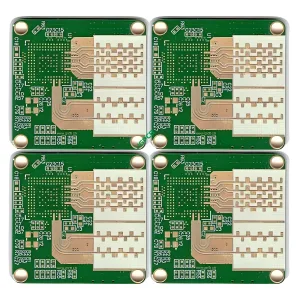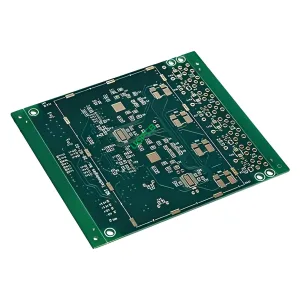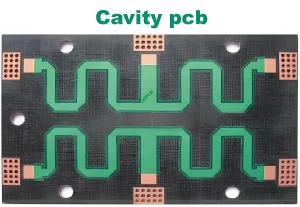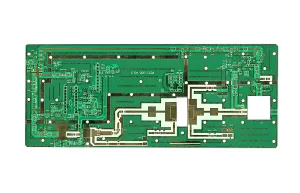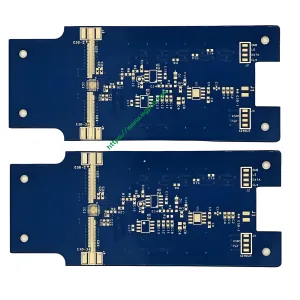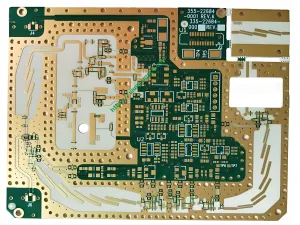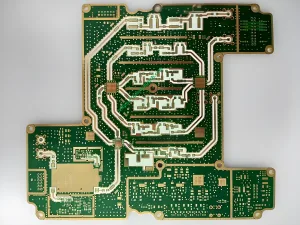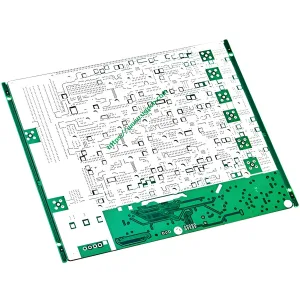
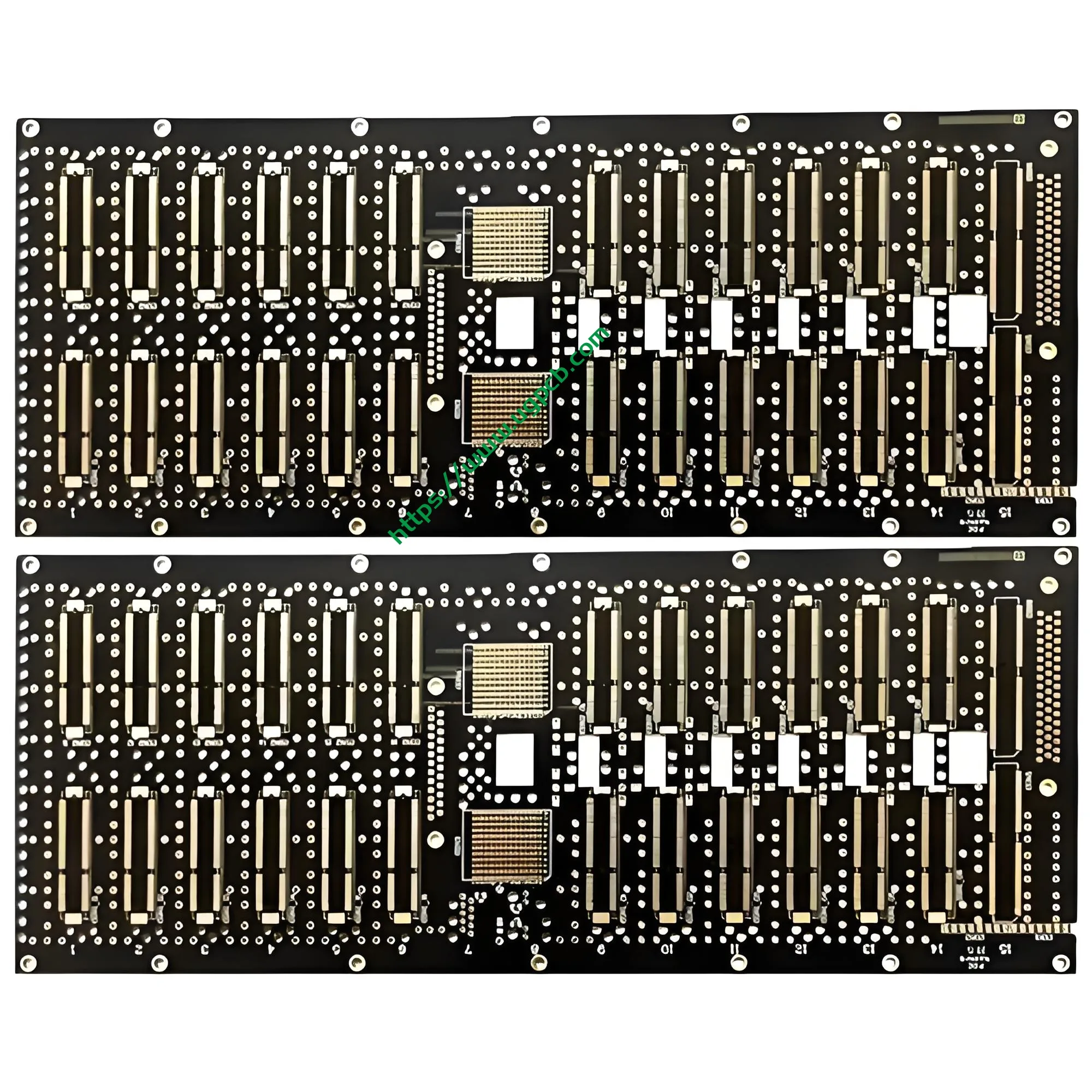
Quick Specifications
| Paramètre | Detail |
|---|---|
| Matériau de base | Rogers RT/duroïde 5870 (random micro‑glass fiber reinforced PTFE composite) |
| Nombre de couches | 2 couches |
| Épaisseur totale du panneau | 0.9 mm |
| Épaisseur diélectrique | 0.762 mm |
| Constante diélectrique (Ne sait pas) @ 10 GHz | 2.33 ± 0.02 (typique) |
| Facteur de dissipation (Df) @ 10 GHz | 0.0012 (typique) |
| Cote d'inflammabilité | UL 94 V‑0 |
| Poids du cuivre | Base 0.5 once (≈18 µm), fini 1 once (≈35 µm) |
| Finition de surface | ACCEPTER (Or par immersion au nickel autocatalytique) |
| Applications clés | Commercial aerospace broadband antennas, circuits microruban et stripline, millimeter‑wave equipment, systèmes radar militaires, systèmes de guidage des missiles, point‑to‑point digital RF antennas |
What Is a Rogers RT5870 High‑Frequency PCB? Definition and Classification
A Rogers RT5870 high‑frequency PCB uses Rogers RT/duroïde 5870 laminate as its core dielectric. This laminate is a PTFE composite. Randomly oriented micro‑glass fibers reinforce the composite. Engineers designed it for demanding stripline and microstrip circuits.
D'un PCB classification standpoint, the RT5870 board falls into these categories:
- By frequency - High‑frequency PCB (PCB RF/micro-ondes) covering Ku‑band and above.
- Par système matériel – PTFE‑based high‑frequency PCB. This differs from hydrocarbon ceramic‑filled or modified‑epoxy systems.
- By application – RF and microwave PCB with military/aerospace‑grade reliability.
- Par nombre de couches – Double‑sided PCB (standard). Multilayer configurations are also supported.
- By IPC specification – High‑speed/high‑frequency base material compliant with IPC‑4103.
Rogers RT/duroïde 5870 first appeared in the 1960s. It has more than 60 years of field‑proven performance. It remains one of the industry’s most mature high‑frequency PCB material solutions.
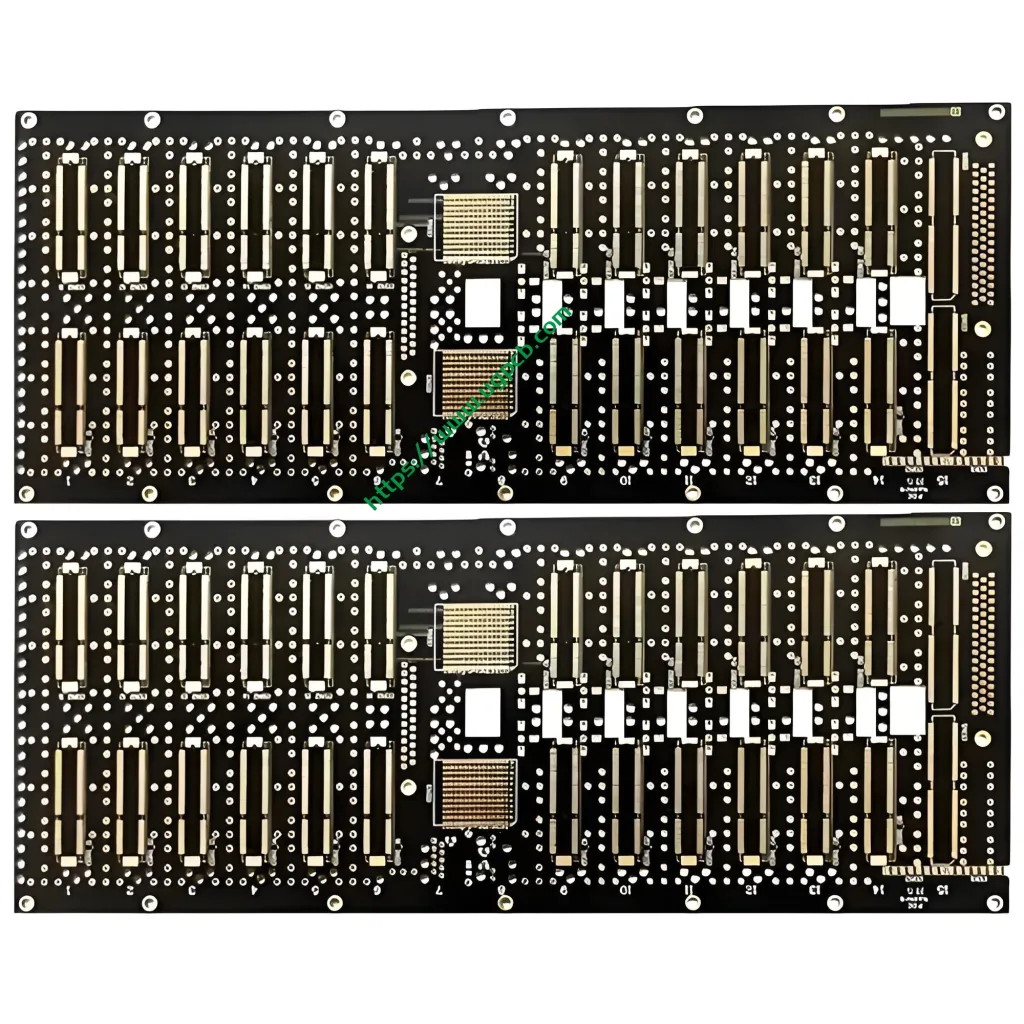
Material Composition and PCB Stackup of UGPCB’s RT5870 Board
Core Substrate: Random Micro‑Glass Fiber Reinforced PTFE Composite
The heart of RT/duroid 5870 is a PTFE matrix. It contains uniformly distributed, randomly oriented micro‑glass fibers. This unique microstructure delivers two important properties. D'abord, it provides isotropic electrical behavior. The dielectric constant stays consistent in X, Oui, and Z directions. Deuxième, it guarantees excellent Dk uniformity from panel to panel.
PCB Stackup
This product is a 2‑layer double‑sided high‑frequency PCB. Total board thickness measures 0.9 mm. The dielectric layer thickness is 0.762 mm. Copper conductors sit on both sides. The base copper weight is 0.5 once (à propos 18 µm). Après le placage, the finished copper reaches 1 once (à propos 35 µm). This design balances high‑frequency signal transmission with current‑carrying capacity.
Finition de surface: ACCEPTER
UGPCB applies an ENIG (Or par immersion au nickel autocatalytique) finition de surface. We deposit a nickel‑phosphorus alloy layer (3–6 μm) d'abord. Then we add a pure gold layer (0.05–0,1 μm). The nickel layer acts as a diffusion barrier. It prevents brittle intermetallic compounds during soldering. The gold layer delivers superior conductivity, résistance à la corrosion, et soudabilité. This finish perfectly matches the needs of high‑frequency signal transmission. It offers outstanding surface flatness and oxidation protection.
Comment ça marche: Why Low Dk and Low Df Transform High‑Frequency PCB Performance
High‑frequency PCBs typically operate above 100 MHz. Microwave bands start at 2 GHz. At these frequencies, the dielectric material directly controls signal quality. Two parameters matter most.
Constante diélectrique (Ne sait pas) et vitesse de propagation du signal
The signal propagation velocity v_p in a PCB transmission line follows this formula:
v_p = c / √(Ne sait pas)
Ici, c is the speed of light in a vacuum (≈ 3 × 10⁸ m/s). With Dk = 2.33, the signal travels at about 65.5% de la vitesse de la lumière (≈ 1.96 × 10⁸ m/s). This is significantly faster than on standard FR‑4 boards. FR‑4 has a Dk around 4.2–4.8. Its signals travel at only 46%–49% of light speed. Faster propagation means lower transmission delay. This advantage proves critical for phase‑sensitive radar and antenna systems.
Facteur de dissipation (Df) and Signal Attenuation
Le facteur de dissipation (Df, also called tan δ) measures how much electromagnetic energy a material turns into heat. A lower Df means less signal loss. RT/duroïde 5870 achieves a Df of only 0.0012 à 10 GHz. C'est 0.12%. Typical FR‑4 materials show Df values between 0.018 et 0.025. Par conséquent, the RT5870 PCB reduces high‑frequency transmission loss by more than an order of magnitude.
Dispersion Control
Different frequencies can travel at different speeds in a dielectric. This effect is called dispersion. It distorts wideband signals. RT/duroïde 5870 maintains a nearly constant Dk across a broad frequency range. This behavior minimizes dispersion. It makes the material a strong fit for wideband high‑frequency PCBs.
Design Essentials for RT5870 High‑Frequency Circuits
Controlled Impedance – Standard 50 Ω Design
Microstrip and stripline serve as the main transmission‑line structures in high‑frequency PCBs. Impedance depends on Dk, épaisseur diélectrique, Largeur de ligne, et épaisseur de cuivre. Using Dk = 2.33, épaisseur diélectrique 0.762 mm, et 1 cuivre oz, un 50 Ω microstrip needs a line width of about 0.762 mm (30 mil). UGPCB tightly controls trace width and spacing during Fabrication de circuits imprimés. This keeps the characteristic impedance on target.
Low Moisture Absorption Design
RT/duroïde 5870 absorbs only 0.02% eau (D48/50% test condition). This ultra‑low moisture uptake prevents Dk drift and signal degradation in humid environments. It suits airborne avionics equipment extremely well.
Thermal Stability Design
Le coefficient de dilatation thermique (CTE) pour RT / Duroid 5870 est 22 ppm/°C (X), 28 ppm/°C (Oui), et 173 ppm/°C (Z) across -55°C to 288°C. The dielectric constant thermal coefficient is -115 ppm/°C (-50° C à 150 ° C). The relatively high Z‑axis CTE demands careful attention to plated through‑hole (PTH) fiabilité. UGPCB meets this challenge with optimized plasma activation and electroless copper processes for PTFE. Our approach secures robust via connections.
Chemical Resistance and Machinability
PTFE materials are highly inert. RT/duroïde 5870 resists all solvents and reagents used in etching and plating. En même temps, the laminate is easy to cut, shear, and machine. This supports precision fabrication of complex PCB outlines.
Performance Data Deep Dive (per IPC‑TM‑650 and Related Standards)
The following table lists the complete performance data for RT/duroid 5870 stratifié. All values come from the official Rogers datasheet. Test methods align with the IPC‑TM‑650 series.
| Paramètre | RT/duroïde 5870 Valeur typique | Méthode d'essai |
|---|---|---|
| Constante diélectrique (processus) @ 10 GHz | 2.33 ± 0.02 | IPC‑TM‑650 2.5.5.5 |
| Constante diélectrique (conception) @ 8–40 GHz | 2.33 | Differential Phase Length Method |
| Dissipation Factor @ 1 MHz | 0.0005 | IPC‑TM‑650 2.5.5.3 |
| Dissipation Factor @ 10 GHz | 0.0012 | IPC‑TM‑650 2.5.5.5 |
| Dk Temperature Coefficient (-50° C à 150 ° C) | -115 ppm/°C | IPC‑TM‑650 2.5.5.5 |
| Résistivité du volume | 2 × 10⁷ Mohm·cm | ASTM D257 |
| Résistivité de surface | 2 × 10⁷ Mohm | ASTM D257 |
| Thermal Conductivity @ 50°C | 0.22 W / m · k | ASTM D5470 |
| CTE X / Oui / Z | 22 / 28 / 173 ppm/°C | IPC‑TM‑650 |
| Résistance à l'écoulement (1 oz ED copper) | 27.2 lbs/in (4.8 N/mm) | IPC‑TM‑650 |
| Densité | 2.2 g/cm³ | - |
| Absorption d'eau | 0.02% | D48/50% |
| Cote d'inflammabilité | UL 94 V‑0 | UL 94 |
| Lead‑Free Process Compatible | Oui | - |
This data demonstrates why the RT5870 high‑frequency PCB excels in dielectric uniformity, faible perte, résistance à l'humidité, and fire safety.
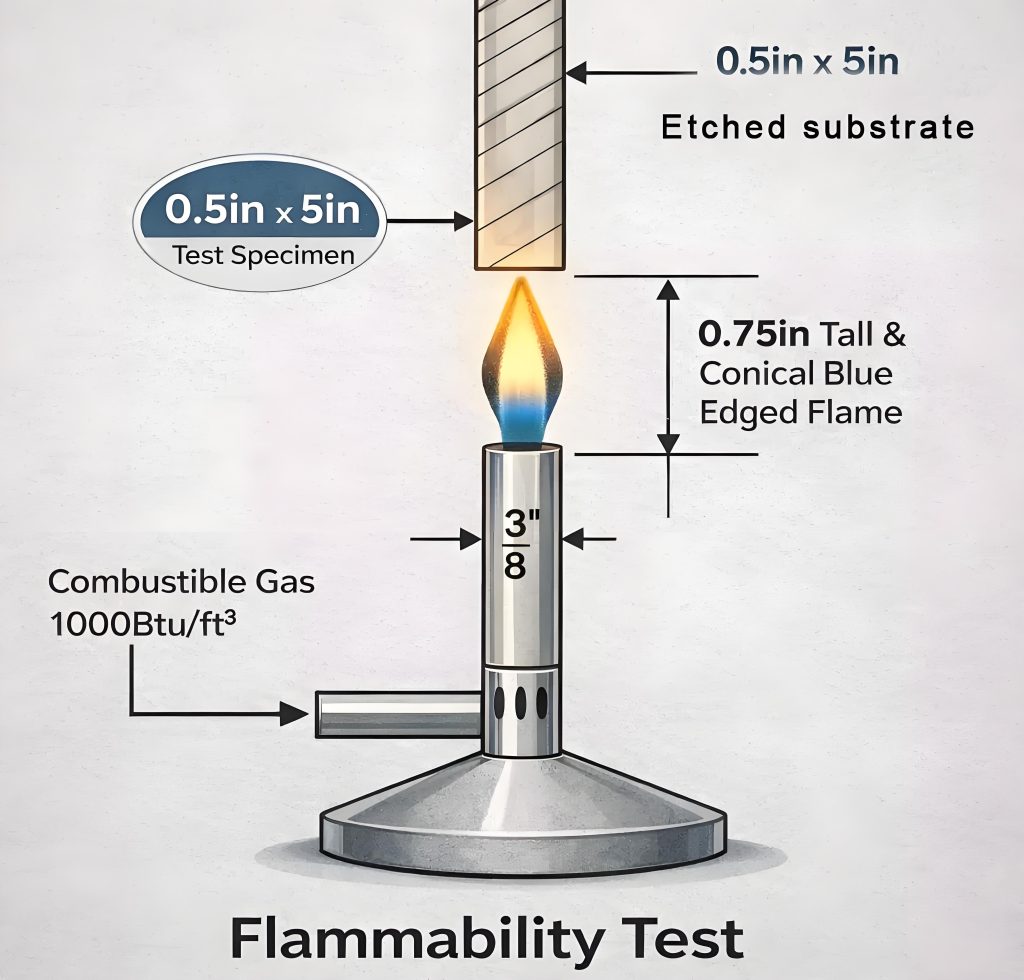
Why Does UL 94 V‑0 Matter?
UL 94 V‑0 is the highest flammability rating for plastic materials in devices. A V‑0 rating means the material self‑extinguishes within 10 seconds during a vertical burn test. Any burning drips will not ignite the cotton indicator. For avionics and military equipment, UL 94 V‑0 is a mandatory safety requirement. RT/duroïde 5870 achieves this strict rating and supports lead‑free soldering. It fully meets the safety and environmental rules for aerospace and defense applications.
Key Features and Competitive Advantages
Five Core Technical Features
- Lowest electrical loss among reinforced PTFE high‑frequency materials.
- Ultra‑low moisture absorption – ideal for high‑humidity environments.
- Isotropic electrical properties – uniform Dk in all three directions.
- Wideband consistency – stable electrical performance from 1 MHz to Ku‑band and beyond.
- Excellente résistance chimique – withstands all standard PCB processing chemicals.
RT5870 vs. RT5880: How to Choose?
RT/duroïde 5870 et RT/duroïde 5880 both belong to the Rogers micro‑glass fiber reinforced PTFE family. Each product excels in different areas.
| Comparaison | RT/duroïde 5870 | RT/duroïde 5880 |
|---|---|---|
| Nsp @ 10 GHz | 2.33 ± 0.02 | 2.20 ± 0.02 |
| Df @ 10 GHz | 0.0012 | 0.0009 |
| CTE‑X (ppm/°C) | 22 | 31 |
| CTE‑Y (ppm/°C) | 28 | 48 |
| Résistance à l'écoulement | 27.2 lbs/in | 31.2 lbs/in |
| Best For | High‑power radar, thermally stable systems | Ultra‑low‑loss communication, satellite |
The RT5870 board offers stronger thermomechanical stability and higher toughness. These qualities serve high‑power radar and avionics that endure intense thermal cycling. En comparaison, RT5880 delivers a slightly lower Dk (2.20) et Df (0.0009). It wins on signal delay and insertion loss.
UGPCB’s RT5870 High‑Frequency PCB Manufacturing Process and Quality Control
Material Preparation and Cutting
We start with genuine Rogers RT/duroid 5870 laminate. We micro‑etch and acid‑clean the copper surface. This step removes oxides and organic contaminants.
Imaging and Etching
We use dry‑film photolithography to transfer the circuit pattern. We optimize etching parameters and apply compensation (facteur de gravure) to tightly hold the 0.762 mm trace width and spacing. This discipline ensures impedance consistency across the high‑frequency PCB.
Forage et placage
Après forage, the PTFE hole walls receive plasma activation. Suivant, we apply electroless copper deposition. This step metallizes the holes and creates reliable through‑hole connections. UGPCB has established mature process parameters specifically for this PTFE PCB step.
Finition de surface – ENIG
We apply a chemical nickel‑gold process. We deposit a nickel layer of 3–6 μm first. Then we add a gold layer of 0.05–0.1 μm. Gold provides low contact resistance and excellent solderability. Nickel forms a diffusion barrier. This ensures long‑term reliability of solder joints on your RT5870 PCBA.
Electrical Test and Inspection
We perform 100% electrical continuity and isolation testing. We also conduct visual inspection according to IPC‑A‑600. Every high‑frequency PCB meets our shipment standard.
UGPCB Assurance qualité
UGPCB operates under ISO 9001 quality management and IPC‑A‑600 workmanship standards. Our high‑frequency PCB manufacturing is fully traceable. We inspect incoming Rogers base materials and perform final checks on every outgoing board.
Typical Application Scenarios for RT5870 PCBs and PCBA Assemblies
Commercial Aerospace Broadband Antennas
RT5870’s Dk uniformity and low loss make it a go‑to PCB material for airborne broadband antenna feed networks. In Ku‑band antennas, signals run through power‑divider circuits. These networks demand strict dielectric loss and phase consistency. RT5870 high‑frequency PCBs meet those demands.
Circuits microruban et stripline
Rogers originally designed RT/duroid 5870 for precision microstrip and stripline circuits. Whether you design filters, coupleurs, power dividers, or impedance‑transformation networks, this laminate provides a predictable dielectric environment. Your circuit performance stays repeatable.
Millimeter‑Wave Equipment
The low dissipation factor pushes RT5870 usage into Ku‑band and beyond. Il prend en charge 24 GHz, 60 GHz, and even 77 GHz millimeter‑wave applications. These include 5G mmWave small cells, radar automobile, and point‑to‑point microwave backhaul.
Military Radar Systems
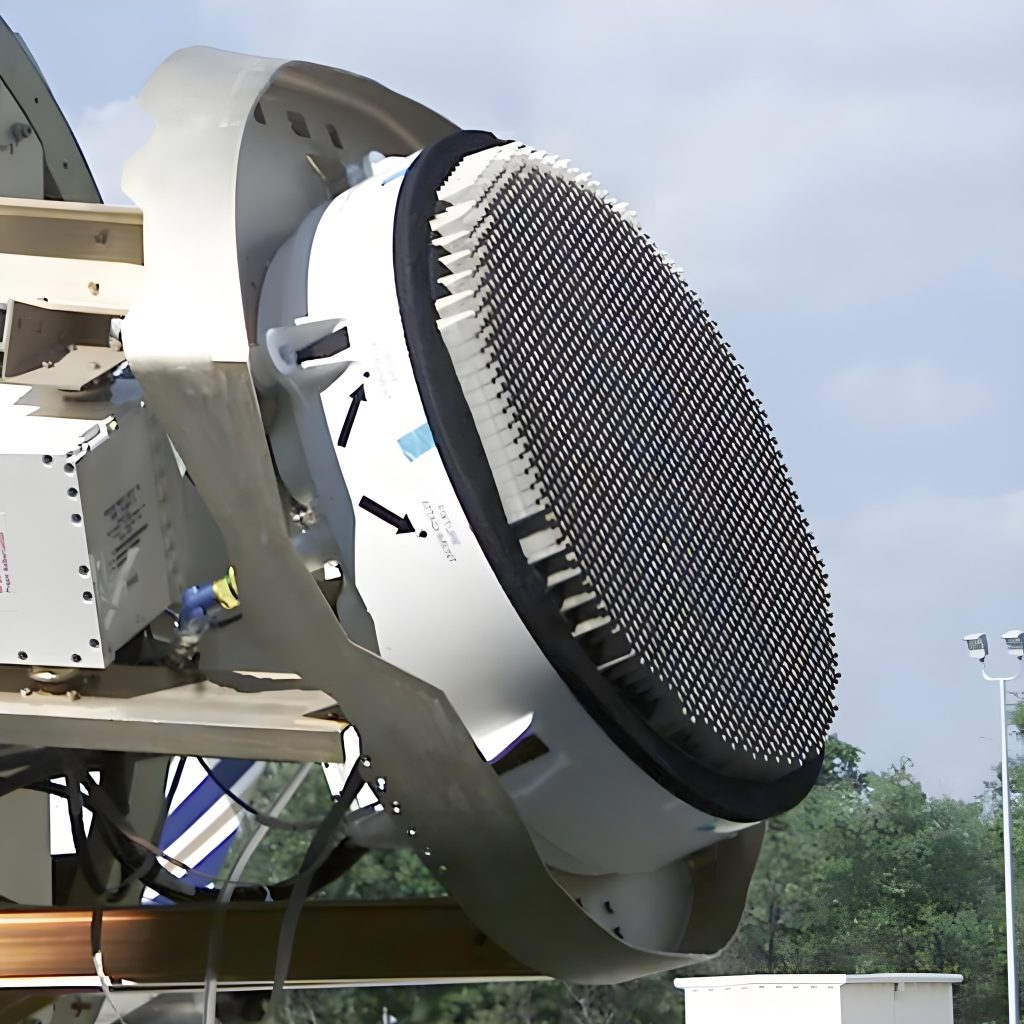
Low loss and strong thermal stability satisfy the rigorous needs of military radar. RT5870 high‑frequency PCBs handle long‑pulse, high‑power signals reliably. You find them in airborne fire‑control radar and ground‑based early‑warning systems.
Missile Guidance Systems
Missile seeker transceiver modules face extreme temperature, vibration, and humidity. RT5870 absorbs almost no moisture (0.02%) and maintains stable electrical properties across a wide temperature range. This ensures signal integrity from launch to target.
Point‑to‑Point Digital RF Antennas
Point‑to‑point microwave links rely on precise antenna gain and beamwidth. RT5870’s superior Dk uniformity guarantees accurate phase alignment across large antenna arrays. Your PCB performance stays predictable element to element.
Delivery Parameters for the RT5870 High‑Frequency PCB
| Paramètre | Spécification |
|---|---|
| Matériau de base | Rogers RT/duroïde 5870 |
| Nombre de couches | 2 couches |
| Épaisseur totale du panneau | 0.9 mm |
| Épaisseur diélectrique | 0.762 mm |
| Nsp @ 10 GHz | 2.33 ± 0.02 |
| Df @ 10 GHz | 0.0012 |
| Cuivre (Base/Finished) | 0.5 once / 1 once |
| Largeur de trace / Espacement | 0.762 mm / 0.762 mm |
| Finition de surface | ACCEPTER |
| Cote d'inflammabilité | UL 94 V‑0 |
| Dimensions | Custom |
| Hybrid Multilayer Support | Oui (RT5870 + FR‑4 or other Rogers materials) |
UGPCB PCBA Services for High‑Frequency Boards
Beyond bare high‑frequency PCBs, UGPCB provides one‑stop PCB (Assemblage de la carte de circuit imprimé) services. For Rogers RT5870 board assembly, nous offrons:
- High‑frequency SMT assembly using low‑loss pad designs and precise stencil apertures.
- Fine‑pitch component soldering (BGA, QFN, et plus).
- Tightly controlled reflow soldering profiles.
- Zone d'intérêt (Inspection optique automatisée) et X‑ray inspection.
- Functional testing at the system level.
When your project needs high‑frequency PCB plus PCBA turnkey delivery, please specify your PCBA requirements at the ordering stage.
Pourquoi choisir UGPCB? – Request Your Quote Today
- ✅ Rogers Authorized Channel Sourcing – Every RT5870 high‑frequency PCB starts with genuine original laminates.
- ✅ 20+ Years of High‑Frequency PCB Manufacturing – Deep expertise in RF and microwave circuit board fabrication.
- ✅ OIN 9001 Certified Manufacturing – Strict quality control from incoming materials to final shipment.
- ✅ Fast Prototyping and Volume Production – Competitive lead times for prototypes and flexible batch scheduling.
- ✅ Global Logistics – Serving North America, Europe, Asia‑Pacific, and other major markets.
- ✅ Assistance technique experte – Engineering assistance from design consultation through PCB production and PCBA.
Contact UGPCB for your Rogers RT5870 high‑frequency PCB or PCBA project.
- 📧 E-mail: sales@ugpcb.com
- 🌐 Site web: www.ugpcb.com
- 📞 Chat en direct: Available on our website
- 📋 Quick RFQ Form: Submit your Gerber files and requirements. We respond with a quotation within 24 heures.
Glossary
| Term | Définition |
|---|---|
| Ne sait pas (Constante diélectrique) | A measure of a material’s ability to store electric field energy. |
| Df (Facteur de dissipation) | A measure of how much electromagnetic energy a material converts to heat; also called loss tangent. |
| PTFE | Polytétrafluoroéthylène, a high‑performance fluoropolymer. |
| ACCEPTER | Or par immersion au nickel autocatalytique, a surface finish for high‑frequency PCBs. |
| CTE | Coefficient de dilatation thermique. |
| PTH | Plated Through Hole, a via with conductive copper plating. |
| Pim | Passive Intermodulation. |
| RF | Radiofréquence, typiquement 100 MHz and above. |
| IPC | Association reliant les industries électroniques, publisher of PCB standards. |
FAQ – Rogers RT5870 High‑Frequency PCBs
T1: How do I choose between RT5870 and RT5880?
A1: RT5870 (Dk=2.33) provides better thermomechanical stability. It suits high‑power radar and avionics. RT5880 (Dk=2.20) offers even lower loss. It is ideal for ultra‑high‑frequency communication and satellite systems. See the comparison table in Section 6.2.
T2: What is the minimum trace width and spacing?
A2: The minimum trace/space depends on copper thickness and your design. Our standard RT5870 product features 0.762 mm lines and spaces. For finer geometries, please contact UGPCB technical support.
T3: Do you support multilayer and hybrid high‑frequency PCBs?
A3: Oui. We build multilayer RT5870 boards and hybrid stackups. We combine RT5870 with other Rogers materials (such as RO4350B, RT5880) or FR‑4.
T4: What is the typical lead time?
A4: Prototype lead times vary by layer count and complexity. Our sales team can provide the fastest available schedule. Volume lead times appear in the official quotation.
Q5: How do high‑frequency PCBs differ from standard PCBs?
A5: High‑frequency PCBs use low‑Dk, low‑Df specialty substrates such as PTFE for RF/microwave signals. Standard FR‑4 boards have higher Dk (4.2–4,8) and higher loss. They suit only low‑frequency digital or analog circuits.
Legal and Compliance Notice
All technical parameters come from the official Rogers Corporation RT/duroid 5870/5880 datasheets. Values are typical. Normal process variations may occur between production batches. IPC‑4103 references serve to indicate the classification system and test methods for high‑frequency substrates. The UL 94 V‑0 flammability rating reflects Rogers’ published product certifications. Actual product performance is subject to UGPCB’s final outgoing inspection report.
© 2024 UGPCB. Tous droits réservés. Rogers RT/duroid is a registered trademark of Rogers Corporation.